Wednesday, February 4, 2015
Picture
Monday, March 5, 2012
Amazing Megillot #10: In Gvil
Monday, April 19, 2010
My Progress #5: My First Mezuza

Today I finished writing my very first Mezuza, which means that I'm a step closer towards my goal of writing a Sefer Torah. This time the stakes were much higher - unlike in Megilat Esther and Shir Hashirim I had to write the Shem Hashem and I had to write everything "Kesidran", chronologically. And of course, going to the Mikva became part of my daily schedule, as I can only write the Shem after a proper immersion.
I will give this Mezuza to be checked by a very skilled Sofer here in my town and considering that he is a master in finding unexpected problems, I must say I'm afraid of what he will say. But as far as I can see all is ok. Actually, there's one "mistake" which I deliberately didn't correct because of a problem with the Klaf. Like in my Megillat Shir Hashirim, I made a small hole in klaf while trying to fix a letter, and for that reason I didn't manage to correct this mistake. Can you find it?
Like all my other Safrut items, this Mezuza was written in Ktav Beit Yosef. And like all Ashkenazi Jews, I followed the Tur's opinion of how the Parsha Setuma should be. Read more about this topic here.
Wednesday, January 20, 2010
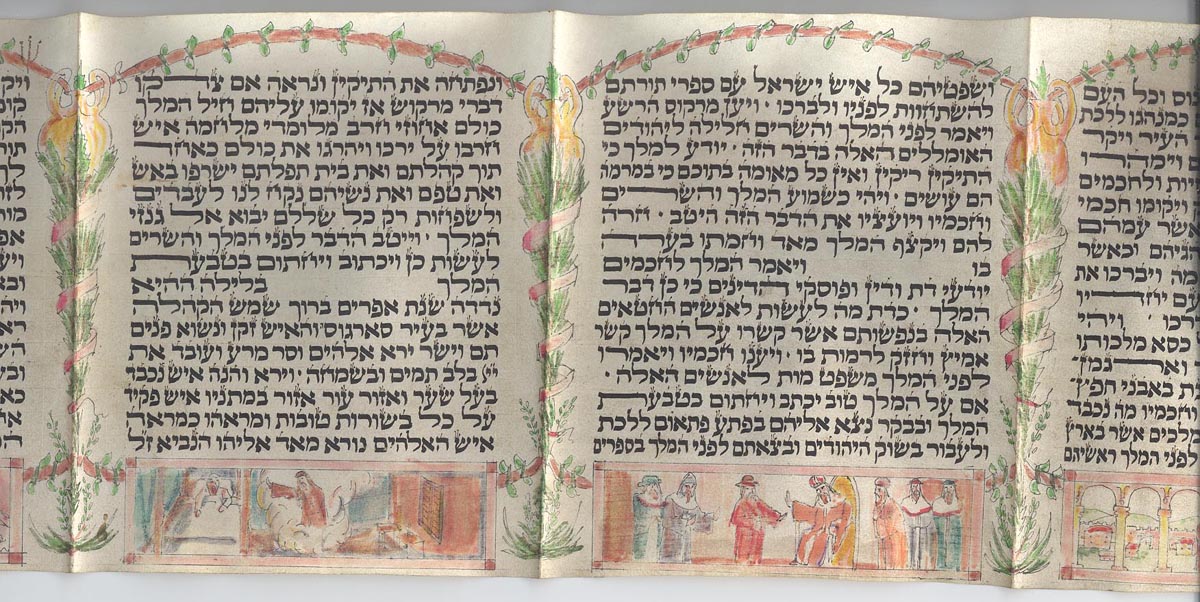
Amazing Megillot #7: Iraqi Esther Scroll
I came across this beautiful Esther Scroll from Iraq. It's a very special piece, with symmetric motifs and splendid coloring. Written in Veilish, the Sephardi version of Ktav Ashurit.Full disclosure:
Esther Scroll
- Ink and tempera on parchment; wooden roller
- Length: 8 3/4 in. (22.2 cm) Diameter: 1 3/4 in. (4.4 cm)
- The Jewish Museum, New York
- Gift of Dr. Harry G. Friedman, F 3374
Published References: The Jewish Museum. THE JEWISH MUSEUM AT 75. Commemorative album. New York: The Jewish Museum, New York, 1980, Color ill.

Tuesday, December 8, 2009
My Progress #4: Megillat Shir Hashirim
This highlights how important it is to look for top-quality klaf; if you can't get it, wait until you find a good one. I couldn't erase mistakes properly and I even did the capital sin of a Sofer - I made a small hole while trying to correct something. It doesn't matter so much since I managed to "place it" just in between two words - look in the last line of the forth column.
Additionally, I used a computerized Tikkun (from which I copy the Megilla layout) which was awful - I was forced to stretch and squash words in almost every line. Now I know: only buy copies of hand-written Tikkunim.
But Shir Hashirim is fun to write, since I can use it every week (there's a minhag of reciting it every Shabbat-eve) and it's shorter than Megillat Esther. Now my next project is to write a large Mezuza - stay tuned!


Sunday, November 29, 2009
Amazing Megillot #6: Sotheby's Important Judaica Auction
Firstly, the allegedly "earliest complete decorated Esther Scroll" (Venice, 1562). It was sold for a whooping U$ 600,000, making it the most expensive item sold in Sotheby's auction. I personally cannot understand why would someone favor this Megilla over the above-mentioned Sefer Torah from the 13th century, but bottom line is that this Megilla is surely unique. Every column starts with only one, large-type, word and subsequent 22 lines. From a Safrut perspective these top large words are not desirable but it doesn't causes the scroll to become Pasul. (click in the image to enlarge)

Friday, October 9, 2009
Pic: Zoomed Shin

Aside from Safrut, I love photography and I wanted to post this cool pic, which I took using my diamond lupe. This is my soon-to-be-completed Meggilat Shir Hashirim and I zoomed in the Shin because I just love this letter, and with the lupe you can take a deeper look in it. It's very easy to mess-up this letter since everything is "squashed" together - the three Yuds and the Taguim. Next to it you can see a Yud and it's lower Tag (lower left side), which is mandatory according to Rabbeinu Tam.
I hope to finish this Megilla in the next two weeks and I will post more pictures.
Chag Sameach
Sunday, September 27, 2009
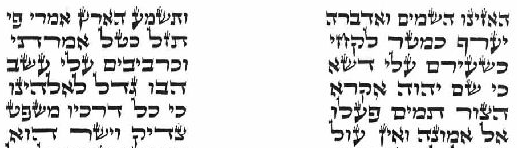
The Two Columns of Shirat Haazinu
This highlights how important this intricate song is in relation to the whole Torah.
Also aesthetically, Haazinu stands out with its special two-column layout. In the modern Torahs, the two columns are perfectly even, like two towers, and usually are two pages long. I wanted to post a picture of the whole thing but I only found this one:

We find the same layout in the Megillat Esther, in which the ten sons of Haman are listed in the same fashion. Like in Haazinu, most sofrim (not me!) stretch the letters so every column will start and end in the same place:
But if you look in the old Torahs and in the Torahs of the Yemenite Jews you will see that the columns there aren't uniform at all. Below is a picture from a Yemenite tikkun:


I guess the Ashkenazi sofrim took the liberty to strectch the lines in order to make the scrolls look nicer, on the grounds of "zeh keli veanveiu".
But there's another thing that really puzzled me. Aside from the layout, the Yemenite scrolls also differ in the actual poem structure and that's the real reason why their columns aren't simetrical - there are less lines and thus some of the lines are longer.
For instance, look in the 17th line in the above picture, "zechor yemot olam.." - this is a long line. In the Ashkenzai scrolls this long line is divided in two, enabling our sofrim to justify the lines. Now that's odd! There are two other places where there's a difference in the poem structure but I will leave it for you to figure it out.
Which is the right structure?
That's where the Aleppo Codex comes to the scene. This is a topic for another post, but it suffices to say that the Aleppo Codex, guarded by the Aleppo Jews until 1948, is the most accurate Tikkun ever. Unfortunately, this Tikkun only covers the Nach; the Torah pages were mysteriously lost in a Arab riot in Aleppo. That is, all the Torah pages were lost besides..... that's right, the pages of Shirat Haazinu! And if you guessed that the Yemenite scrolls are identical to it, you are right. I got this image from the Aleppo Codex website:

This would imply that the Ahskenazi structure of Shirat Hazinu is problematic. Halacha says that if there's a pause (parsha setuma or petucha) in a wrong place, this will invalidate a Sefer Torah. If the Ashkenazi scrolls have a different poem structure, some of the open spaces are in the wrong place!The answer is simple: the open spaces in Shirat Haazinu (and Az Yashir) are not open and separate Parshas, but a special layout of a song. The halachot of Parsha Petucha and Setuma don't apply here and whatever layout you have - Yemenite or Ashkenazi - will be Kosher for all intents and purposes. So although it's clear that the Yemenite arrangement is more reliable, you should not start complaining about our modern-day structure.
This is the story of the layout of Shirat Haazinu. I hope you enjoyed and I wish you a Gmar Hatima Tova!
Tuesday, July 21, 2009
Esnoga's Scrolls
All of them are unique and showcase the elegance and taste of the Dutch Jews of that era.
The Megillat Esther below has some very beautiful illustrations in between each column and is written is a very odd layout - 30 lines (see my post on this subject here) and each line is way too long (each line should ideally have 30 letters, which is three times the word "lemishpechotam", but in this scroll there are more than 60 letters per line). The letter Peh has a very different shape, with a big Tag in the left top corner.
This other Megilla has 32 lines, also not standard, but the lines have the proper amount of letters. What catches my attention is the arrangements of the Parshiot - if you look carefully you will see that the Parsha of "איש יהודי" is written in the middle of the line and "אחר הדברים האלה" has a very odd layout - it starts almost where the preceding line ended. According to our Mesorah, all the Parshiot of Megillat Esther should have a Setuma layout (see my post on this subject here) and if so, this Sofer followed the Rambam's opinion of Setuma and Petucha.
Next is my personal favorite, a Sefirat Haomer scroll. This is the first time I see such scroll and it takes a little time before you actually understand what's going on. The top box is the days' count - 46 days; the middle and bottom boxes are the week's count.
Last but not least, this antique Torah scroll written in Veilish script (read more here). The top Lamed in this Sefer torah is almost bent backwords, opposite to the Lamed of our modern scrolls, which are slightly bent forward.
Wednesday, March 25, 2009
Amazing Megillot #4 - Papercut on Red Leather
This is a very special and contemporary Megillat Esther made by a personal frien, Uri Revach.
It's hard to do papercut in a Megilla since the Megilla becomes too delicate and thus hard to handle. Aside from this, the papercut work hardly gets its full value since there's nothing behind it - no contrast.
So this artist came up with a solution - he stuck the Megilla in red leather, enhancing the papercut work and also giving to the Megilla a "royalty" feel. He also made the case, which is made out of wood, silver, gold and ivory. All in all, a true masterpiece.
Price upon request.
Friday, March 13, 2009
Purim of Saragossa
Before the story, a brief Halachic briefing. Everyone must give the proper "kavod" to a Sefer Torah or any other holy scroll and many customs we have today are a reflection of this Halacha. That's why we keep the Torah in a special cabinet, the Aron Hakodesh, and also why we all stand when the Chazzan carries the Torah to the Bimah for the Parshat Hashavua reading. Most rabbis say that one shouldn't take out a Sefer Torah from the Aron just to show it to visitors, another related Halacha.
Specifically pertaining to the holiness of a Mezuza, I've seen a discussion about a case where the gentile king or ruler requested a Mezuza for his house or palace. Some rabbis were very much against it since we fear for the Mezuza's "kavod", while others like the Rema permit it on the grounds that sometimes we make exceptions for the fear that turning down a royal request will create unnecesary tensions ("Eiva" in Hebrew). That's exactly what happened in Zaragoza, in the 15th century.
I quote a better story-teller:
"Scholars still debate the location of the story. Many favor Siracusa (Syracuse, on the island of Sicily) as the location of our story some 600 (1421) years ago. Others refer to Saragossa, Spain as the location. In any event, The Jewish main street of the city contained 12 synagogues. At the annual royal visit three Torahs dressed in gold and silver were taken from each synagouge to welcome and parade the King through the town. One day the leaders of the community decided that the practice violates the sanctity of the Torah and that henceforth the Torah containers would be marched dressed as before but empty without the Torahs. The practice went well for 22 years.You can read a longer version of this story on the Chabad site.
One day an apostate by the name of Marcus at a royal meeting revealed the secret. The King in a fury ordered a surprise inspection the next day and the slaughter of all Jews if Marcus is indeed correct. That night the Prophet Elijah appeared in the dreams of each of the 12 sextons and ordered them to insert the Torah in the empty cases. The next day, upon finding the scrolls in the containers the King ordered Marcus executed and relieved the Jews of taxes for a period. As a result of the miracle, the scroll was written and the 17th of Shevat celebrated as the Purim of Saragossa or Siracusa, still o bserved in many Sephardi families to this day."
And the best part, we have some great pics from this rare Megilla! (credit goes to the Foundation for the Advancement of Sephardic Studies and Culture. Be sure to check the stories of other less known Purims here and here)

Thursday, March 5, 2009
Amazing Megillot #3 - The Gross Family Meggilla

_____ 
This Megilla is like no other. It's an antique piece from the 18th century Germany and it remains in good condition. The coolness of this Megilla: the illustrations are very complex and detailed, also in various layouts, so the writing is not "uniform" and standardized like normal Megillot - it differs from page to page. Sometimes it has a round shape, or a long shape, as dictated by the illustrations around it.
This Megilla belongs to the private collection of the Gross Family, Tel Aviv. You can get a limited-edition facsimile edition for "just" U$ 4,000. You can read more here.
Wednesday, February 18, 2009
Amazing Megillot #2 - The Agam Meggilla
I saw this one in the website of the Library of Congress. I've seen other works by Agam but never a Holy Book and this Megilla really stands out because of the cool visual effects that Agam's trademark. Here's the Library's official description:
"The Agam Megillah (London and Israel, 1997). A recent addition to the Library's Hebraic collections is a modern decorated megillah by noted Israeli artist Ya'akov Agam. Produced on parchment measuring thirty-two inches high, the limited edition includes a silk-screened border by the artist, with the text handwritten by the scribe. In this megillah, the traditional text is adorned with distinctly modern decorative artwork. (Copyright © 2001 Artists Rights Society [ars], New York/adagp, Paris)"
Wednesday, February 11, 2009
Amazing Megillot Series #1

I saw this absolutely fabulous Megilat Esther in a Jerusalem Judaica store. It's not an antique piece - it's actually brand new. I can't find out who's the artist, I only know he's Russian, and this "bargain" has a price tag of U$ 100,000. It's easily the nicest Megilla I've ever seen, since everything is perfect - the writing is spotless, the color drawings make a strong statement and the sketching work is a very original idea.


,-circa.jpg)