Showing posts with label yemenite. Show all posts

Monday, July 18, 2022

The Last Two Lines of Shirat Hayam

This post is related to my last post on Shirat Haazinu - you might want to read that first.

The Talmud in Megillah 16b states:
אָמַר רַבִּי חֲנִינָא בַּר פָּפָּא, דָּרֵשׁ רַבִּי שֵׁילָא אִישׁ כְּפַר תְּמַרְתָּא: כּל הַשִּׁירוֹת כּוּלָּן נִכְתָּבוֹת אָרִיחַ עַל גַּבֵּי לְבֵינָה
Rabbi Chanina (...) says all songs are written a small brick (writing) above a brick (blank space), and a brick above a small brick.

The Talmud here is referring to the classic brick-and-mortar layout which is featured in all Torah Scrolls throughout time - 30 lines beggining with Az Yashir ending at Betoch Hayam. The layout is easily attainable up to the last two lines, which are much longer and therefore present a problem for the scribe - how should they be written?

Looking at historical and more recent scrolls, one can find three completely different arrangements of the last two lines, and the underlying discussion is if the two last lines are at all part of the Shirat Hayam. Unlike the other lines, the last two are not written in poetic language, and seem to revert back to the narrative preceding the Shirat Hayam - perhaps an indication that this section is different from the rest.

The first Mesora we have relies on this understanding and it has the last two lines written in regular prose, without any special layout or spacing. This tradition was popular in earlier times specially in Ashkenaz and proponents of this opinion bring a proof from our prayers in Shacharit, which repeats Hashem Yimloch LeOlam Vaed in the 27th line. This repetition indicates the ending of the song, similar to Psalm 150 which has the last pasuk repeated in morning prayers כל הנשמה תהלל יה הללו־יה, indicating the end of the psalms of praise. In any event, this structure is straightforward and easy to write - see below some examples:


This layout has fallen out of use in the last few hundred years, even though there's Halachic basis for it and it also seems to "fit" well in the overall symmtry of the text.

The second Mesora is assymetrical, and divides these two lines with one blank space causing the text to look different than the preceding lines. This layout is found in the most important historical Torahs and codices, including the Leningrad Codex , the Bologna Torah and finally Ashkar fragment (the oldest witness of them all - it only has a few pages and Shirat Hayam is one of them, and you can see the layout of the last two lines if looking attentively).


Leningrad Codex:
Leningrad Codex

Bologna Torah:


Ashkar fragment - hard to see but look closely


The Yemenite Torah scrolls have this layout too, and that's always a reliable indication of how ancient and well established this Mesora was in earlier times.

We now turn to the third layout, mentioned by Rabbi Menachem Meiri in his scribal work Keriat Sefer. The Meiri brings that Rabbi Meir Halevy Aboulafia (source here) he had in his possesion a booklet that was allegedly a reliable copy of the Rambam's text but Rabbi Aboulafia was unconfortable about the featured layout of the last two lines of Shirat HaYam found there, which looked like this:

Rabbi Aboulafia (known as the "Rama") held that this layout cannot be correct because in all preceding 3 stanza lines lines of the Shira, the first and last stanzas only have only one word, and in this layout there are three (את מי הים) in the beggining and two words in the end (בתוך הים). He therefore used a different but similar layout when writing his own two Torahs, in this way:

His influential scribal work Masoret Seyag LaTorah championed this layout and discussed it in detail, and being very well respected by Sephardic and Ashkenazi communities alike, Rabbi Aboulafia's layout quickly became the dominant layout in the Jewish world, even though today there are many questions surrounding this custom. 

Here are some examples of scroll utilizing the Rama's layout:

13th century Sephardic scroll sold by Sotheby's:


Another 13th century Sephardic scroll, sold by Sotheby's for 250,000usd, and in the item's description it is noted that the scribe followed Rabbi Aboulafia's layout:


The Sefer Torah of another rishon, the Rabbeinu Nissim of Girona (Ran) has survived (although recent scholarship challenges this attribution - see here for a detailed analysis) and we can see this layout there too - an indication that in Sepharadic lands this layout was already widespread at this time. It's interesting to note that Rabbeinu Nissim actually tweaked the layout just a little - the very last word of the Shira - הים - is not written all the way in the end of the page, but indented a little before. Professor Penkower (here, page 25) explains that this was done in the context of creating a Parasha Petucha, but that's beyond the scope of our discussion. See here a pic I took years back when visiting the National Library of the Hebrew University, and look closely at the very last word - it's written before the end of the line:

Coming back to the second layout, we should revisit the Rambam's opinion. As we have seen, Rabbi Aboulafia's booklet was attributed to the Rambam and it allegedly featured the last line divided in three, but this booklet seems to be problematic at least in this very specific instance.

Scholars today agree that the Rambam used the second layout in the Mishne Torah and not the Rama's, as he based his text on the famous Aleppo Codex. While the Shirat Hayam part of the Aleppo Codex dissapeared in 1948, research has shown conclusively that the codex had the same layout as the other ancient scrolls we have today (Leningrad, Bologna) and therefore it's no surprise that the Yemenite tradition follows that same layout.

However when you look at our versions of the Mishne Torah, you don't see the second layout - you see the Meiri's layout. See below:


Interesting to see that my copy has a note:
Rabbi Menachem di Lonzano wrote in his Or Torah: Don't heed to the layout found in (other) editions of the Rambam because they are mistaken and are not the layout written by the Rambam - the printers made the layout from their own heart.

 *In this edition we have printed the correct layout as seen in Or Torah (the publishers)

Clearly Rabbi di Lonzano, an influential Masora expert of the 16th century, was sure that the Rambam had the Ashkenazi/Sephardi (Aboulafia) layout, but this is most certainly incorrect as we mentioned above. And by the same token, the printers' correction of the layout was a mistake too, in effect causing a censhorship of the original design used by the Rambam - similar to the censorship of Shirat Haazinu discussed in my previous post. 

Now it's possible to appreciate the work of Shabtai Frankel, a Rabbi and businessman who funded a Kolel dedicated to researching and fixing mistakes in the Rambam's Mishne Torah. His acclaimed edition is a real gem for situations like ours - see below how he printed this page, opposed to my edition above:


See here a zoom of the last lines lines:

Frankel uses the second layout we discussed above, which was featured in the Aleppo Codex and is also seen in the Leningrad Codex - and not the Ashkenazi/Sephardi layout as we have it in our Torah Scrolls. By the way, note how the last line is indented similar to Rabbeinu Nissim's Torah Scroll discussed above - I haven't seem a consensus about this indentation in the Aleppo Codex so this is surprising.

Now note how afterwards Frankel elegantly mentions the layout "according to Rabbi Aboulafia's testimony" - the three stanzas the Rama saw in the booklet attributed to the Rambam (בתוך הים in one stanza), but not the Rama's ammended version, which he felt more confortable with but as we now know, was never written by the Rambam. Frankel's edition shies away from censorship and it's refreshing to see how openly his edition deals with this controversy, but this is a recent development.

Throughout many centuries, the layout of the only two songs found in our Torah scrolls were both censored in our standard Mishne Torah versions in order to comply with the dominant Ashkenazi/Sephardi Mesora - directly against the Rambam's detailed and clear account of how the two songs should look like. This is a good example of the limited success of some of the Rambam's directives in the Mishne Torah - sometimes he succeeded to popularize Halachot but sometimes, like here, he failed (see more about the scope of the Rambam's influence on Mesora here, page 16 - article by Prof Yosef Ofer). 

It's also interesting to note that some scrolls will follow the Rambam's ruling in Shirat Hayam but not in Shirat Haazinu, although most will follow Rabbi Aboulafia in both songs. Dr Shlomo Zucker, when analyzing a unique old scroll auctioned by Sotheby's, notes that these small nuances allow us to identify a Torah's origin:

"The fact that the present scroll presents the Maimonidean division of the Song at the Sea and the Abulafian version of the Song of Moses is a clear indication that it was written in Spain. In Sephardic Torah-scrolls written after the expulsion in the lands of the Sephardic diaspora, both songs are always according to Meir ha-Levi Abul'afia, while only the Yemenites follow Maimonides' order in both songs."

Rabbi Mordechai Breuer, one of the leading experts of the Aleppo Codex, conducted many studies of this codex versus the others and the result was always a clear superiority of the Aleppo Codex - exactly what the Rambam said almost 1000 years ago about this same codex, which he used for his own Sefer Torah. Rabbi Breuer even wondered if a new community in a new land should perhaps adopt his edition based on the Aleppo Codex for their Torah Scrolls, like the Rambam had hoped for (sourceYosef Ofer, The Masora on scripture and its methods).

While the scribes did eventually adopt the Aleppo Codex as the basis for scrolls of the Neviim and Ketuvim - there was no unified Mesora until the appearance of this codex - in regards to the Torah scrolls history has taken a different path and everyone continues to follow our Mesora, based on the Rama's ruling. Or as Rabbi Sorkin puts it, using a play with words from Exodus 14,  ובני ישראל יצאים ביד רמה - the Jewish People fulfill their obligation with the "Yad Rama" (name of another famous book from Rabbi Abulafia), i.e. we rely on the Rama's opinion to fulfil the Mitzva of Writing a Torah Scroll and this is the undisputed Halacha for almost a milennia.

- this article was based extensively on the excellent article by Y. M. Sorkin, entitled אריח על גבי לבינה.

Sunday, April 22, 2012

Writing on Red Gvil!

My posts are usually concise write-ups about Halacha discussions. This post is different - an open and honest account of my first time writing in Gevil parchement, opposed to the standard Klaf parchement used in all scrolls today. 


For quite a few months already, I have had this obsession of getting a Gvil to write on. It's really difficult to purchase one - I tried Mea Shearim safrut stores, Machon Gvil, fellow Sofrim, to no avail. I eventually saw Binyamin's posts about writing in a Yemnite-style red gvil and I asked him for assistance. He said he would send me a sample so I can have an idea, but being that he is a busy man, many months have passed and I gave up on it.


Just before Pessach I received this tube from the mail with a small but beautiful red gvil, a bottle of carbon ink, a very good reed and a note from Binyamin, excusing himself for the delay. No need to excuse - you made my day.


It turns out that the small piece of Gvil was perfect for a Menorah-shaped Lamnatzeach, which I spoke about in depth in my last post. As we have seen, this is a kabbalistic piece with a very specific connection to Sefirat Haomer, so the timing was perfect - I wrote it just before Pessach.


So I made the sirtut, evenly spaced and couldn't wait to start writing. Although I had a carbon-ink of my own - DioLanetzach - I wrote with Binyomin's ink as he advised me. After all, I know absolutly nothing about this parchement so I prefer not to take risks.


I start writing. The letters are all smudging and i can't get it right. I was sure I messed up this Gvil, which I waited so long to write on. But you will not believe what was my mistake - I'm even embarassed to admit. Well... being that I always wrote on klaf, I always instinctivaly take the klaf and start writing in the inside side - i don't even think. In my rush to get the Lamnatzeach ready, I did the stupiedest mistake possible - I wrote in the klaf-like side of the Gvil, which is the wrong one. I knew that. You must write in the outside layer, which in this klaf is super shiny and sooth. That's what I call starting with the left foot.


So I turn the gvil and must start doing all the sirtut again! Duh! But once I start writing - in the correct side - it all feels right. The ink flows well, the reed is steady and most importantly, the Gvil is unbelievably smooth and pleasant to write on. I couldn't stop thinking how cool it was to write in the way Moshe Rabbeinu wrote his Torah Scolls (yes, he used Gevil). The less strentgh you apply, the better is the result. As I had absolutly no training for writing in this way, I was learning as I was writing. It was similar to writing in Klaf but not the same. To illustrate the difference, it's like playing tennis in clay and then playing in a hard court. You must adjust your swing and many plays come out differently. In short:


  • The Gvil is very shiny and in my opinion, more beautiful than the Klaf. The redness of this Gvil gives that “deluxe” feeling that is hard to match.
  • The parchment is incredibly smooth. Perhaps because of how the leather treated, I’m not sure, but this feature really stands out.
  • Also, the actual writing must be done in a much more smooth way, almost like painting a canvas. You need simple, precise strokes and unlike the klaf, you rarely need to add ink in the letters or work on them too much.
  • I wrote with a thin bamboo reed and it was tricky to get the flow of the ink right. I eventually adapted and found my way, but again, the actual cutting of the reed differs from feather.
  • The letters dry in a matter of seconds, while in the Klaf it can take more than a few minutes.
  • The reed is not as sharp as a feather and the writing has a simpler look, with less details and strokes. For instance, I could only make simple, bare Taguin, as opposed to the usual Zayin-shaped Tagim.
  • Overall, I would say it’s easier to write in Gvil with a reed because the writing flows easier and you can write quicker.


It was late in the night already but I managed to finish the work. But I had one big mistake - I forgot the Yud of Elokim, one of the names of Hashem. Aside from that the symmetry of the Menorah wasn't perfect and I wanted to correct a few words to make it right.

But how do you erase a letter?? Hum.. scraping I thought. So I tried to scrape a small extra Tag I made by mistake and I immediatly see that this ruins the parchement and makes re-writing on it impossible. I email Binyomim and he says to erase with cottom-bud and water. Water! The #1 enemy of the Klaf is used to fix mistakes in the Gvil - intriguing. And by then I'm thankul I didn't use Dio Lanetzach, which is water resistant and therefore unusuble in Gevil! As mentioned in the Keset Hasofer, you are alowed to erase the Mem Sofit from the word Elokim and rewrite the forgotten Yud + a new Mem since this word is not a Shem if it has no Yud. The erasing was easy and re-writing is very easy and quick, unlike in Klaf which takes work and very much attention. Below, the pics I took before my corrections:


Monday, March 5, 2012

Amazing Megillot #10: In Gvil

It's one of my dreams to write in Gvil, so I was very interested to see a picture of this Gevil Megillat Esther, written in Veillish. Hat tip to Melech.

Sunday, September 27, 2009

The Two Columns of Shirat Haazinu

The Mitzva of writing a Sefer Torah comes from this past week's Parsha, Haazinu. In the preceding Parsha, G-d says to Moshe that the Jews should "write this song", in a reference to Haazinu, one of the Torah's two songs (the other one is Az Yashir). Although the commandment refers only to Haazinu the commentators note that it's prohibited to divide the Torah and write it in a form of "megillot, megillot" i.e. in fragments, since all the Torah is one. So the commentators all conclude that the commandment must have been to write the whole Torah, which will contain the song of Haazinu.

This highlights how important this intricate song is in relation to the whole Torah.

Also aesthetically, Haazinu stands out with its special two-column layout. In the modern Torahs, the two columns are perfectly even, like two towers, and usually are two pages long. I wanted to post a picture of the whole thing but I only found this one:

We find the same layout in the Megillat Esther, in which the ten sons of Haman are listed in the same fashion. Like in Haazinu, most sofrim (not me!) stretch the letters so every column will start and end in the same place:


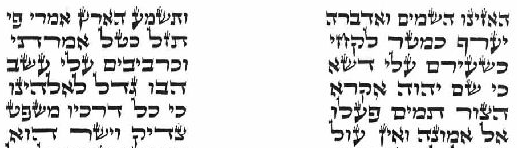
But if you look in the old Torahs and in the Torahs of the Yemenite Jews you will see that the columns there aren't uniform at all. Below is a picture from a Yemenite tikkun:


I guess the Ashkenazi sofrim took the liberty to strectch the lines in order to make the scrolls look nicer, on the grounds of "zeh keli veanveiu".

But there's another thing that really puzzled me. Aside from the layout, the Yemenite scrolls also differ in the actual poem structure and that's the real reason why their columns aren't simetrical - there are less lines and thus some of the lines are longer.

For instance, look in the 17th line in the above picture, "zechor yemot olam.." - this is a long line. In the Ashkenzai scrolls this long line is divided in two, enabling our sofrim to justify the lines. Now that's odd! There are two other places where there's a difference in the poem structure but I will leave it for you to figure it out.

Which is the right structure?

That's where the Aleppo Codex comes to the scene. This is a topic for another post, but it suffices to say that the Aleppo Codex, guarded by the Aleppo Jews until 1948, is the most accurate Tikkun ever. Unfortunately, this Tikkun only covers the Nach; the Torah pages were mysteriously lost in a Arab riot in Aleppo. That is, all the Torah pages were lost besides..... that's right, the pages of Shirat Haazinu! And if you guessed that the Yemenite scrolls are identical to it, you are right. I got this image from the Aleppo Codex website:


This would imply that the Ahskenazi structure of Shirat Hazinu is problematic. Halacha says that if there's a pause (parsha setuma or petucha) in a wrong place, this will invalidate a Sefer Torah. If the Ashkenazi scrolls have a different poem structure, some of the open spaces are in the wrong place!

The answer is simple: the open spaces in Shirat Haazinu (and Az Yashir) are not open and separate Parshas, but a special layout of a song. The halachot of Parsha Petucha and Setuma don't apply here and whatever layout you have - Yemenite or Ashkenazi - will be Kosher for all intents and purposes. So although it's clear that the Yemenite arrangement is more reliable, you should not start complaining about our modern-day structure.

This is the story of the layout of Shirat Haazinu. I hope you enjoyed and I wish you a Gmar Hatima Tova!