Showing posts with label rambam. Show all posts

Monday, July 18, 2022

The Last Two Lines of Shirat Hayam

This post is related to my last post on Shirat Haazinu - you might want to read that first.

The Talmud in Megillah 16b states:
אָמַר רַבִּי חֲנִינָא בַּר פָּפָּא, דָּרֵשׁ רַבִּי שֵׁילָא אִישׁ כְּפַר תְּמַרְתָּא: כּל הַשִּׁירוֹת כּוּלָּן נִכְתָּבוֹת אָרִיחַ עַל גַּבֵּי לְבֵינָה
Rabbi Chanina (...) says all songs are written a small brick (writing) above a brick (blank space), and a brick above a small brick.

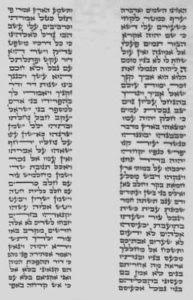
The Talmud here is referring to the classic brick-and-mortar layout which is featured in all Torah Scrolls throughout time - 30 lines beggining with Az Yashir ending at Betoch Hayam. The layout is easily attainable up to the last two lines, which are much longer and therefore present a problem for the scribe - how should they be written?

Looking at historical and more recent scrolls, one can find three completely different arrangements of the last two lines, and the underlying discussion is if the two last lines are at all part of the Shirat Hayam. Unlike the other lines, the last two are not written in poetic language, and seem to revert back to the narrative preceding the Shirat Hayam - perhaps an indication that this section is different from the rest.

The first Mesora we have relies on this understanding and it has the last two lines written in regular prose, without any special layout or spacing. This tradition was popular in earlier times specially in Ashkenaz and proponents of this opinion bring a proof from our prayers in Shacharit, which repeats Hashem Yimloch LeOlam Vaed in the 27th line. This repetition indicates the ending of the song, similar to Psalm 150 which has the last pasuk repeated in morning prayers כל הנשמה תהלל יה הללו־יה, indicating the end of the psalms of praise. In any event, this structure is straightforward and easy to write - see below some examples:


This layout has fallen out of use in the last few hundred years, even though there's Halachic basis for it and it also seems to "fit" well in the overall symmtry of the text.

The second Mesora is assymetrical, and divides these two lines with one blank space causing the text to look different than the preceding lines. This layout is found in the most important historical Torahs and codices, including the Leningrad Codex , the Bologna Torah and finally Ashkar fragment (the oldest witness of them all - it only has a few pages and Shirat Hayam is one of them, and you can see the layout of the last two lines if looking attentively).


Leningrad Codex:
Leningrad Codex

Bologna Torah:


Ashkar fragment - hard to see but look closely


The Yemenite Torah scrolls have this layout too, and that's always a reliable indication of how ancient and well established this Mesora was in earlier times.

We now turn to the third layout, mentioned by Rabbi Menachem Meiri in his scribal work Keriat Sefer. The Meiri brings that Rabbi Meir Halevy Aboulafia (source here) he had in his possesion a booklet that was allegedly a reliable copy of the Rambam's text but Rabbi Aboulafia was unconfortable about the featured layout of the last two lines of Shirat HaYam found there, which looked like this:

Rabbi Aboulafia (known as the "Rama") held that this layout cannot be correct because in all preceding 3 stanza lines lines of the Shira, the first and last stanzas only have only one word, and in this layout there are three (את מי הים) in the beggining and two words in the end (בתוך הים). He therefore used a different but similar layout when writing his own two Torahs, in this way:

His influential scribal work Masoret Seyag LaTorah championed this layout and discussed it in detail, and being very well respected by Sephardic and Ashkenazi communities alike, Rabbi Aboulafia's layout quickly became the dominant layout in the Jewish world, even though today there are many questions surrounding this custom. 

Here are some examples of scroll utilizing the Rama's layout:

13th century Sephardic scroll sold by Sotheby's:


Another 13th century Sephardic scroll, sold by Sotheby's for 250,000usd, and in the item's description it is noted that the scribe followed Rabbi Aboulafia's layout:


The Sefer Torah of another rishon, the Rabbeinu Nissim of Girona (Ran) has survived (although recent scholarship challenges this attribution - see here for a detailed analysis) and we can see this layout there too - an indication that in Sepharadic lands this layout was already widespread at this time. It's interesting to note that Rabbeinu Nissim actually tweaked the layout just a little - the very last word of the Shira - הים - is not written all the way in the end of the page, but indented a little before. Professor Penkower (here, page 25) explains that this was done in the context of creating a Parasha Petucha, but that's beyond the scope of our discussion. See here a pic I took years back when visiting the National Library of the Hebrew University, and look closely at the very last word - it's written before the end of the line:

Coming back to the second layout, we should revisit the Rambam's opinion. As we have seen, Rabbi Aboulafia's booklet was attributed to the Rambam and it allegedly featured the last line divided in three, but this booklet seems to be problematic at least in this very specific instance.

Scholars today agree that the Rambam used the second layout in the Mishne Torah and not the Rama's, as he based his text on the famous Aleppo Codex. While the Shirat Hayam part of the Aleppo Codex dissapeared in 1948, research has shown conclusively that the codex had the same layout as the other ancient scrolls we have today (Leningrad, Bologna) and therefore it's no surprise that the Yemenite tradition follows that same layout.

However when you look at our versions of the Mishne Torah, you don't see the second layout - you see the Meiri's layout. See below:


Interesting to see that my copy has a note:
Rabbi Menachem di Lonzano wrote in his Or Torah: Don't heed to the layout found in (other) editions of the Rambam because they are mistaken and are not the layout written by the Rambam - the printers made the layout from their own heart.

 *In this edition we have printed the correct layout as seen in Or Torah (the publishers)

Clearly Rabbi di Lonzano, an influential Masora expert of the 16th century, was sure that the Rambam had the Ashkenazi/Sephardi (Aboulafia) layout, but this is most certainly incorrect as we mentioned above. And by the same token, the printers' correction of the layout was a mistake too, in effect causing a censhorship of the original design used by the Rambam - similar to the censorship of Shirat Haazinu discussed in my previous post. 

Now it's possible to appreciate the work of Shabtai Frankel, a Rabbi and businessman who funded a Kolel dedicated to researching and fixing mistakes in the Rambam's Mishne Torah. His acclaimed edition is a real gem for situations like ours - see below how he printed this page, opposed to my edition above:


See here a zoom of the last lines lines:

Frankel uses the second layout we discussed above, which was featured in the Aleppo Codex and is also seen in the Leningrad Codex - and not the Ashkenazi/Sephardi layout as we have it in our Torah Scrolls. By the way, note how the last line is indented similar to Rabbeinu Nissim's Torah Scroll discussed above - I haven't seem a consensus about this indentation in the Aleppo Codex so this is surprising.

Now note how afterwards Frankel elegantly mentions the layout "according to Rabbi Aboulafia's testimony" - the three stanzas the Rama saw in the booklet attributed to the Rambam (בתוך הים in one stanza), but not the Rama's ammended version, which he felt more confortable with but as we now know, was never written by the Rambam. Frankel's edition shies away from censorship and it's refreshing to see how openly his edition deals with this controversy, but this is a recent development.

Throughout many centuries, the layout of the only two songs found in our Torah scrolls were both censored in our standard Mishne Torah versions in order to comply with the dominant Ashkenazi/Sephardi Mesora - directly against the Rambam's detailed and clear account of how the two songs should look like. This is a good example of the limited success of some of the Rambam's directives in the Mishne Torah - sometimes he succeeded to popularize Halachot but sometimes, like here, he failed (see more about the scope of the Rambam's influence on Mesora here, page 16 - article by Prof Yosef Ofer). 

It's also interesting to note that some scrolls will follow the Rambam's ruling in Shirat Hayam but not in Shirat Haazinu, although most will follow Rabbi Aboulafia in both songs. Dr Shlomo Zucker, when analyzing a unique old scroll auctioned by Sotheby's, notes that these small nuances allow us to identify a Torah's origin:

"The fact that the present scroll presents the Maimonidean division of the Song at the Sea and the Abulafian version of the Song of Moses is a clear indication that it was written in Spain. In Sephardic Torah-scrolls written after the expulsion in the lands of the Sephardic diaspora, both songs are always according to Meir ha-Levi Abul'afia, while only the Yemenites follow Maimonides' order in both songs."

Rabbi Mordechai Breuer, one of the leading experts of the Aleppo Codex, conducted many studies of this codex versus the others and the result was always a clear superiority of the Aleppo Codex - exactly what the Rambam said almost 1000 years ago about this same codex, which he used for his own Sefer Torah. Rabbi Breuer even wondered if a new community in a new land should perhaps adopt his edition based on the Aleppo Codex for their Torah Scrolls, like the Rambam had hoped for (sourceYosef Ofer, The Masora on scripture and its methods).

While the scribes did eventually adopt the Aleppo Codex as the basis for scrolls of the Neviim and Ketuvim - there was no unified Mesora until the appearance of this codex - in regards to the Torah scrolls history has taken a different path and everyone continues to follow our Mesora, based on the Rama's ruling. Or as Rabbi Sorkin puts it, using a play with words from Exodus 14,  ובני ישראל יצאים ביד רמה - the Jewish People fulfill their obligation with the "Yad Rama" (name of another famous book from Rabbi Abulafia), i.e. we rely on the Rama's opinion to fulfil the Mitzva of Writing a Torah Scroll and this is the undisputed Halacha for almost a milennia.

- this article was based extensively on the excellent article by Y. M. Sorkin, entitled אריח על גבי לבינה.

Tuesday, May 3, 2022

Shirat Haazinu: 70 or 67 lines?


One of the few columns that stand out in a Sefer Torah is Shirat Hayam, with its “brick and mortar” shape, and Haazinu, with its “two towers” shape. As a general rule, the Torah Scroll has small blank spaces scattered around every column, and they serve to delineate paragraphs and to provide to the reader a moment of reflection.

I have written about the importance of the correct placement of these blank spaces, called in Rabbinic parlance Parshiot Petuchot and Setumot, in an older post and I encourage you to look there too.

But as a whole, the Torah layout is a continuous prose in all its columns, save the two instances mentioned above. Both are songs, and it seems that the unusual layout is intended to highlight their poetic structure. Commentators offer more esoteric explanations, that the two towers Haazinu layout allude to the downfall of the wicked, which are mentioned in one of the stanzas (this explanation is also applied to the two tower layout of Haman's wicked sons in Esther's Scroll, discussed here).

The Rambam dedicates many pages to the correct layout of all Parshiot in the Torah, and he writes that Shirat Haazinu should be divided in 70 lines. Look at the text in Sefaria:
צוּרַת שִׁירַת הַאֲזִינוּ - כָּל שִׁיטָה וְשִׁיטָה יֵשׁ בָּאֶמְצַע רֶוַח אֶחָד כְּצוּרַת הַפָּרָשָׁה הַסְּתוּמָה. וְנִמְצָא כָּל שִׁיטָה חֲלוּקָה לִשְׁתַּיִם. וְכוֹתְבִין אוֹתָהּ בְּשִׁבְעִים שִׁיטוֹת. וְאֵלּוּ הֵן.

That’s indeed how our Torahs (see example pic at the top of this post) are structured - both Ashkenazi and Sephardi scrolls - in accordance to the Rambam’s account and we would expect that to be the case, as the Rambam had in his possession the prized Aleppo Codex - the most authoritative codex according to our tradition.

The Yemenite Jews have a handful differences in their Mesora of the Torah text, minor differences in the spellings but one very visible variance stands out. Their parshat Haazinu is written in 67 lines, unlike Ashkenazi and Sephardic scrolls.

When looking closely, they have a different arrangement in three stanzas, which are merged together forming a longer, more squeezed, line. Because of that, the layout of their Haazinu column is much less homogenic and the “two towers” are not perfectly aligned. See a picture of the Yemenite tikkun:


We all know the Teimanim follow the rulings of the Rambam closely, which in turn begs the question - how do they reconcile their Mesora with the Rambam?

Let’s turn to the Aleppo Codex again. As I discussed elsewhere, this codex is attributed to the Masorete Ben Asher, and was salvaged from the Aleppo synagogue pillaging in the 1947 Arab protests against the establishment of the State of Israel..

The local Sephardi community guarded the Codex closely, and very few outsiders managed to find a way to look at it. One of the few was Humberto Cassuto, a famous scholar who wanted to investigate if this Codex was indeed the one attributed to the Ben Asher lineage. Professor Cassuto was granted limited access and couldn’t study it throughly, but he cast doubt at the provenance of the Codex because he saw that the Haazinu of the Codex had 67 lines, and not 70 lines as discussed in the Rambam’s Mishne Torah.

Many scholars started to investigate this finding. It turned out that the Yemenites have a different reading of the Rambam and in their manuscripts it states that Haazinu has 67 lines - just like Professor Cassuto observed in the Codex, except he wasn’t aware that his own Rambam’s edition was corrupted. The very feature Prof Cassuto found to be suspicious turned out to be the best proof of the authenticity of the Codex. An early manuscript of the Rambam from Oxford's collection has the same version as the Yemenites, and that's how Mechon Mamre has it in their online Rambam:
יא  צוּרַת שִׁירַת הַאֲזִינוּ (דברים לב,א-מג)--כָּל שִׁטָּה וְשִׁטָּה, יֵשׁ בְּאֶמְצָעָהּ רֵוַח אֶחָד כְּצוּרַת הַפָּרָשָׁה הַסְּתוּמָה, וְנִמְצֵאת כָּל שִׁטָּה חֲלוּקָה לִשְׁתַּיִם; וְכוֹתְבִין אוֹתָהּ בְּשֶׁבַע וְשִׁשִּׁים שִׁטּוֹת.  וְאֵלּוּ הֶן

Although almost all the Chumash part of the Codex was destroyed (or hid away, as claimed by Matti Friedman’s great book discussed here), the Haazinu pages observed by Prof Cassuto have survived and can be seen in the Israel Museum and online. See it here:


The Yemenites kept the Rambam’s proposed Mesora (save one puzzling, small variance towards the end of Haazinu in the stanza starting with "Gam Betula" which the Yemenites start with the preceding "Gam Bachur" - the similar words seemed to have caused this confusion but perhaps there's a better explanation I'm not aware of). 

The Ashkenazi and Sephardi did not, and there was an obvious attempt to cover up the discrepancy between their tradition (70 lines) and the Rambam’s (67), and while a few expert scholars (like 16th century Menachem di Lonzanu, in his popular work Or Torah - see here at the bottom) eventually noted conflicting versions of the Mishne Torah, this caused much confusion and eventually most scholars became convinced that the versions of the Mishne Torah with 67 lines were simply wrong because they didn't comply with the vast majority of the existing scrolls.

The Ashkenazi and Sephardi structure of 70 lines has its source in the Masechet Sofrim 12 (exact link here, where it states the first word of every line totaling 70), which is one of the handful small tractates found in the Babylonian Talmud and is generally attributed to the Gaonic period. Even though the Codex was housed in Aleppo - a major Sephardic center - for a very long time, the Sephardic world adopted the 70 line tradition which was the most prevalent and based their text in Rabbi Meir Aboulafia’s (who was an opponent of the Rambam) authoritative compendium Masoret Seyag Latorah - not the Aleppo Codex. Ironically, the Aleppo community guarded the Codex as its prized relic while following another Mesora for the Haazinu parsha (credit for the great Prof Marc Shapiro for this insight).

A few scholars have attempted to conduct studies of Torah Scrolls from different pre-war communities in regards to their Haazinu structure, in order to discover how prevalent was the 70 line structure. Scholars have found that there were more than two options - some scrolls had a little more than 70 lines while others fewer than 67, some had no unique structure at all, while others had Haazinu in the brick and mortar layout of Shirat Hayam! It seems like the scribes generally knew that Haazinu had a special layout but had limited knowledge of how to write the special structure.

The difficulty in regards to Haazinu stems from this Talmudic passage in Megillah:
אָמַר רַבִּי חֲנִינָא בַּר פָּפָּא, דָּרֵשׁ רַבִּי שֵׁילָא אִישׁ כְּפַר תְּמַרְתָּא: כּל הַשִּׁירוֹת כּוּלָּן נִכְתָּבוֹת אָרִיחַ עַל גַּבֵּי לְבֵינָה  חוּץ מִשִּׁירָה זוֹ וּמַלְכֵי כְנַעַן, שֶׁאָרִיחַ עַל גַּבֵּי אָרִיחַ וּלְבֵינָה עַל גַּבֵּי לְבֵינָה. מַאי טַעְמָא — שֶׁלֹּא תְּהֵא תְּקוּמָה לְמַפַּלְתָּן — 
Said Rabbi Hanina bar Pappa, Rabbi Shila, a man of the village of Temarta, expounded: all songs -- all of them -- are written a small brick (writing) above a brick (blank space), and a brick above a small brick, except this song (Sons of Haman) and [the song of] the kings of Canaan, which are a small brick above a small brick and a brick above a brick.
Note that Haazinu is not mentioned as one of the exceptions, and you could infer from this passage that Haazinu should be written like all other songs - in a brick and mortar fashion! That is the likely explanation of why some older scrolls have this feature - perhaps some scribes based themselves in the simple understanding of this Gemara. The Noda Biyuda discusses the Halachic status of this layout and based on this understanding he tries to find a way to not invalidate these scrolls. See below how a Haazinu in brick-and-mortar shape would look like:

However, the Masechet Sofrim is categorical, and clearly states that Haazinu is not to be written like Shirat Hayam, and that's the normative Halacha - even though the Masechet Sofrim is from the Gaonic period and hence, theoretically less authoritative than the Talmud which seems to imply that Haazinu should be written like all songs - in brick and mortar layout.

Professor Mordechai Breuer, one of the leading experts of the Aleppo Codex, attempted to harmonize the Talmudic passage above with the ruling of the Masechet Sofrim by developing the idea that Haazinu is not a real Song/Shira, and therefore not the subject of the Talmud's discussion above. In other words, Haazinu is in a category of its own and it's unlike Shirat Hayam, Bnei Haman and Shirat Devorah (see here page 23 for further discussion and a great resource in this topic).

The complexity of this Talmudic passage is the best explanation of why there's not one single option when it comes to writing Haazinu - the Talmud is ambigious and the scribes had a tough time getting it right.

However, scholarly research has shown that in both Ashkenazi (Prof Goshen-Gottstein) and Italy (see Prof. Orlit Kolodny here with more details), the most common layout was undoubtedly the 70 line structure, as per the Masechet Sofrim. Less than 10% of the 250+ scrolls surveyed have the 67 layout, which means that the Rambam/Yemenite Mesora was actually not very popular. While the Rambam tried to push for the 67 Mesora in his very detailed account of how Haazinu should be written, it seems clear that already in his time this Mesora was not dominant and his initiative did not gain much traction in the wider Jewish world. The fact that the Rambam's manuscript was censored to conform with the 70 line Mesora is an indication that there was a push back to the Rambam's directive, and the censorship (see more about this in Prof Marc Shapiro's "Changing the Immutable") was a very efficient way to safeguard the prevalent Mesora of the Masechet Sofrim - it even fooled an expert scholar like Prof Cassuto.

Friday, September 12, 2014

Tzitzis - wool, cashmere, cotton or silk?

As I wrote my Sefer Torah, I often look topically in a few commentaries to further understand the text and be more focused.

I'm now at Parshat Noach, and I had a chance to study the Ben Ish Chai commentary on the passage (Bereishit 9:7)

  ואתם, פרו ורבו; שרצו בארץ, ורבו-בה

While his kabalistic explanation to this passage is beyond the scope of this blog, the Ben Ish Chai does link this mitzva of having children to the mitzva of tzitzis. Both commandments provide a special protection to those who fulfill it and he goes on to detail the Halachot of tzitzis. By chance this mitzva is also to be found in this week's Parsha גדילים תעשה לך so although I usually only write about Safrut here, I will open an exception just this time. 

The Talmud says that only sheep wool and linen are considered "fabric" in regards to tzizis, and therefore one should only make tzizis from these two fabrics. Other garments are only rabinically required to have tzizis. The authoritative Shulchan Aruch rules this way, and the Sephardim generally are careful with this. 

However the Rema, followed by Ashkenazim, rules like another opinion of the Talmud that fabrics other than wool and linen are also biblically required to have tzizis. That's why Ashkenazim use cotton tzitzis, although many try to be machmir like the ruling of the Shulchan Aruch. 

The catch - written in big letters Mehadrin
but on the left side "hashgacha only for
the threads".
Mesh tzitzit


However some fabrics seen today in the market are not required to have tzitzis even Rabinically; polyester is the best example. A square polyester garment does not need tzitzis, even though you can see many judaica stores (and even on Amazon) selling mesh polyester tzitzis as a solution for hot summer days. That's rather ironic - according to Halacha it's totally unnecessary to wear mesh tzitzis and the person might as well wear no tzitzis. If you want to perform the mitzva you should do it right and mesh tzitzis has no Halacha significance according to all (this is the widely accepted ruling of Iggrot Moshe 2:1). 

So we have established that wool and linen are undisputedly the best option for tzizis, as far as the Biblical miztva of tzitzis is concerned. 

Actually, that's imprecise. The wool that is undisputedly subject to tzizis is sheep's wool but other woolen fabrics such as cashmere, which is wool from goats, are not undisputed for Biblical miztva of tzitzis and therefore less optimal specially for Sephardim. Goat and sheep are two completely different animals, and while sheep wool is white, goats wool is more beige.

Cashmere goat wool
Sheep and goat


That's very relevant when buying a Tallit. Since we only wear Tallit briefly every day for shacharit, there's an unofficial consensus of wearing only woolen Tallit to make sure that at least once a day you will be wearing the optimal tzizis fabric - Ashkenazim and Sephardim alike. For this reason, virtually every Tallit sold in Judaica stores is made from sheep wool. 

However lately I've seen some specialty stores selling cashmere Tallit, which would go against the consensus I mentioned. Always make sure you buy Tallit from sheep wool.

Now let's turn to the second undisputedly good tzizis fabric - linen. I personally love everything made of linen for summer use, since it's a strong and breathable fabric - in fact, throughout history linen was regarded as the most superior and fine fabric (see here for more on that). But let's get back to Halacha:

Alongside sheep wool, linen is also a "Biblical fabric" and ideal for tzitzis use according to the Shulchan Aruch I quoted before, but an external factor is a threat to using linen tzitzis - Shaatnez, the Biblical prohibition of mixing linen and wool. I will quote a very good piece delineating this issue I found in YUTorah:

    The Gemara, Menachot 40a, states that the rabbis placed certain limitations on the use of linen garments for the mitzvah of tzitzit.  According to Rashi, ad loc., the rabbis prohibited placing techelet on a linen garment.  The reason is because techelet is not only unique in its color, but it must also be made of wool.  While the Torah does allow a wool techelet string to be placed on a linen garment, this leniency only applies if there is a fulfillment of the mitzvah of tzitzit.  However, if for whatever reason, there is no fulfillment of the mitzvah of tzitzit, one violates the prohibition of sha'atnez by wearing such a garment.  Out of concern that one might wear such a garment without adhering to the many laws of tzitzit and techelet, the rabbis banned placing techelet on linen garments.  Rabbeinu Tam, Shabbat 25b s.v. Sadin, disputes the opinion of Rashi and claims that the ban is not limited to techelet.  The ban extends to the use of any linen garment, even if no techelet is placed on the garment.
    Teshuvot HaRosh 2:8, claims that the common practice is to follow the opinion of Rabbeinu Tam and to disallow the use of all linen garments for the mitzvah of tzitzit.  However, he notes that upon arriving in Spain he noticed that many people used linen to fulfill the mitzvah of tzitzit.  He suggests that they might have been relying on the fact that there is no techelet, and perhaps even Rabbeinu Tam would agree that there is less of a concern.
      Shulchan Aruch, Orach Chaim 9:6, cites the opinion of Rabbeinu Tam as normative.  However, Rama ad loc., mentions the leniency of Teshuvot HaRosh that if only linen is available one may use it for tzitzit, as there is no techelet available.  It should be noted, that nowadays there are many people who place techelet on their garments, and Teshuvot HaRosh's leniency may not be applicable.  This would apply even to those who question the authenticity of modern day techelet, as the concern exists that by allowing linen garments, it may lead to someone who does use modern day techelet to violate the prohibition of sha'atnez. 
It's also interesting to add that the influential Chaye Adam (Hil. Tzitzis 11:12) writes:
כלל י״א סי׳ י״ב ״וכבר
 נתפשט המנהג בקהלתינו לעשות טלית של פשתים
 וציצית של פשתים, ע״פ הגר״א ז״ל״
He is saying the custom of his community, in Poland, was to wear linen tzitzis like the ruling of the Gr"a, the Vilna Gaon. In other words, he is giving the same testimony teh Teshuvat HaRosh gave when he arrived in Spain. So it seems clear that it wasn't uncommon to wear linen tzitzit in both Ashkenazi and Sephardic communities.

Linen tzitsis with Techelet
It seems to me to be a case of Halacha VeEin Morim Kein i.e. it's permissible and optimal to wear linen tzitzit but this should not be a publicized practice because of the concern than less knowledgeable people will eventually transgress Shaatnez as a result. 

And I will also add that this concern for other people is not farfetched - the vast majority of people, even among the observant communities, don't know Hilchot Tzitzis in depth and as you have seen, these Halachot are rather complex and often times a little confusing (I did try my best to keep this post as organized and short as possible..). Click here to see a website selling linen tzizis with techelet, which questionable according to what we have seen.

SO, Tzitzis - wool, cashmere, cotton or silk? Answer: Tallit surely should be made of sheep wool and tzizis you wear all day can be from cotton too.


Monday, September 1, 2014

Book Review: Sacred Monsters by N. Slifkin

As I was writing Parshat Bereishit in my ongoing Sefer Torah project, one theme stood out from the story of creation: the Bnei Elohim. The Torah says:

6:2 That the sons of God saw the daughters of men that they were fair; and they took them wives of all which they chose.
6:3 And the LORD said, My spirit shall not always strive with man, for that he also is flesh: yet his days shall be an hundred and twenty years.
6:4 There were giants in the earth in those days; and also after that, when the sons of God came in unto the daughters of men, and they bare children to them, the same became mighty men which were of old, men of renown.
The Torah seems to speak negatively of these "sons of God". I quickly realized that although I learn this Parsha every year since I'm a small kid, I never really stopped to think about this.

I suppose my teachers in school intentionally didn't spend much time exploring who these people were. I was told by a very knowledgeable educator that specifically today, in times where Lord of the Rings and other fantasy stories are so popular, there is a point not to explore the theme of giants and unusual creatures mentioned in the Torah. Many educators are afraid kids will start looking at Torah as just another fantasy book, cv"s. 

But even worst than confusing the Torah with fantasy books, kids can find many cartoons and movies inspired in Biblical stories that are visually stunning and often have their own takes on some creatures of the Torah. Most notably, as I a started writing Parshat Noach a few weeks ago, Hollywood released "Noah", a blockbuster movie loosely inspired in the story of Noach. 

Hollywood's Bnei Elohim
These movies can be actually even more dangerous for our kids since they always take artistic license and make up a whole bunch of things. Specifically in "Noah", the film, the Bnei Elohim are depicted as stone monsters made of light, with seven hands (see picture). If we don't teach the "giants" theme for our kids in school, I would say that they should equally not be exposed to cartoons and movies based on Torah stories. 

But not everyone agrees with this mindset. Recently, a Rabbi launched a successful Kickstarter campaign to raise funds for a fantasy book for kids based on the Torah, with the argument that Jewish-fantasy books can be a good alternative to kids who like to read Harry Potter and Lord of the Rings. I disagree. 

So I decided to look for somebody that would shed light in the concept of giants like Bnei Elohim and Og but I found very little resources. The best one I've come across is Sacred Monsters, by Rabbi Natan Slifkin aka Zoo Rabbi. 

For the unninitiated, Rabbi Slifkin was in the epicenter of a huge theological feud a few years ago. He wrote about Creation and how to reconcile the Torah's account with science, based of classical Jewish commentators. Although he got an endorsement from the very respected Rosh Yeshiva of Philadelphia, his book became subject to virulent attacks from a segment of the Haredi world that rejects scientific reconciliation with Torah. I was learning in Ner Yisrael at the time and my Rosh Yeshiva, Rabbi Aharon Feldman, was a very important figure in this debate. Click here for Rabbi Slifkin's own link list of this controversy.

Be it as it may, Sacred Monsters is a very open and honest discussion about how we should look at the many unusual and strange creatures mentioned in the Torah. Rabbi Slifkin uses a scientific approach and is not afraid of asking questions nor shy to offer unusual answers. 

Og as a real super giant
Rabbi Slifkin discusses how big were the giants mentioned in the Torah. According to some, they were literarily hundeds of meters tall. But he also mentions the Rambam, who says that Og was probably not taller than 5 meters since it's organically impossible to be taller than that. 

Rabbi Slifkin brings many examples of modern day "giants" that measure over 3 meters and notes that the Rambam's estimation would indeed make sense from a scientific point of view. 

Although the book does mention other giants and also the very tall Moshe Rabbeinu, I was disappointed not to see a specific discussion of the Bnei Elohim. After all, they were the first giants mentioned in the Torah and the forebearers of Og. 

After reading almost the entire book, I leave with a feeling that we know very little about most of the unusual creatures of the Torah. There are opinions  that offer some plausible possibilities and Rabbi Slifkin often broadens the discussion bringing in achademics and zoologists, but from the classical Jewish commentators there are many gaps and speculation. 

I do think the book is an excellent resource and introduction guide for those who want to know the a little of everything. It did kind of leave me with even more questions than before but that's not necessarily a bad thing!


Tuesday, December 18, 2012

The Aleppo Codex: Book Review from a Scribe's Perspective

I've been meaning to write about the Aleppo/Ben Asher Codex for a long time. Now that Matti Friedman came out with a masterpiece book on this topic, I will try my best to write about how this Codex is very relevant for Safrut enthusiasts and scribes in particular.

Briefing

Until now I had only seen books on this subject from scholars, aimed for the academic audience. Matti's book is a mainstream book written like a thriller, so it's a very enjoyable and easy read. Matti is careful to create an interesting story line while sticking to the facts and stating his sources in the appendix, chapter by chapter. He successfully provides the full context in which the fabulous story of the Codex took place and goes back and forth in time delving into the historical relevance of the book and also how it affected so many different people and communities throughout its existence.

The Story (short version + spoliers)

The Ben Asher Codex was written sometime in the 10th century c.e., in Tiberias while the  Masoretes were focusing in gathering and establishing the Mesora of vowels, words and missing letters of the Torah. Aaron Ben Asher was the prince of the Masoretes and his codex was widely believed to be the most accurate ever produced, an opinion shared by Maimonides when he saw this book in his own desk in Fustat some centuries later.

The Codex eventually was brought to the Aleppo community, where it was guarded for many centuries until the Arab riots following the creation of the State of Israel. That's when Matti's book gets more interesting.

In 1958, the Aleppo Rabbis sent the Codex with Faham, who was fleeing to Israel via Alexandretta (Turkey). Faham was supposed to give the Codex to the head of the Syrian community in Israel but instead, he gave it to the head of the Aliya Department, Shragai, who gave it to the then President of Israel, Ben Tzvi, a turn of events that triggered a court case a few years later.

The big question discussed in Matti's book is the fact the only about 65% of the Aleppo Codex is in possession of the Ben Zvi Institute in Israel today. What happened to the rest? Interesting to note that the missing pages pretty much cover the whole Bible part of the Codex - the most important section. What we have today is pretty much most of Book of Prophets (Neviim) and Book of Writings (Ketuvim).

To summarize Matti's research, all the possibilities are narrowed down to two options. Either the agent of the Aliya Department in Alexandretta stole the missing parts from Faham, who publicly complained he had been robbed there. Or the Codex was received by President Itzhak Ben Zvi in its entirety but after it was stored in the Institute, someone stole it - other very important manuscripts were reported missing in the early days of the Institute. These two possibilities were and still are potentially very embarrassing for the Israeli authorities so the Institute did their best to cover-up and have always adopted the version that the missing parts were lost in the mob of the Aleppo synagogue, a version that is conclusively not true according to Matti. He also brings good evidence that the missing parts were actually in the manuscript black market as late as 1985, in a colorful story featuring the Bukharian jeweler Shlomo Moussaief (see here a NYT Magazine article based on Matti's book with some additional reporting)

Sample page of the Aleppo Codex
Halachic Status of the Aleppo Codex

The Rambam (Maimonides) explicitly pushed for the usage of the Aleppo/Ben Asher Codex, and here you can see verbatim:

:(משנה תורה" (הלכות ספר תורה פרק ח הלכה ד"
וספר שסמכנו עליו בדברים אלו הוא הספר הידוע במצרים שהוא כולל ארבעה ועשרים ספרים שהיה בירושלים מכמה שנים להגיה ממנו הספרים ועליו היו הכל סומכין לפי שהגיהו בן אשר ודקדק בו שנים הרבה והגיהו פעמים רבות כמו שהעתיקוּ ועליו סמכתי בספר התורה שכתבתי כהלכתו


Although the Rosh argues on the Rambam in regards to the layout of the "open" and "closed" Parshiot (see my post about this here), the Shulchan Aruch ruled that if it's impossible to write it in a universal layout, which both Rambam and Rosh will agree, one should follow the Rambam because he had the Aleppo/Ben Asher Codex in his possession and based his opinion on this Codex, which is superior to all others. Therefore the opinion of the Rosh is "overruled" by the Ben Asher Codex.

After the Ben Asher Codex found its way to Aleppo, the community safeguarded it as a holy relic and effectively made it impossible for other communities to fully study it, so its unique features remained unnacessible for the Ashkenazi scribes by and large throughout the centuries.

Halachic Implications of the Codex

As the years passed, the Ben Zvi Institute made the Aleppo Codex available for the public and recently many groups started to push its adoption for the scrolls of the Na"ch. The Aleppo Codex differs from the traditional layout used in Megillat Esther, for instance, and that alone would be a significant controversy since all Jewish communities use this scroll in Purim for public readings, and any change would no doubt bring disputes.

But aside from the Megillat Esther issue, some communities have custom of reading the Shabbat's Haftarot from scrolls and adopting the Aleppo Codex would also bring disputes. This custom was instituted by the Gr"a, one of Judaism's brightest minds, and anybody living in Jerusalem has seen this numerous times - many of the early settlers of Jerusalem were disciples of the Gr"a and in general, the holy city follows his customs. The Gr"a instructed the scribes to use what is known in the field as the Berditchev tikkun layout, a puzzling book that doesn't conform with the Aleppo Codex layout in the Neviim and Ketuvim.

So in no time, there was a battle between the Jerusalem-based disciples of the Gr"a, who always wrote their Na"ch scrolls according to the Gr"a's Berdichev tikkun versus Bnei Brak, one of Israel centers of Torah learning and a city who generally doesn't follow the Gr"a customs. The Bnei Brak-based groups favored the use of the Aleppo Codex, as it is undeniably the most accurate one.

So any scribe trying to buy a Tikkun, his personal codice to guide him in layout and spelling, will find different options depending where he goes. In Jerusalem, the shops will usually sell Tikunim following the instructions of the Gr"a while in Bnei Brak you will see some Aleppo Codex options too. But even more than that, there's a war of words betweeen the two camps, and when I got my Tikkunim, I snapped some pictures from both sides' claims. See below, the first two are from Talmidei HaGra and the last is from the Aleppo Codex backers.


So as you see, the 65% of what we have from the Crown already brought considerate challenges and disputes in the Safrut world and not all have backed its adoption. You can only begin to imagine what would've happened if we had all the Codex, more specifically , the Bible part. While the usage of scrolls for Na"ch is limited, all Jewish communities and synagogues have numerous Torah scrolls and continue to write new ones every day. If the Aleppo Codex for the Bible would be available, I anticipate that we would have a similar, but much more heated war of words and I wonder how many communities would start adopting the Aleppo Codex for their own scrolls.