Showing posts with label tikkun. Show all posts

Thursday, July 15, 2021

Rabbi Meir's Torah

"בתורתו של רבי מאיר מצאו כתוב, "והנה טוב מאד" (בראשית א, לא) - "והנה טוב מות" (בראשית רבה וילנא, ט, ה)


"ויעש ה' אלקים לאדם ולאשתו כותנות עור וילבישם" (בראשית ג, כא). בתורתו של ר' מאיר מצאו כתוב: "כותנות אור" (בראשית רבה תיאודור-אלבק, כ, כא)


This Medrash says that Rabbi Meir’s Torah had some variant readings distinct from our mainstream Mesora. Instead of טוב מאד, his text was טוב מות; instead of כותנות עור, he had כותנות אור


This is a puzzling and difficult concept to understand. The Talmud (Eiruvim 13a) says that Rabbi Meir was an expert Sofer, who learned by the foremost leaders of his generation - Rabbi Yishmael and Rabbi Akiva. 


While a small variant reading of עור and אור is a relatively minor issue, Rabbi Meir’s other variant - טוב מות - seems completely different and unrelated to the mainstream text. What can be the connection between טוב מאד and טוב מות, which was highlighted by Chazal as a point of variance between two traditions ?


I usually like to follow a somewhat scholarly approach in my posts, but to answer this question I will turn to Derash. 


There are many comments about  the connection between עור and אור, mostly based one the famous Zohar that originally the skin of Adam was translucent, full of light, but after his sin it turned like our skin, hence the connection between the words. 


Exploring this concept further, I've heard in the name of Reb Tzadok Hacohen |(please comment if you have the written source)  that specifically Rabbi Meir had the unique ability to understand the ultimate purpose of everything in this world and how all connects in a meta-physical reality. In his perception, כותנות עור was very clearly not just leather clothes but clothes hiding a spiritual light and Rabbi Meir could perceive that in all creation at any given time - not only before Adam’s sin. For Rabbi Meir, all creation was connected and he saw how that worked.


What about the connection of מאד and מות


If we take Reb Tzakok’s insight a step further, that our traditions and Rabbi Meir's reflect two different worldviews, let’s analyze why this specific variant has been highlighted. Both מאד and מות start with the Mem, the middle letter of the Hebrew alphabet and the letter representing the present time. We can see that Rabbi Meir could start from the Mem and perceive the very end-objective of everything, and this is codified in the word מות, going from the Mem directly to the Tav - the final letter of the alphabet and the ultimate goal. 


However, our perception is not like Rabbi Meir’s, and we cannot connect all the dots of the world around us. The best we can do is try to go back to how things started and from there try to find meaning. That’s the מאד - starting from the Mem, going to back to the Aleph which is the symbol of Hashem’s unity and then to the Daled, which is the letter highlighting how Hashem interacts with our world. That’s our approach to dealing with this world (see more about this concept in Ari Bergmann's podcast here).


Hence we find a possible connection between the two readings and how they represent differing worldview approaches, as explored by Reb Tzadok. It turned out to be that Rabbi Meir’s approach was not tenable, and the mainstream text is indeed טוב מאד


Of course, this discussion leads to the question of how the Torah text can have variant readings, which in turn challenges the Rambam’s view that our Masoretic text is the “immaculate text”, without any changes through time. To read a great piece on this, which requires a more scholarly approach, see this great post at the Kotzk Blog, discussing what would happen if we would find an authoritative old scroll that differs from our accepted Masoretic text. 


One possible conventional answer is brought by the Torah Temima (source), who writes that some understand the Medrash to be referring not to Rabbi Meir’s actual Torah Scroll but his written novelea, where he expounded the meaning of the Torah text. Or perhaps his marginal glosses written around his personal Torah Scroll. In other words, he had no actual variant Mesora. 


Be it as it may, as for the connection between מאד and מות, we have found that these variant readings can be understood not as a mere curiosity; it’s a hidden message highlighted by the Medrash, and up to us to understand its message.

Tuesday, December 8, 2009

My Progress #4: Megillat Shir Hashirim

I finally managed to finish my Megillat Shir Hashirim, which took some 4 months to write. I had a very tough time writing this one since the klaf was quite bad, specially in the very first column, and this dragged the process more since I couldn't write as fast as usual.

This highlights how important it is to look for top-quality klaf; if you can't get it, wait until you find a good one. I couldn't erase mistakes properly and I even did the capital sin of a Sofer - I made a small hole while trying to correct something. It doesn't matter so much since I managed to "place it" just in between two words - look in the last line of the forth column.

Additionally, I used a computerized Tikkun (from which I copy the Megilla layout) which was awful - I was forced to stretch and squash words in almost every line. Now I know: only buy copies of hand-written Tikkunim.

But Shir Hashirim is fun to write, since I can use it every week (there's a minhag of reciting it every Shabbat-eve) and it's shorter than Megillat Esther. Now my next project is to write a large Mezuza - stay tuned!


Posted by Picasa

Wednesday, October 14, 2009

Bet of Bereishit and the Masechet Sofrim

The Mesechet Sofrim, one of the mini-Tractates of the Talmud, says:


The second statement is well known and all Sifrei Torahs have the large-type Bet at the start. However the commentary of the Masechet Sofrim, "Shehi Takim Leolam", is difficult to understand but I will leave it to you to come up with explanations.

I want to focus in the first statement - that the Bet should have four Tagim. The only time I saw this bet was in an old Tikkun, but the fact is that all modern day Torahs do not have these Taguim. This is how it should look, according to the Masechet Sofrim:


What's strange is that this Masechet Sofrim is a prime source and I had a tough time understanding how can we afford ignore it. For instance, the Gemara says that the "foot" of the Daled should be slightly bent and according to many opinions a Daled that has a straight "foot" will invalidate the Torah scroll. If we are so stringent about what's mentioned in the Gemara, why do we ignore what's mentioned in the Masechet Sofrim?

The answer to this question is interesting. Aside from the Masechet Sofrim, there's another even smaller Tractate called Masechet Sefer Torah. Most of the content of this little Masechta is anyways mentioned in its "big brother", the Masechet Sofrim, which includes Halachot of Sefer Torah, Mezuza, Tefillin and Mesora. Rabbi Chaim Kanievski, in his work on the small Tractates of the Talmud, asks why there's a need for both Masechtas if they are essentially dealing with the same topic.

His answer is quite radical. He says that the Masechet Sofrim is not part of the Talmud (written between 300 and 400 CE), but a later addition by the Geonim, who lived in the 6th century. Basically, the Geonim took one of the little Tractates of the Talmud - the Masechet Sefer Torah - and expanded it, creating the Masechet Sofrim, which deals with all Safrut related Halachot.

If so, Halachot only brought in the Masechet Sofrim do have less weight than the Halachot mentioned in the Talmud. The four Tagim of the Bet of Bereishit is a telling example of this phenomena and that's why we don't have them in our scrolls today.

Sunday, September 27, 2009

The Two Columns of Shirat Haazinu

The Mitzva of writing a Sefer Torah comes from this past week's Parsha, Haazinu. In the preceding Parsha, G-d says to Moshe that the Jews should "write this song", in a reference to Haazinu, one of the Torah's two songs (the other one is Az Yashir). Although the commandment refers only to Haazinu the commentators note that it's prohibited to divide the Torah and write it in a form of "megillot, megillot" i.e. in fragments, since all the Torah is one. So the commentators all conclude that the commandment must have been to write the whole Torah, which will contain the song of Haazinu.

This highlights how important this intricate song is in relation to the whole Torah.

Also aesthetically, Haazinu stands out with its special two-column layout. In the modern Torahs, the two columns are perfectly even, like two towers, and usually are two pages long. I wanted to post a picture of the whole thing but I only found this one:

We find the same layout in the Megillat Esther, in which the ten sons of Haman are listed in the same fashion. Like in Haazinu, most sofrim (not me!) stretch the letters so every column will start and end in the same place:


But if you look in the old Torahs and in the Torahs of the Yemenite Jews you will see that the columns there aren't uniform at all. Below is a picture from a Yemenite tikkun:


I guess the Ashkenazi sofrim took the liberty to strectch the lines in order to make the scrolls look nicer, on the grounds of "zeh keli veanveiu".

But there's another thing that really puzzled me. Aside from the layout, the Yemenite scrolls also differ in the actual poem structure and that's the real reason why their columns aren't simetrical - there are less lines and thus some of the lines are longer.

For instance, look in the 17th line in the above picture, "zechor yemot olam.." - this is a long line. In the Ashkenzai scrolls this long line is divided in two, enabling our sofrim to justify the lines. Now that's odd! There are two other places where there's a difference in the poem structure but I will leave it for you to figure it out.

Which is the right structure?

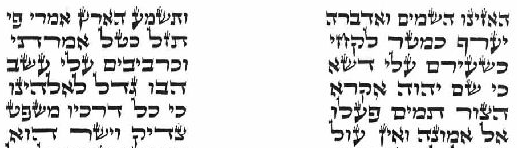
That's where the Aleppo Codex comes to the scene. This is a topic for another post, but it suffices to say that the Aleppo Codex, guarded by the Aleppo Jews until 1948, is the most accurate Tikkun ever. Unfortunately, this Tikkun only covers the Nach; the Torah pages were mysteriously lost in a Arab riot in Aleppo. That is, all the Torah pages were lost besides..... that's right, the pages of Shirat Haazinu! And if you guessed that the Yemenite scrolls are identical to it, you are right. I got this image from the Aleppo Codex website:


This would imply that the Ahskenazi structure of Shirat Hazinu is problematic. Halacha says that if there's a pause (parsha setuma or petucha) in a wrong place, this will invalidate a Sefer Torah. If the Ashkenazi scrolls have a different poem structure, some of the open spaces are in the wrong place!

The answer is simple: the open spaces in Shirat Haazinu (and Az Yashir) are not open and separate Parshas, but a special layout of a song. The halachot of Parsha Petucha and Setuma don't apply here and whatever layout you have - Yemenite or Ashkenazi - will be Kosher for all intents and purposes. So although it's clear that the Yemenite arrangement is more reliable, you should not start complaining about our modern-day structure.

This is the story of the layout of Shirat Haazinu. I hope you enjoyed and I wish you a Gmar Hatima Tova!

Thursday, February 12, 2009

Keset Hasofer and my Amazing Find

Countless books were written about Safrut throughout the centuries. The library of a Sofer must surely include the basics: Tur, Shulchan Aruch, Mishnat Sofrim (authored by the Chafetz Haim) and the Talmud passages relating to the writing of Sefer Torah, Tefillin and Mezuzot. 

But anyone trying to get down to the practical Halacha will soon find that the plethora of information in this subject makes it difficult to get the final answer of rather basic questions, like the permissibility of writing with feathers, opposed to reeds. This question is a very telling example. If one will only look at the Tur and Shulchan Aruch he will conclude that it's prohibited to write with feathers, as stated in these books. But, hey, all Ashkenazi sofrim do write with feathers, so what is going on? 

That's when the Keset Hasofer comes into the picture. The author of the popular Kitzur Shulchan Aruch, Rabbi Shlomo Ganzfried, wrote the Keset to organize and give a final answer to all Safrut-related questions. Like he did in the Kitzur Shulchan Aruch, Rabbi Ganzfried compiled this book in a way anyone could understand and the Keset Hasofer was accepted as the last word for all Ashkenazi sofrim. For instance, he writes that the minhag of the scribes is to use feather quills and that there's absolutely nothing wrong with this practice. The final answer and his guide is the practical Halacha followed by Sofrim up to this day. 

One of the leading rabbis of European Jewry in the first half of the nineteenth century, the Chatam Sofer said that no sofer could start to write a Sefer Torah, Mezuza or Tefillin before mastering the Keset Hasofer. He wrote a glowing Haskama (letter of aprobation) featured in the beggining of the Keset Hasofer, alongside with the Haskama of the Tzanz Rebbe, also known as the Divrei Chaim.

In later editions, Rabbi Ganzfried included additional notes and also a list of how the parshiot should be written, and correct spellings (he draws from the Minhat Shai, discussed here).

Having all this in mind, I knew I had to buy the Keset Hasofer but I couldn't find it anywhere. I tried the usual book shops in Jerusalem, to no avail. So I forgot about it. I started to search for another important work, the Torah Shelema of Rabbi Kasher, and a friend directed me to a used-books shop in Mea Shearim. The smallest bookshop I've ever seen, this shop was specialized in old books but it is almost impossible to find anything there - all books, from the Zohar to Feldheim, are mixed together. So I decided to leave, but in my last look back something got my attention - a very old Keset Hasofer.
Unable to hide my excitement to the shop keeper, I was really happy to see that the book was in mint condition, despite its age. As I opened the front page, I saw the date - 1902. And I could also read the name of the previous owner in the top - "Aharon Toisig" along with a stamp from the son of Rabbi Ganzfried stating that "anyone possessing this book without this stamp is liable for stealing". You can infer from this warning that there were people printing this popular sefer without the permission of Rabbi Ganzfried's family. 

I was sure this was no coincidence - this book was destined to come to my hands! So after some half hour discussing the price, I got this book for 120 shekels, or 30 dollars, a bargain.

Below are some pictures of this sefer.