Showing posts with label petuha. Show all posts

Tuesday, May 3, 2022

Shirat Haazinu: 70 or 67 lines?


One of the few columns that stand out in a Sefer Torah is Shirat Hayam, with its “brick and mortar” shape, and Haazinu, with its “two towers” shape. As a general rule, the Torah Scroll has small blank spaces scattered around every column, and they serve to delineate paragraphs and to provide to the reader a moment of reflection.

I have written about the importance of the correct placement of these blank spaces, called in Rabbinic parlance Parshiot Petuchot and Setumot, in an older post and I encourage you to look there too.

But as a whole, the Torah layout is a continuous prose in all its columns, save the two instances mentioned above. Both are songs, and it seems that the unusual layout is intended to highlight their poetic structure. Commentators offer more esoteric explanations, that the two towers Haazinu layout allude to the downfall of the wicked, which are mentioned in one of the stanzas (this explanation is also applied to the two tower layout of Haman's wicked sons in Esther's Scroll, discussed here).

The Rambam dedicates many pages to the correct layout of all Parshiot in the Torah, and he writes that Shirat Haazinu should be divided in 70 lines. Look at the text in Sefaria:
צוּרַת שִׁירַת הַאֲזִינוּ - כָּל שִׁיטָה וְשִׁיטָה יֵשׁ בָּאֶמְצַע רֶוַח אֶחָד כְּצוּרַת הַפָּרָשָׁה הַסְּתוּמָה. וְנִמְצָא כָּל שִׁיטָה חֲלוּקָה לִשְׁתַּיִם. וְכוֹתְבִין אוֹתָהּ בְּשִׁבְעִים שִׁיטוֹת. וְאֵלּוּ הֵן.

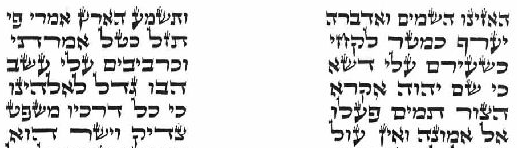
That’s indeed how our Torahs (see example pic at the top of this post) are structured - both Ashkenazi and Sephardi scrolls - in accordance to the Rambam’s account and we would expect that to be the case, as the Rambam had in his possession the prized Aleppo Codex - the most authoritative codex according to our tradition.

The Yemenite Jews have a handful differences in their Mesora of the Torah text, minor differences in the spellings but one very visible variance stands out. Their parshat Haazinu is written in 67 lines, unlike Ashkenazi and Sephardic scrolls.

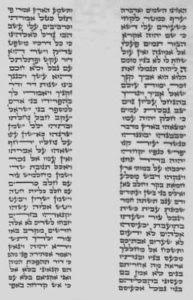
When looking closely, they have a different arrangement in three stanzas, which are merged together forming a longer, more squeezed, line. Because of that, the layout of their Haazinu column is much less homogenic and the “two towers” are not perfectly aligned. See a picture of the Yemenite tikkun:


We all know the Teimanim follow the rulings of the Rambam closely, which in turn begs the question - how do they reconcile their Mesora with the Rambam?

Let’s turn to the Aleppo Codex again. As I discussed elsewhere, this codex is attributed to the Masorete Ben Asher, and was salvaged from the Aleppo synagogue pillaging in the 1947 Arab protests against the establishment of the State of Israel..

The local Sephardi community guarded the Codex closely, and very few outsiders managed to find a way to look at it. One of the few was Humberto Cassuto, a famous scholar who wanted to investigate if this Codex was indeed the one attributed to the Ben Asher lineage. Professor Cassuto was granted limited access and couldn’t study it throughly, but he cast doubt at the provenance of the Codex because he saw that the Haazinu of the Codex had 67 lines, and not 70 lines as discussed in the Rambam’s Mishne Torah.

Many scholars started to investigate this finding. It turned out that the Yemenites have a different reading of the Rambam and in their manuscripts it states that Haazinu has 67 lines - just like Professor Cassuto observed in the Codex, except he wasn’t aware that his own Rambam’s edition was corrupted. The very feature Prof Cassuto found to be suspicious turned out to be the best proof of the authenticity of the Codex. An early manuscript of the Rambam from Oxford's collection has the same version as the Yemenites, and that's how Mechon Mamre has it in their online Rambam:
יא  צוּרַת שִׁירַת הַאֲזִינוּ (דברים לב,א-מג)--כָּל שִׁטָּה וְשִׁטָּה, יֵשׁ בְּאֶמְצָעָהּ רֵוַח אֶחָד כְּצוּרַת הַפָּרָשָׁה הַסְּתוּמָה, וְנִמְצֵאת כָּל שִׁטָּה חֲלוּקָה לִשְׁתַּיִם; וְכוֹתְבִין אוֹתָהּ בְּשֶׁבַע וְשִׁשִּׁים שִׁטּוֹת.  וְאֵלּוּ הֶן

Although almost all the Chumash part of the Codex was destroyed (or hid away, as claimed by Matti Friedman’s great book discussed here), the Haazinu pages observed by Prof Cassuto have survived and can be seen in the Israel Museum and online. See it here:


The Yemenites kept the Rambam’s proposed Mesora (save one puzzling, small variance towards the end of Haazinu in the stanza starting with "Gam Betula" which the Yemenites start with the preceding "Gam Bachur" - the similar words seemed to have caused this confusion but perhaps there's a better explanation I'm not aware of). 

The Ashkenazi and Sephardi did not, and there was an obvious attempt to cover up the discrepancy between their tradition (70 lines) and the Rambam’s (67), and while a few expert scholars (like 16th century Menachem di Lonzanu, in his popular work Or Torah - see here at the bottom) eventually noted conflicting versions of the Mishne Torah, this caused much confusion and eventually most scholars became convinced that the versions of the Mishne Torah with 67 lines were simply wrong because they didn't comply with the vast majority of the existing scrolls.

The Ashkenazi and Sephardi structure of 70 lines has its source in the Masechet Sofrim 12 (exact link here, where it states the first word of every line totaling 70), which is one of the handful small tractates found in the Babylonian Talmud and is generally attributed to the Gaonic period. Even though the Codex was housed in Aleppo - a major Sephardic center - for a very long time, the Sephardic world adopted the 70 line tradition which was the most prevalent and based their text in Rabbi Meir Aboulafia’s (who was an opponent of the Rambam) authoritative compendium Masoret Seyag Latorah - not the Aleppo Codex. Ironically, the Aleppo community guarded the Codex as its prized relic while following another Mesora for the Haazinu parsha (credit for the great Prof Marc Shapiro for this insight).

A few scholars have attempted to conduct studies of Torah Scrolls from different pre-war communities in regards to their Haazinu structure, in order to discover how prevalent was the 70 line structure. Scholars have found that there were more than two options - some scrolls had a little more than 70 lines while others fewer than 67, some had no unique structure at all, while others had Haazinu in the brick and mortar layout of Shirat Hayam! It seems like the scribes generally knew that Haazinu had a special layout but had limited knowledge of how to write the special structure.

The difficulty in regards to Haazinu stems from this Talmudic passage in Megillah:
אָמַר רַבִּי חֲנִינָא בַּר פָּפָּא, דָּרֵשׁ רַבִּי שֵׁילָא אִישׁ כְּפַר תְּמַרְתָּא: כּל הַשִּׁירוֹת כּוּלָּן נִכְתָּבוֹת אָרִיחַ עַל גַּבֵּי לְבֵינָה  חוּץ מִשִּׁירָה זוֹ וּמַלְכֵי כְנַעַן, שֶׁאָרִיחַ עַל גַּבֵּי אָרִיחַ וּלְבֵינָה עַל גַּבֵּי לְבֵינָה. מַאי טַעְמָא — שֶׁלֹּא תְּהֵא תְּקוּמָה לְמַפַּלְתָּן — 
Said Rabbi Hanina bar Pappa, Rabbi Shila, a man of the village of Temarta, expounded: all songs -- all of them -- are written a small brick (writing) above a brick (blank space), and a brick above a small brick, except this song (Sons of Haman) and [the song of] the kings of Canaan, which are a small brick above a small brick and a brick above a brick.
Note that Haazinu is not mentioned as one of the exceptions, and you could infer from this passage that Haazinu should be written like all other songs - in a brick and mortar fashion! That is the likely explanation of why some older scrolls have this feature - perhaps some scribes based themselves in the simple understanding of this Gemara. The Noda Biyuda discusses the Halachic status of this layout and based on this understanding he tries to find a way to not invalidate these scrolls. See below how a Haazinu in brick-and-mortar shape would look like:

However, the Masechet Sofrim is categorical, and clearly states that Haazinu is not to be written like Shirat Hayam, and that's the normative Halacha - even though the Masechet Sofrim is from the Gaonic period and hence, theoretically less authoritative than the Talmud which seems to imply that Haazinu should be written like all songs - in brick and mortar layout.

Professor Mordechai Breuer, one of the leading experts of the Aleppo Codex, attempted to harmonize the Talmudic passage above with the ruling of the Masechet Sofrim by developing the idea that Haazinu is not a real Song/Shira, and therefore not the subject of the Talmud's discussion above. In other words, Haazinu is in a category of its own and it's unlike Shirat Hayam, Bnei Haman and Shirat Devorah (see here page 23 for further discussion and a great resource in this topic).

The complexity of this Talmudic passage is the best explanation of why there's not one single option when it comes to writing Haazinu - the Talmud is ambigious and the scribes had a tough time getting it right.

However, scholarly research has shown that in both Ashkenazi (Prof Goshen-Gottstein) and Italy (see Prof. Orlit Kolodny here with more details), the most common layout was undoubtedly the 70 line structure, as per the Masechet Sofrim. Less than 10% of the 250+ scrolls surveyed have the 67 layout, which means that the Rambam/Yemenite Mesora was actually not very popular. While the Rambam tried to push for the 67 Mesora in his very detailed account of how Haazinu should be written, it seems clear that already in his time this Mesora was not dominant and his initiative did not gain much traction in the wider Jewish world. The fact that the Rambam's manuscript was censored to conform with the 70 line Mesora is an indication that there was a push back to the Rambam's directive, and the censorship (see more about this in Prof Marc Shapiro's "Changing the Immutable") was a very efficient way to safeguard the prevalent Mesora of the Masechet Sofrim - it even fooled an expert scholar like Prof Cassuto.

Friday, October 18, 2013

Column 1 of 214

I will be posting each column here, and I'm happy to hear feedback. In the third day, it's missing a few words, which I will complete soon. Also some blurbs of ink here and there, but all in all I'm happy I got to this first milestone.
Although in the picture it looks like everything it's slanted that's an illusion - if you zoom you can see the sirtut.
I had difficulty in the beginning but now my writing is going smooth, specially in the second half of the column. I perfected my Aleph in that section, which now is more straight (I want to avoid "wavy" Alephs; I prefer straight lines).
Shabbat Shalom

Tuesday, December 18, 2012

The Aleppo Codex: Book Review from a Scribe's Perspective

I've been meaning to write about the Aleppo/Ben Asher Codex for a long time. Now that Matti Friedman came out with a masterpiece book on this topic, I will try my best to write about how this Codex is very relevant for Safrut enthusiasts and scribes in particular.

Briefing

Until now I had only seen books on this subject from scholars, aimed for the academic audience. Matti's book is a mainstream book written like a thriller, so it's a very enjoyable and easy read. Matti is careful to create an interesting story line while sticking to the facts and stating his sources in the appendix, chapter by chapter. He successfully provides the full context in which the fabulous story of the Codex took place and goes back and forth in time delving into the historical relevance of the book and also how it affected so many different people and communities throughout its existence.

The Story (short version + spoliers)

The Ben Asher Codex was written sometime in the 10th century c.e., in Tiberias while the  Masoretes were focusing in gathering and establishing the Mesora of vowels, words and missing letters of the Torah. Aaron Ben Asher was the prince of the Masoretes and his codex was widely believed to be the most accurate ever produced, an opinion shared by Maimonides when he saw this book in his own desk in Fustat some centuries later.

The Codex eventually was brought to the Aleppo community, where it was guarded for many centuries until the Arab riots following the creation of the State of Israel. That's when Matti's book gets more interesting.

In 1958, the Aleppo Rabbis sent the Codex with Faham, who was fleeing to Israel via Alexandretta (Turkey). Faham was supposed to give the Codex to the head of the Syrian community in Israel but instead, he gave it to the head of the Aliya Department, Shragai, who gave it to the then President of Israel, Ben Tzvi, a turn of events that triggered a court case a few years later.

The big question discussed in Matti's book is the fact the only about 65% of the Aleppo Codex is in possession of the Ben Zvi Institute in Israel today. What happened to the rest? Interesting to note that the missing pages pretty much cover the whole Bible part of the Codex - the most important section. What we have today is pretty much most of Book of Prophets (Neviim) and Book of Writings (Ketuvim).

To summarize Matti's research, all the possibilities are narrowed down to two options. Either the agent of the Aliya Department in Alexandretta stole the missing parts from Faham, who publicly complained he had been robbed there. Or the Codex was received by President Itzhak Ben Zvi in its entirety but after it was stored in the Institute, someone stole it - other very important manuscripts were reported missing in the early days of the Institute. These two possibilities were and still are potentially very embarrassing for the Israeli authorities so the Institute did their best to cover-up and have always adopted the version that the missing parts were lost in the mob of the Aleppo synagogue, a version that is conclusively not true according to Matti. He also brings good evidence that the missing parts were actually in the manuscript black market as late as 1985, in a colorful story featuring the Bukharian jeweler Shlomo Moussaief (see here a NYT Magazine article based on Matti's book with some additional reporting)

Sample page of the Aleppo Codex
Halachic Status of the Aleppo Codex

The Rambam (Maimonides) explicitly pushed for the usage of the Aleppo/Ben Asher Codex, and here you can see verbatim:

:(משנה תורה" (הלכות ספר תורה פרק ח הלכה ד"
וספר שסמכנו עליו בדברים אלו הוא הספר הידוע במצרים שהוא כולל ארבעה ועשרים ספרים שהיה בירושלים מכמה שנים להגיה ממנו הספרים ועליו היו הכל סומכין לפי שהגיהו בן אשר ודקדק בו שנים הרבה והגיהו פעמים רבות כמו שהעתיקוּ ועליו סמכתי בספר התורה שכתבתי כהלכתו


Although the Rosh argues on the Rambam in regards to the layout of the "open" and "closed" Parshiot (see my post about this here), the Shulchan Aruch ruled that if it's impossible to write it in a universal layout, which both Rambam and Rosh will agree, one should follow the Rambam because he had the Aleppo/Ben Asher Codex in his possession and based his opinion on this Codex, which is superior to all others. Therefore the opinion of the Rosh is "overruled" by the Ben Asher Codex.

After the Ben Asher Codex found its way to Aleppo, the community safeguarded it as a holy relic and effectively made it impossible for other communities to fully study it, so its unique features remained unnacessible for the Ashkenazi scribes by and large throughout the centuries.

Halachic Implications of the Codex

As the years passed, the Ben Zvi Institute made the Aleppo Codex available for the public and recently many groups started to push its adoption for the scrolls of the Na"ch. The Aleppo Codex differs from the traditional layout used in Megillat Esther, for instance, and that alone would be a significant controversy since all Jewish communities use this scroll in Purim for public readings, and any change would no doubt bring disputes.

But aside from the Megillat Esther issue, some communities have custom of reading the Shabbat's Haftarot from scrolls and adopting the Aleppo Codex would also bring disputes. This custom was instituted by the Gr"a, one of Judaism's brightest minds, and anybody living in Jerusalem has seen this numerous times - many of the early settlers of Jerusalem were disciples of the Gr"a and in general, the holy city follows his customs. The Gr"a instructed the scribes to use what is known in the field as the Berditchev tikkun layout, a puzzling book that doesn't conform with the Aleppo Codex layout in the Neviim and Ketuvim.

So in no time, there was a battle between the Jerusalem-based disciples of the Gr"a, who always wrote their Na"ch scrolls according to the Gr"a's Berdichev tikkun versus Bnei Brak, one of Israel centers of Torah learning and a city who generally doesn't follow the Gr"a customs. The Bnei Brak-based groups favored the use of the Aleppo Codex, as it is undeniably the most accurate one.

So any scribe trying to buy a Tikkun, his personal codice to guide him in layout and spelling, will find different options depending where he goes. In Jerusalem, the shops will usually sell Tikunim following the instructions of the Gr"a while in Bnei Brak you will see some Aleppo Codex options too. But even more than that, there's a war of words betweeen the two camps, and when I got my Tikkunim, I snapped some pictures from both sides' claims. See below, the first two are from Talmidei HaGra and the last is from the Aleppo Codex backers.


So as you see, the 65% of what we have from the Crown already brought considerate challenges and disputes in the Safrut world and not all have backed its adoption. You can only begin to imagine what would've happened if we had all the Codex, more specifically , the Bible part. While the usage of scrolls for Na"ch is limited, all Jewish communities and synagogues have numerous Torah scrolls and continue to write new ones every day. If the Aleppo Codex for the Bible would be available, I anticipate that we would have a similar, but much more heated war of words and I wonder how many communities would start adopting the Aleppo Codex for their own scrolls.


Sunday, September 27, 2009

The Two Columns of Shirat Haazinu

The Mitzva of writing a Sefer Torah comes from this past week's Parsha, Haazinu. In the preceding Parsha, G-d says to Moshe that the Jews should "write this song", in a reference to Haazinu, one of the Torah's two songs (the other one is Az Yashir). Although the commandment refers only to Haazinu the commentators note that it's prohibited to divide the Torah and write it in a form of "megillot, megillot" i.e. in fragments, since all the Torah is one. So the commentators all conclude that the commandment must have been to write the whole Torah, which will contain the song of Haazinu.

This highlights how important this intricate song is in relation to the whole Torah.

Also aesthetically, Haazinu stands out with its special two-column layout. In the modern Torahs, the two columns are perfectly even, like two towers, and usually are two pages long. I wanted to post a picture of the whole thing but I only found this one:

We find the same layout in the Megillat Esther, in which the ten sons of Haman are listed in the same fashion. Like in Haazinu, most sofrim (not me!) stretch the letters so every column will start and end in the same place:


But if you look in the old Torahs and in the Torahs of the Yemenite Jews you will see that the columns there aren't uniform at all. Below is a picture from a Yemenite tikkun:


I guess the Ashkenazi sofrim took the liberty to strectch the lines in order to make the scrolls look nicer, on the grounds of "zeh keli veanveiu".

But there's another thing that really puzzled me. Aside from the layout, the Yemenite scrolls also differ in the actual poem structure and that's the real reason why their columns aren't simetrical - there are less lines and thus some of the lines are longer.

For instance, look in the 17th line in the above picture, "zechor yemot olam.." - this is a long line. In the Ashkenzai scrolls this long line is divided in two, enabling our sofrim to justify the lines. Now that's odd! There are two other places where there's a difference in the poem structure but I will leave it for you to figure it out.

Which is the right structure?

That's where the Aleppo Codex comes to the scene. This is a topic for another post, but it suffices to say that the Aleppo Codex, guarded by the Aleppo Jews until 1948, is the most accurate Tikkun ever. Unfortunately, this Tikkun only covers the Nach; the Torah pages were mysteriously lost in a Arab riot in Aleppo. That is, all the Torah pages were lost besides..... that's right, the pages of Shirat Haazinu! And if you guessed that the Yemenite scrolls are identical to it, you are right. I got this image from the Aleppo Codex website:


This would imply that the Ahskenazi structure of Shirat Hazinu is problematic. Halacha says that if there's a pause (parsha setuma or petucha) in a wrong place, this will invalidate a Sefer Torah. If the Ashkenazi scrolls have a different poem structure, some of the open spaces are in the wrong place!

The answer is simple: the open spaces in Shirat Haazinu (and Az Yashir) are not open and separate Parshas, but a special layout of a song. The halachot of Parsha Petucha and Setuma don't apply here and whatever layout you have - Yemenite or Ashkenazi - will be Kosher for all intents and purposes. So although it's clear that the Yemenite arrangement is more reliable, you should not start complaining about our modern-day structure.

This is the story of the layout of Shirat Haazinu. I hope you enjoyed and I wish you a Gmar Hatima Tova!

Monday, April 13, 2009

Petuchot and Setumot


This is one of the most hotly debated topics of Safrut and I just want to write a little bit about the basics and how this subject impacts us today. Although this is a longer-than-usual post, I can safely say it's my most important piece so far in this blog, since it has a direct impact in two daily Mitzvot - Mezuza and Tefillin.

The Basics
The Torah is comprised of many parshiot, or "segments", which can be connected to each other in two ways, in a "Setuma" (סתומה) layout or in a "Petuha" (פתוחה) layout. The Rambam and the Rosh discuss what's the exact layout of Setuma and Petuha and in many instances what is a Parsha Stuma for the Rosh is a Petuha for the Rambam.

The two instances where they disagree are the following:

  1. According to the Rambam, whenever a Parsha starts in the middle of the line that will be considered a Parsha Setuma. The Rosh will say the opposite - according to him this is the layout of a Parsha Petuha.
  2. According to the Rambam, whenever a Parsha starts in the beggining of the line that is the Parsha Petuha. The Rosh says that this is a Parsha Setuma.
The best way to visualize this discussion is by taking a look at the Mezuzot of the Ashkenazim and the Sephardim. As you will see in the next section of this post, the Talmud says that the Mezuzot must have a Setuma layout and the Sephardic Jews write it like the opinion of the Rambam (see pic below). According to the Rosh, this is actually a Parsha Petuha layout !


The Poskim say that the Sofer must try to write the פרשיות in the two layouts in which there's no debate ("universal layouts"), in order to follow both the Rambam and Rosh. There are two universal layouts - one Petuha and one Setuma - and you can identify them in the picture in the right. The "space" at the top is a universal Parsha Petuha while the "space" at the bottom of this picture is a universal Setuma.

Today, all the sofrim don't have to worry about these layout issues since they have the luxury of copying it from spotless computerized Tikkunim, so all Sifrei Torah today have the universal Petuchot and Setumot, which is great. But until recently the sofrim didn't have such great Tikkunim and they occasionally had to use a non-universal layout.

If a Sofer is forced to use a non-universal layout the Rema notes that he should not stray away from the opinion of the Rambam, since he had a very reliable Tikkun in his possession. Most scholars say that this Tikkun is the Aleppo Codex, and I hope I can write a more about this codex in the future.

Impact in the Modern Day Mezuzot

As I introduced in the previous section, the Rambam vs. Rosh discussion has a direct impact in the layout of our מזוזות. The Mezuza has two Parshiot - Shema and Vehaia - and the Talmud says that they must be connected in a Setuma layout. You would think that we again use the "universal" Setuma layout in a Mezuza but that's not the case and that's when this whole subject becomes really interesting. The Sephardim, expectedly, follow the non-universal Setuma of the Rambam and they are "safe", since they have no business with the Rosh's shita. But for the Ashkenazim is really tricky and here is why.

Until some 300 years ago, if one would open an Ashkenazi Mezuza he would see a very odd layout, that would not conform with ANY of the main opinions. Basically, the Parshiot were written without any pause, almost like the two parshiot were in fact one. Although this was a very established Minhag, many Halachic authorities sought to fix the problem and choose an alternative layout. There were two main solutions proposed, one by the Taz (Turei Zahav) and another, more "radical", by the another leading Rabbi (can't remeber the name now..).

The Taz's proposal, which changed the established Minhag just a little and allegedly was good both for the Rosh and Rambam's opinions, was widely accepted by the Ashkenazi Jews and it has emerged to become the standard layout which we use until this very day. You can see the modern day Ashekenazi (left) and Sephardi (right) Mezuzot in the pics below.


There's a third solution, proposed by the Mahari Abuhab, which is very interesting and worth to mention. He proposed the most obvious solution: to use the universal Setuma layout, thus solving all the problems. No one really accepted this solution, and the Shach (יו"ד סימן רפח סק"י) speculates that there is Mesorah that disctates all the words which are line-headers. According to the Mahari Abuhav, the line of the second Parsha will not start with "Vehaia", like the Ashkenazi and Sephardi Mezuzot, but with the word "Mitzva" (see pic below). That might explain why people didn't follow this opinion. Rabbi Moshe Feinstein explores this topic in more depth in יו"ד סימן ק"פ.


I find it strange that the Ashekenazi Jews don't write the Mezuza in the way the Sephardim do, in accordance to the Rambam's shita. After all, the Rema did say that when in doubt the opinion of the Rambam should be followed, and here in Mezuza I would think the same rule applies. I guess the Ashkenazim were hesitant to completely refuse their old Minhag and preferred the Taz's solution, which is a slight amendment to the Mezuza layout they already had.

Impact in Modern Day Tefillin

While the Petuhot/Setumot topic has great revelance to Mezuza, its relevance to Tefillin is even greater. If a Mezuza wasn't written in a proper Setuma way, the Mezuza is still Kosher "bedieved". In Tefilin, it's more problematic - if a Tefillin doesn't have this Setuma layout, the Tefilin are potentially Pasul!

Like in Mezuza, the Sephardim do the Setuma layout like the Rambam, so once again they're safe. Most of the Ashkenazim follow once again the solution of the Taz, but I've heard of many Hassidim who are Makpid in following the Rambam in the Tefilin layout because of the above-mentioned stringency. From my personal research, even tough these groups have Rambam Tefillins, their Mezuzot are written according to the Taz, a rather ironic fact. In my humble opinion both Mezuzot and Tefillin should be written in the same Setuma way - be it like the Rambam or like the Taz - but that is the least of my "problems":

I've heard that some "Briskers" wear two Rashi Tefillin - one according to the Taz and another one according to the Rambam, just to be safe. Now that's really odd. If you would (theoretically) be a Chassidish Brisker you would probably wear two Rashi Tefillins (Rambam +Taz) and two Rabbeinu Tam Tefillins (Rambam+Taz)!

Now I understand better what they say in the name of the Gaon - that we would have to own over 70 pairs of Tefillin if we wanted to be "yotze" all the opinions.

Another Important Discussion

I didn't even mentioned the "Breuer" factor - the recent debate about the Petuchot and Setumot found in the Aleppo Codex, extensively explored by the late Rabbi Breuer. That's a whole different story, and it's difficult to fully understand it before knowing the basics of Setuma and Petuha Parshiot, which you hopefully do know by now. I will get into this in another opportunity. Gitten Tzimmer!