Showing posts with label antique. Show all posts

Tuesday, December 18, 2012

The Aleppo Codex: Book Review from a Scribe's Perspective

I've been meaning to write about the Aleppo/Ben Asher Codex for a long time. Now that Matti Friedman came out with a masterpiece book on this topic, I will try my best to write about how this Codex is very relevant for Safrut enthusiasts and scribes in particular.

Briefing

Until now I had only seen books on this subject from scholars, aimed for the academic audience. Matti's book is a mainstream book written like a thriller, so it's a very enjoyable and easy read. Matti is careful to create an interesting story line while sticking to the facts and stating his sources in the appendix, chapter by chapter. He successfully provides the full context in which the fabulous story of the Codex took place and goes back and forth in time delving into the historical relevance of the book and also how it affected so many different people and communities throughout its existence.

The Story (short version + spoliers)

The Ben Asher Codex was written sometime in the 10th century c.e., in Tiberias while the  Masoretes were focusing in gathering and establishing the Mesora of vowels, words and missing letters of the Torah. Aaron Ben Asher was the prince of the Masoretes and his codex was widely believed to be the most accurate ever produced, an opinion shared by Maimonides when he saw this book in his own desk in Fustat some centuries later.

The Codex eventually was brought to the Aleppo community, where it was guarded for many centuries until the Arab riots following the creation of the State of Israel. That's when Matti's book gets more interesting.

In 1958, the Aleppo Rabbis sent the Codex with Faham, who was fleeing to Israel via Alexandretta (Turkey). Faham was supposed to give the Codex to the head of the Syrian community in Israel but instead, he gave it to the head of the Aliya Department, Shragai, who gave it to the then President of Israel, Ben Tzvi, a turn of events that triggered a court case a few years later.

The big question discussed in Matti's book is the fact the only about 65% of the Aleppo Codex is in possession of the Ben Zvi Institute in Israel today. What happened to the rest? Interesting to note that the missing pages pretty much cover the whole Bible part of the Codex - the most important section. What we have today is pretty much most of Book of Prophets (Neviim) and Book of Writings (Ketuvim).

To summarize Matti's research, all the possibilities are narrowed down to two options. Either the agent of the Aliya Department in Alexandretta stole the missing parts from Faham, who publicly complained he had been robbed there. Or the Codex was received by President Itzhak Ben Zvi in its entirety but after it was stored in the Institute, someone stole it - other very important manuscripts were reported missing in the early days of the Institute. These two possibilities were and still are potentially very embarrassing for the Israeli authorities so the Institute did their best to cover-up and have always adopted the version that the missing parts were lost in the mob of the Aleppo synagogue, a version that is conclusively not true according to Matti. He also brings good evidence that the missing parts were actually in the manuscript black market as late as 1985, in a colorful story featuring the Bukharian jeweler Shlomo Moussaief (see here a NYT Magazine article based on Matti's book with some additional reporting)

Sample page of the Aleppo Codex
Halachic Status of the Aleppo Codex

The Rambam (Maimonides) explicitly pushed for the usage of the Aleppo/Ben Asher Codex, and here you can see verbatim:

:(משנה תורה" (הלכות ספר תורה פרק ח הלכה ד"
וספר שסמכנו עליו בדברים אלו הוא הספר הידוע במצרים שהוא כולל ארבעה ועשרים ספרים שהיה בירושלים מכמה שנים להגיה ממנו הספרים ועליו היו הכל סומכין לפי שהגיהו בן אשר ודקדק בו שנים הרבה והגיהו פעמים רבות כמו שהעתיקוּ ועליו סמכתי בספר התורה שכתבתי כהלכתו


Although the Rosh argues on the Rambam in regards to the layout of the "open" and "closed" Parshiot (see my post about this here), the Shulchan Aruch ruled that if it's impossible to write it in a universal layout, which both Rambam and Rosh will agree, one should follow the Rambam because he had the Aleppo/Ben Asher Codex in his possession and based his opinion on this Codex, which is superior to all others. Therefore the opinion of the Rosh is "overruled" by the Ben Asher Codex.

After the Ben Asher Codex found its way to Aleppo, the community safeguarded it as a holy relic and effectively made it impossible for other communities to fully study it, so its unique features remained unnacessible for the Ashkenazi scribes by and large throughout the centuries.

Halachic Implications of the Codex

As the years passed, the Ben Zvi Institute made the Aleppo Codex available for the public and recently many groups started to push its adoption for the scrolls of the Na"ch. The Aleppo Codex differs from the traditional layout used in Megillat Esther, for instance, and that alone would be a significant controversy since all Jewish communities use this scroll in Purim for public readings, and any change would no doubt bring disputes.

But aside from the Megillat Esther issue, some communities have custom of reading the Shabbat's Haftarot from scrolls and adopting the Aleppo Codex would also bring disputes. This custom was instituted by the Gr"a, one of Judaism's brightest minds, and anybody living in Jerusalem has seen this numerous times - many of the early settlers of Jerusalem were disciples of the Gr"a and in general, the holy city follows his customs. The Gr"a instructed the scribes to use what is known in the field as the Berditchev tikkun layout, a puzzling book that doesn't conform with the Aleppo Codex layout in the Neviim and Ketuvim.

So in no time, there was a battle between the Jerusalem-based disciples of the Gr"a, who always wrote their Na"ch scrolls according to the Gr"a's Berdichev tikkun versus Bnei Brak, one of Israel centers of Torah learning and a city who generally doesn't follow the Gr"a customs. The Bnei Brak-based groups favored the use of the Aleppo Codex, as it is undeniably the most accurate one.

So any scribe trying to buy a Tikkun, his personal codice to guide him in layout and spelling, will find different options depending where he goes. In Jerusalem, the shops will usually sell Tikunim following the instructions of the Gr"a while in Bnei Brak you will see some Aleppo Codex options too. But even more than that, there's a war of words betweeen the two camps, and when I got my Tikkunim, I snapped some pictures from both sides' claims. See below, the first two are from Talmidei HaGra and the last is from the Aleppo Codex backers.


So as you see, the 65% of what we have from the Crown already brought considerate challenges and disputes in the Safrut world and not all have backed its adoption. You can only begin to imagine what would've happened if we had all the Codex, more specifically , the Bible part. While the usage of scrolls for Na"ch is limited, all Jewish communities and synagogues have numerous Torah scrolls and continue to write new ones every day. If the Aleppo Codex for the Bible would be available, I anticipate that we would have a similar, but much more heated war of words and I wonder how many communities would start adopting the Aleppo Codex for their own scrolls.


Sunday, April 22, 2012

Writing on Red Gvil!

My posts are usually concise write-ups about Halacha discussions. This post is different - an open and honest account of my first time writing in Gevil parchement, opposed to the standard Klaf parchement used in all scrolls today. 


For quite a few months already, I have had this obsession of getting a Gvil to write on. It's really difficult to purchase one - I tried Mea Shearim safrut stores, Machon Gvil, fellow Sofrim, to no avail. I eventually saw Binyamin's posts about writing in a Yemnite-style red gvil and I asked him for assistance. He said he would send me a sample so I can have an idea, but being that he is a busy man, many months have passed and I gave up on it.


Just before Pessach I received this tube from the mail with a small but beautiful red gvil, a bottle of carbon ink, a very good reed and a note from Binyamin, excusing himself for the delay. No need to excuse - you made my day.


It turns out that the small piece of Gvil was perfect for a Menorah-shaped Lamnatzeach, which I spoke about in depth in my last post. As we have seen, this is a kabbalistic piece with a very specific connection to Sefirat Haomer, so the timing was perfect - I wrote it just before Pessach.


So I made the sirtut, evenly spaced and couldn't wait to start writing. Although I had a carbon-ink of my own - DioLanetzach - I wrote with Binyomin's ink as he advised me. After all, I know absolutly nothing about this parchement so I prefer not to take risks.


I start writing. The letters are all smudging and i can't get it right. I was sure I messed up this Gvil, which I waited so long to write on. But you will not believe what was my mistake - I'm even embarassed to admit. Well... being that I always wrote on klaf, I always instinctivaly take the klaf and start writing in the inside side - i don't even think. In my rush to get the Lamnatzeach ready, I did the stupiedest mistake possible - I wrote in the klaf-like side of the Gvil, which is the wrong one. I knew that. You must write in the outside layer, which in this klaf is super shiny and sooth. That's what I call starting with the left foot.


So I turn the gvil and must start doing all the sirtut again! Duh! But once I start writing - in the correct side - it all feels right. The ink flows well, the reed is steady and most importantly, the Gvil is unbelievably smooth and pleasant to write on. I couldn't stop thinking how cool it was to write in the way Moshe Rabbeinu wrote his Torah Scolls (yes, he used Gevil). The less strentgh you apply, the better is the result. As I had absolutly no training for writing in this way, I was learning as I was writing. It was similar to writing in Klaf but not the same. To illustrate the difference, it's like playing tennis in clay and then playing in a hard court. You must adjust your swing and many plays come out differently. In short:


  • The Gvil is very shiny and in my opinion, more beautiful than the Klaf. The redness of this Gvil gives that “deluxe” feeling that is hard to match.
  • The parchment is incredibly smooth. Perhaps because of how the leather treated, I’m not sure, but this feature really stands out.
  • Also, the actual writing must be done in a much more smooth way, almost like painting a canvas. You need simple, precise strokes and unlike the klaf, you rarely need to add ink in the letters or work on them too much.
  • I wrote with a thin bamboo reed and it was tricky to get the flow of the ink right. I eventually adapted and found my way, but again, the actual cutting of the reed differs from feather.
  • The letters dry in a matter of seconds, while in the Klaf it can take more than a few minutes.
  • The reed is not as sharp as a feather and the writing has a simpler look, with less details and strokes. For instance, I could only make simple, bare Taguin, as opposed to the usual Zayin-shaped Tagim.
  • Overall, I would say it’s easier to write in Gvil with a reed because the writing flows easier and you can write quicker.


It was late in the night already but I managed to finish the work. But I had one big mistake - I forgot the Yud of Elokim, one of the names of Hashem. Aside from that the symmetry of the Menorah wasn't perfect and I wanted to correct a few words to make it right.

But how do you erase a letter?? Hum.. scraping I thought. So I tried to scrape a small extra Tag I made by mistake and I immediatly see that this ruins the parchement and makes re-writing on it impossible. I email Binyomim and he says to erase with cottom-bud and water. Water! The #1 enemy of the Klaf is used to fix mistakes in the Gvil - intriguing. And by then I'm thankul I didn't use Dio Lanetzach, which is water resistant and therefore unusuble in Gevil! As mentioned in the Keset Hasofer, you are alowed to erase the Mem Sofit from the word Elokim and rewrite the forgotten Yud + a new Mem since this word is not a Shem if it has no Yud. The erasing was easy and re-writing is very easy and quick, unlike in Klaf which takes work and very much attention. Below, the pics I took before my corrections:


Wednesday, January 20, 2010

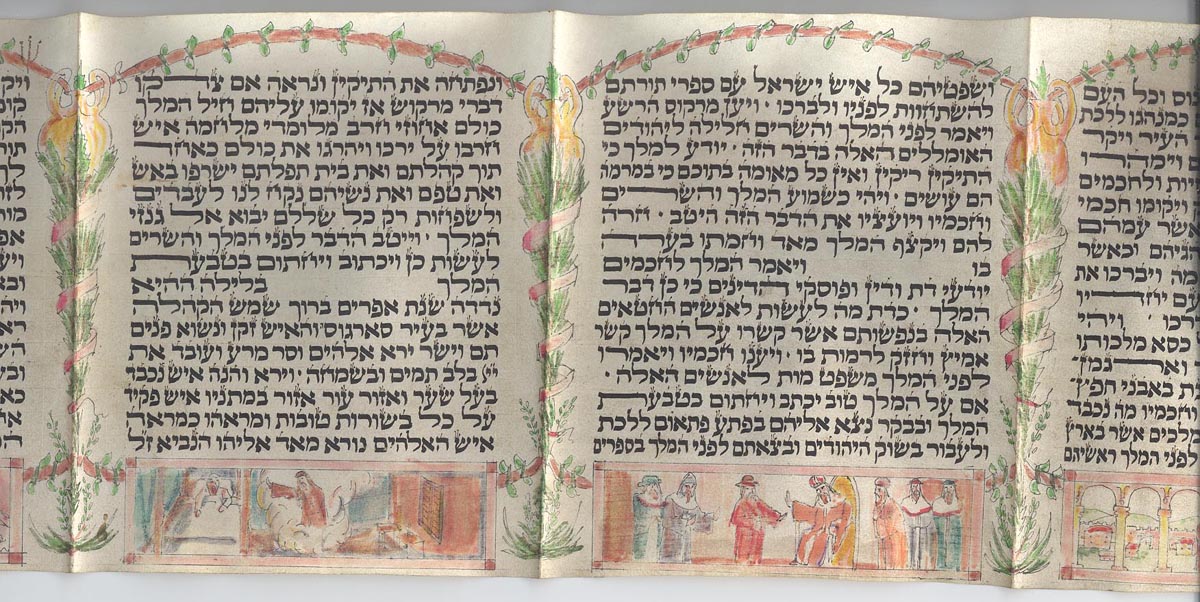
Amazing Megillot #7: Iraqi Esther Scroll

I came across this beautiful Esther Scroll from Iraq. It's a very special piece, with symmetric motifs and splendid coloring. Written in Veilish, the Sephardi version of Ktav Ashurit.
Full disclosure:

Esther Scroll

Published References: The Jewish Museum. THE JEWISH MUSEUM AT 75. Commemorative album. New York: The Jewish Museum, New York, 1980, Color ill.


Sunday, November 29, 2009

Amazing Megillot #6: Sotheby's Important Judaica Auction

In my previous post I wrote about Sotheby's Sefer Torah auction, which pocketed 398,500 (the estimate was 300,000 to 500,000). But there were a few interesting Megillot being auctioned as well and I singled out three of them.

Firstly, the allegedly "earliest complete decorated Esther Scroll" (Venice, 1562). It was sold for a whooping U$ 600,000, making it the most expensive item sold in Sotheby's auction. I personally cannot understand why would someone favor this Megilla over the above-mentioned Sefer Torah from the 13th century, but bottom line is that this Megilla is surely unique. Every column starts with only one, large-type, word and subsequent 22 lines. From a Safrut perspective these top large words are not desirable but it doesn't causes the scroll to become Pasul. (click in the image to enlarge)


Next is a magnificent Megilla from Prague, 1700's, decorated by Jean-Paul Franck. From the catalogue: "Additionally, nude, half-length female figures emerge from scrolling foliate vines and peacocks, perched in naturalistic poses create a theatrical, albeit unrelated, backdrop to the Hebrew text." This is odd but not uncommon in old Megillot, unfortunately. Sold for U$ 134,500.
And finally, this Megilla from Italy, 19th century, sold for U$ 43,750.

Saturday, November 21, 2009

Sotheby's Sefer Torah Auction

Menachem Butler pointed me to Sotheby's Important Judaica auction which will take place in just a few days. One of the Auction's highlights is a complete Spanish Sefer Torah from the 13th century and in Sotheby's catalogue there's a very interesting write-up detaling the origin and the style of this Torah. For Safrut fans, this is a delightful read that expounds the sources and Minhagim of writing the extra Taguim in Torah Scrolls, as per the ancient Sefer Hataguim.

One of the key traits of this Sefer is the fact that it didn't originally have the Taguim in all Shatnez Getz letters thorought the scroll but a later scribe added these taguim, in conformity with the present day Minhag. The original Sofer followed the opinion of the Rambam, which holds that only Mezuzot need Taguim in all Shaatnez Getz letters, and the later Sofer added them because over time all Bnei Israel started to use the Shaatnez Getz taguim in Torah Scrolls.

I encourage you to read the whole report, it's a real eye-opener. Here's the link for the article, and here's the link for the pdf-presentation with pictures.

Sunday, September 27, 2009

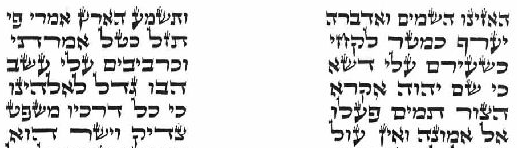
The Two Columns of Shirat Haazinu

The Mitzva of writing a Sefer Torah comes from this past week's Parsha, Haazinu. In the preceding Parsha, G-d says to Moshe that the Jews should "write this song", in a reference to Haazinu, one of the Torah's two songs (the other one is Az Yashir). Although the commandment refers only to Haazinu the commentators note that it's prohibited to divide the Torah and write it in a form of "megillot, megillot" i.e. in fragments, since all the Torah is one. So the commentators all conclude that the commandment must have been to write the whole Torah, which will contain the song of Haazinu.

This highlights how important this intricate song is in relation to the whole Torah.

Also aesthetically, Haazinu stands out with its special two-column layout. In the modern Torahs, the two columns are perfectly even, like two towers, and usually are two pages long. I wanted to post a picture of the whole thing but I only found this one:

We find the same layout in the Megillat Esther, in which the ten sons of Haman are listed in the same fashion. Like in Haazinu, most sofrim (not me!) stretch the letters so every column will start and end in the same place:


But if you look in the old Torahs and in the Torahs of the Yemenite Jews you will see that the columns there aren't uniform at all. Below is a picture from a Yemenite tikkun:


I guess the Ashkenazi sofrim took the liberty to strectch the lines in order to make the scrolls look nicer, on the grounds of "zeh keli veanveiu".

But there's another thing that really puzzled me. Aside from the layout, the Yemenite scrolls also differ in the actual poem structure and that's the real reason why their columns aren't simetrical - there are less lines and thus some of the lines are longer.

For instance, look in the 17th line in the above picture, "zechor yemot olam.." - this is a long line. In the Ashkenzai scrolls this long line is divided in two, enabling our sofrim to justify the lines. Now that's odd! There are two other places where there's a difference in the poem structure but I will leave it for you to figure it out.

Which is the right structure?

That's where the Aleppo Codex comes to the scene. This is a topic for another post, but it suffices to say that the Aleppo Codex, guarded by the Aleppo Jews until 1948, is the most accurate Tikkun ever. Unfortunately, this Tikkun only covers the Nach; the Torah pages were mysteriously lost in a Arab riot in Aleppo. That is, all the Torah pages were lost besides..... that's right, the pages of Shirat Haazinu! And if you guessed that the Yemenite scrolls are identical to it, you are right. I got this image from the Aleppo Codex website:


This would imply that the Ahskenazi structure of Shirat Hazinu is problematic. Halacha says that if there's a pause (parsha setuma or petucha) in a wrong place, this will invalidate a Sefer Torah. If the Ashkenazi scrolls have a different poem structure, some of the open spaces are in the wrong place!

The answer is simple: the open spaces in Shirat Haazinu (and Az Yashir) are not open and separate Parshas, but a special layout of a song. The halachot of Parsha Petucha and Setuma don't apply here and whatever layout you have - Yemenite or Ashkenazi - will be Kosher for all intents and purposes. So although it's clear that the Yemenite arrangement is more reliable, you should not start complaining about our modern-day structure.

This is the story of the layout of Shirat Haazinu. I hope you enjoyed and I wish you a Gmar Hatima Tova!

Tuesday, July 14, 2009

Otiot Meshunot - Odd Letters of the Torah

In the Torah scrolls of today, there are very few scribal oddities and it's not so hard to single them out:
  • Large and small letters - example: the large Bet of the word Bereshit.
  • The inverted Nuns in the Parsha of Vayehi Binsoa.
  • The splitted Vav in the word "Shalom", in last week's Parsha.
  • Dots on top of specific words like "Hanistarot Lashem".
However, many old Sifrei Torah have many more oddities that are no longer in use today (see images). One of the most famous examples is the Peh Melufaf, which is still in use in the Teimani scrolls, and the Torah Shlema has an extensive list of these less popular odd letters. Also, there are numerous additional tagim that are often times mentioned by popular commentators like the Baal Haturim that also fell is disuse. 

 The Meiri compiled a very detailed work (Kriat Sefer) on the odd letters, depicting the oddities of the Torahs of his time. A more contemporary Sefer was written by the Badei Aharon roughly 150 years ago. There of course the ancient Sefer HaTagin (see image) , which according to tradition was copied by Eli HaCohen from the 12 stones of Yehoshua Bin Nun over two thousand years ago.

What are these letters? 

Various Geonim, Rishonim and Achronim have mentioned these letters and among them, the Rambam simply says that this is a very old tradition that should be observed. Few elaborate on the reason behind these oddities but the fact is that there was such a tradition and at some point this tradition was lost. But before the Second World War there was this "in-between" period where some communities accepted this tradition while others were very critical of it, arguing that this tradition was rather unreliable. This controversy gathered more attention when an old Torah scroll written by Beit Yehuda, a famous rabbi, was found to have numerous otiot meshunot. 

Also the first Rebbe of Zanz reportedly wrote his Sefer Torah with unusual Otiot Meshunot, and in both cases even those who didn't approve this Minhag were afraid to say bad about these Torahs, given their exceptional importance. 

 Following the devastating events of the Holocaust, few antique Torah Scrolls remained intact and the Mesora of the odd letters was wiped out alongside with the European shtetls. This topic is of special interest to me since I'm planning to start writing my own Sefer Torah soon. All these scribal oddities are so interesting and did feature in the Sifrei Torah of previous generations so I have to admit that I felt tempted to add some of these oddities in my own Torah. 

That's why I decided to study Rabbi Ratzabi's authoritative sefer on this subject, featured in the Torah Shelema, and now that I finished learning it I have another approach to this subject. Rabbi Ratzabi doesn't say if scribes should or shouldn't write the Otiot Meshunot but he somehow expounds how confusing and complex this topic is and it becomes clear that whoever decides to write the Otiot Meshunot will be putting himself in a sea of possibilities where there isn't a clear path to follow. That is the danger of following a Mesora that isn't yours; it's almost like inventing a Gezeira Shava out of your own mind, which is forbidden. The very few oddities that have been preserved in our scrolls have resisted the test of time and are our only undisputed Mesora. Here and there I hear of people talking about bringing back the Mesora of Otiot Meshunot but this page was turned after the Holocaust, as I noted above. Whatever is left of it is a living testament of the richness of the field of Safrut and how it evolved over centuries of Exile and persecutions.

Wednesday, March 25, 2009

Amazing Megillot #4 - Papercut on Red Leather


This is a very special and contemporary Megillat Esther made by a personal frien, Uri Revach.

It's hard to do papercut in a Megilla since the Megilla becomes too delicate and thus hard to handle. Aside from this, the papercut work hardly gets its full value since there's nothing behind it - no contrast.

So this artist came up with a solution - he stuck the Megilla in red leather, enhancing the papercut work and also giving to the Megilla a "royalty" feel. He also made the case, which is made out of wood, silver, gold and ivory. All in all, a true masterpiece.

Price upon request.

Friday, March 13, 2009

Purim of Saragossa

Now that we've all celebrated Purim, I want to share with you the story of another Purim, known to few, which is celebrated by the descendants of the Jewish Comunity of Saragossa (also spelled Zaragoza, Siracuse or Syracuse). Since this story is about a Sefer Torah, it's connected and relevant to this blog.

Before the story, a brief Halachic briefing. Everyone must give the proper "kavod" to a Sefer Torah or any other holy scroll and many customs we have today are a reflection of this Halacha. That's why we keep the Torah in a special cabinet, the Aron Hakodesh, and also why we all stand when the Chazzan carries the Torah to the Bimah for the Parshat Hashavua reading. Most rabbis say that one shouldn't take out a Sefer Torah from the Aron just to show it to visitors, another related Halacha.

Specifically pertaining to the holiness of a Mezuza, I've seen a discussion about a case where the gentile king or ruler requested a Mezuza for his house or palace. Some rabbis were very much against it since we fear for the Mezuza's "kavod", while others like the Rema permit it on the grounds that sometimes we make exceptions for the fear that turning down a royal request will create unnecesary tensions ("Eiva" in Hebrew). That's exactly what happened in Zaragoza, in the 15th century.

I quote a better story-teller:
"Scholars still debate the location of the story. Many favor Siracusa (Syracuse, on the island of Sicily) as the location of our story some 600 (1421) years ago. Others refer to Saragossa, Spain as the location. In any event, The Jewish main street of the city contained 12 synagogues. At the annual royal visit three Torahs dressed in gold and silver were taken from each synagouge to welcome and parade the King through the town. One day the leaders of the community decided that the practice violates the sanctity of the Torah and that henceforth the Torah containers would be marched dressed as before but empty without the Torahs. The practice went well for 22 years.

One day an apostate by the name of Marcus at a royal meeting revealed the secret. The King in a fury ordered a surprise inspection the next day and the slaughter of all Jews if Marcus is indeed correct. That night the Prophet Elijah appeared in the dreams of each of the 12 sextons and ordered them to insert the Torah in the empty cases. The next day, upon finding the scrolls in the containers the King ordered Marcus executed and relieved the Jews of taxes for a period. As a result of the miracle, the scroll was written and the 17th of Shevat celebrated as the Purim of Saragossa or Siracusa, still observed in many Sephardi families to this day."

You can read a longer version of this story on the Chabad site.
And the best part, we have some great pics from this rare Megilla! (credit goes to the Foundation for the Advancement of Sephardic Studies and Culture. Be sure to check the stories of other less known Purims here and here)

Thursday, March 5, 2009

Amazing Megillot #3 - The Gross Family Meggilla

_____

This Megilla is like no other. It's an antique piece from the 18th century Germany and it remains in good condition. The coolness of this Megilla: the illustrations are very complex and detailed, also in various layouts, so the writing is not "uniform" and standardized like normal Megillot - it differs from page to page. Sometimes it has a round shape, or a long shape, as dictated by the illustrations around it.

This Megilla belongs to the private collection of the Gross Family, Tel Aviv. You can get a limited-edition facsimile edition for "just" U$ 4,000. You can read more here.

Thursday, February 12, 2009

Keset Hasofer and my Amazing Find

Countless books were written about Safrut throughout the centuries. The library of a Sofer must surely include the basics: Tur, Shulchan Aruch, Mishnat Sofrim (authored by the Chafetz Haim) and the Talmud passages relating to the writing of Sefer Torah, Tefillin and Mezuzot. 

But anyone trying to get down to the practical Halacha will soon find that the plethora of information in this subject makes it difficult to get the final answer of rather basic questions, like the permissibility of writing with feathers, opposed to reeds. This question is a very telling example. If one will only look at the Tur and Shulchan Aruch he will conclude that it's prohibited to write with feathers, as stated in these books. But, hey, all Ashkenazi sofrim do write with feathers, so what is going on? 

That's when the Keset Hasofer comes into the picture. The author of the popular Kitzur Shulchan Aruch, Rabbi Shlomo Ganzfried, wrote the Keset to organize and give a final answer to all Safrut-related questions. Like he did in the Kitzur Shulchan Aruch, Rabbi Ganzfried compiled this book in a way anyone could understand and the Keset Hasofer was accepted as the last word for all Ashkenazi sofrim. For instance, he writes that the minhag of the scribes is to use feather quills and that there's absolutely nothing wrong with this practice. The final answer and his guide is the practical Halacha followed by Sofrim up to this day. 

One of the leading rabbis of European Jewry in the first half of the nineteenth century, the Chatam Sofer said that no sofer could start to write a Sefer Torah, Mezuza or Tefillin before mastering the Keset Hasofer. He wrote a glowing Haskama (letter of aprobation) featured in the beggining of the Keset Hasofer, alongside with the Haskama of the Tzanz Rebbe, also known as the Divrei Chaim.

In later editions, Rabbi Ganzfried included additional notes and also a list of how the parshiot should be written, and correct spellings (he draws from the Minhat Shai, discussed here).

Having all this in mind, I knew I had to buy the Keset Hasofer but I couldn't find it anywhere. I tried the usual book shops in Jerusalem, to no avail. So I forgot about it. I started to search for another important work, the Torah Shelema of Rabbi Kasher, and a friend directed me to a used-books shop in Mea Shearim. The smallest bookshop I've ever seen, this shop was specialized in old books but it is almost impossible to find anything there - all books, from the Zohar to Feldheim, are mixed together. So I decided to leave, but in my last look back something got my attention - a very old Keset Hasofer.
Unable to hide my excitement to the shop keeper, I was really happy to see that the book was in mint condition, despite its age. As I opened the front page, I saw the date - 1902. And I could also read the name of the previous owner in the top - "Aharon Toisig" along with a stamp from the son of Rabbi Ganzfried stating that "anyone possessing this book without this stamp is liable for stealing". You can infer from this warning that there were people printing this popular sefer without the permission of Rabbi Ganzfried's family. 

I was sure this was no coincidence - this book was destined to come to my hands! So after some half hour discussing the price, I got this book for 120 shekels, or 30 dollars, a bargain.

Below are some pictures of this sefer.


Wednesday, February 11, 2009

Amazing Megillot Series #1


I saw this absolutely fabulous Megilat Esther in a Jerusalem Judaica store. It's not an antique piece - it's actually brand new. I can't find out who's the artist, I only know he's Russian, and this "bargain" has a price tag of U$ 100,000. It's easily the nicest Megilla I've ever seen, since everything is perfect - the writing is spotless, the color drawings make a strong statement and the sketching work is a very original idea.