Tuesday, April 20, 2021
Lavlor Judaica - it's here!
Tuesday, December 1, 2020
Mezuza Art
Mezuza Art!
How far can Judaica art go?
In my opinion, it hasn’t gone far enough. Of course, there must be respect and reverence to the subject matter - holy scrolls that need to be treated as such. With that said, it’s hard to find Judaica items that are modern or inspired in pop-art, for example.
Perhaps this has to do with the history of the Jewish people, who often needed to hide their religious items or at least be discreet. But in the present time such concerns no longer apply, and at the same time art has become ubiquitous and present in most homes - even if their Mezuza cases are passable. I think modern art can elevate Jewish practice in a very unique way, infusing it with added symbolism and imagination.
Not long ago, M. Cattelan was able to elevate a simple banana into a 6 figure art piece (sarcastically called Comedian), which has become an instant pop art hit. This is my prototype for my house’s Mezuza case, which is suitable for 10cm Mezuza scroll. I needed a way to add the traditional Shin to the case, so I used the theme of Chiquita bananas, which is the most popular brand here in Europe. A mezuza case inspired by a banana pop artpiece? Why not. If we keep it respectful, a Mezuza Banana art case can be a tool towards elevating your home and perhaps showing that if a banana artpiece hung in a wall can fetcha whooping U$120,000 price tag, our Mezuzot are surely worth more. Or is this only good enough for Purim?
Sunday, December 19, 2010
Using the Magnifying Lense in Safrut

One of the most important concepts of Safrut is that every word should be "Mukaf Gevil" - which means that it should be surrounded by white. For instance, when two letters touch each other there's a no Mukaf Gevil - the letters don't have their own place in the Klaf. That renders a scroll Pasul.
Thursday, October 28, 2010
My Progress #6: 2nd Mezuza
Monday, October 4, 2010
Mark of Cain and the Mezuza of Egypt
יג ויאמר קין אל יהוה גדול עוני מנשא יד הן גרשת אתי היום מעל פני האדמה ומפניך אסתר והייתי נע ונד בארץ והיה כל מצאי יהרגני טו ויאמר לו יהוה לכן כל הרג קין שבעתים יקם וישם יהוה לקין אות לבלתי הכות אתו כל מצאו
The Midrashim speak about this Ot / אות and there a few possibilities mentioned:
- Hashem gave Cain the gift of Shabbos, also called an "Ot" - [אות היא לעולם [שמות לא: יז., and by keeping the Shabbat Cain was guaranteed to survive.
- Hashem gave Cain a dog to protect him from the other creatures.
- Hashem marked his forehead with one of the Hebrew Alphabet's 22 letters (Rashi)
So it seems to me that there's room for interpretation here and I have an alternative option, based on the Torah Shelema's take on an old Minhag on Hilchot Mezuza. Please bare with me as I lay the background story before I move forward.
In the times of the Geonim there was a Minhag of writing additional mystical names in the Mezuza alongside the Mezuza's Parshiot. The ספר יראים brings it down here and you can see this odd Mezuza below:

The Rambam and others strongly opposed this practice and this Minhag eventually fell in disuse. But if you look carefully, you will see five letters written in an odd font at the very end of the Mezuza. Rabbi Kasher brings the first explanation, which is that these are angel names written in special Kabbalistic code, but he goes to explore a whole different possibility - that these might be Ktav Ivri letters, which is the old Hebrew script used by Jews before the times of Ezra the prophet. In regards to this second explanation, the question is obvious - why in world would five Ktav Ivri find their way in a Mezuza?
The answer is unique and extremely interesting. In the last Makah of Egypt, the angels came down to kill the Egyptian firstborns and Hashem told Am Israel to mark their door so the angels would not enter their houselhold (exodus 12:13):
והיה הדם לכם לאות, על הבתים אשר אתם שם, וראיתי את-הדם, ופסחתי עלכם; ולא-יהיה בכם נגף למשחית, בהכתי בארץ מצריםThe simple reading is that the blood will be a sign, but here again some commentators say that the sign was actually a letter, written with blood in the doorposts. More precisely, an X which is the Ktav Ivri letter for Tav, which symbolizes life (תחיה) [The Jews at that time only used Ktav Ivri and that's why they marked it like an X and not in the shape of our current Tav (ת)].
Rabbi Kasher says that because the X protected the Jews in Egypt, it's reasonable to assume that many started to add this X to their actual Mezuzot for an "enhanced protection" - after all, the Mitzva of Mezuza is a remembrance to the Mezuza of Mitzraim, which was simply an X.
That explains the first of the five letters, the X.
The five Ktav Ivri letters in the Mezuza are equivalent to תחאחא in our script and they mean תחיה אמן חיים אמן - a prayer for life. But the point is, that Rabbi Kasher identifies the X in the Mezuza as the very X marked in the doorposts in Egypt, which in turn was called an "אות / Ot".
If so, perhaps the unidentified "אות / Ot" given to Cain is here again the same unidentified "Ot" that is mentioned by Yetziat Mitzraim - the X, or Tav. But why would Hashem give out of all letters the Tav?
The explanation is the same as in Yetziat Mitzraim: Tav is the initial of תחיה, "you shall live", and it was Hashem's guarantee to Cain that he would not be murdered - that is, that he would live.
So after we connect the "אות / Ot" of Cain, to the "אות / Ot" of the Ktav Ivri Mezuza, which in turn is connected to the "אות / Ot" of Egypt, we have a consistent explanation of which letter is bring alluded all along - the X, the Ktav Ivri equivalent of our Tav.
Below you can see the source, which is the Torah Shelema (by the way, a hard to find but invaluable resource to anyone seeking clarity in the topic of Ktav Ivri and Ktav Ashurit).
Monday, April 19, 2010
My Progress #5: My First Mezuza

Today I finished writing my very first Mezuza, which means that I'm a step closer towards my goal of writing a Sefer Torah. This time the stakes were much higher - unlike in Megilat Esther and Shir Hashirim I had to write the Shem Hashem and I had to write everything "Kesidran", chronologically. And of course, going to the Mikva became part of my daily schedule, as I can only write the Shem after a proper immersion.
I will give this Mezuza to be checked by a very skilled Sofer here in my town and considering that he is a master in finding unexpected problems, I must say I'm afraid of what he will say. But as far as I can see all is ok. Actually, there's one "mistake" which I deliberately didn't correct because of a problem with the Klaf. Like in my Megillat Shir Hashirim, I made a small hole in klaf while trying to fix a letter, and for that reason I didn't manage to correct this mistake. Can you find it?
Like all my other Safrut items, this Mezuza was written in Ktav Beit Yosef. And like all Ashkenazi Jews, I followed the Tur's opinion of how the Parsha Setuma should be. Read more about this topic here.
Sunday, March 21, 2010
Stam Stories #3: Alter Rebbe's Mezuzot
It has been told that the Alter Rebbe (the first Lubavitcher Rebbe) was once visited by a melamed (teacher of Jewish topics) from Klimowitz.
“I have a small favor to ask of you,” the Alter Rebbe said. “Will you please go to the town of Yanowitz and purchase some Mezuzos from Reb Reuven, the sofer [scribe], for me?” he asked.
“It would be my pleasure,” the melamed answered without a second thought.
“Excellent,” answered the Rebbe. “In that case, please hand Reb Reuven this letter.”
Delighted with the opportunity to fulfill his Rebbe's request, the Chosid departed immediately. Along the way, the melamed thought "I think I'll ask Reb Reuven to write some Mezuzos for me as well. Yes, despite their high price, I'll get just as many as the Rebbe. After all, is there any greater proof of their quality than the Rebbe himself buying Reb Reuven's Mezuzos?"
When the melamed arrived at the house of the scribe, he handed Reb Reuven the letter from the Rebbe and ordered the same number of mezuzos for both the Alter Rebbe and himself. Reb Reuven told him he would have to wait several days. True to his word, a few days later the Mezuzos were ready.
“Be careful not to mix up your Mezuzos with the Rebbe's Mezuzos,” Reb Reuven cautioned, the melammed as he handed them over, carefully indicating which package was which.
“These are the ones written especially for the Rebbe,” he said, pointing to one of the small bundles.
On the way home, our melamed began to think: "What possible harm could come from substituting one batch of Mezuzos for the other?"
The melamed decided to intentionally give the Alter Rebbe the wrong ones, and take the Rebbe's Mezuzos for himself. He rationalized "If the Rebbe noticed the change, he would claim to have accidently mixed them up.
As soon as the melamed arrived in Lubavitch, he rushed to the Rebbe's office to give him the Mezuzos.
The Rebbe carefully examined the package and looked intently at each of the Mezuzos.
Then the Rebbe said, “Are these the ones Reb Reuven sent to me?”
The melamed became nervous and reluctantly answered, “Perhaps I made a mistake and confused yours with the ones I bought for myself.”
So he took out the second parcel and handed them to the Alter Rebbe.
The Alter Rebbe scrutinized them closely.
Then he happily said, “Ah, yes. These are the Mezuzos I ordered.”
Angry and confused, the melamed went back to Yanowitz to confront the sofer Reb Reuven.
“Why did you sell me Mezuzos that were posul [not kosher]?” he demanded in a loud voice.
He recounted to the scribe how he had mistakenly given the Rebbe the wrong package. Then he described in detail the Rebbe's reaction to the first Package (the one designated by Reb Reuven as the melammed's Mezuzos) and then to the second package (the one designated by Reb Reuven as the Rebbe's Mezuzos).
"It's obvious", he yelled, "that the first Mezuzos were no good."
Reb Reuven answered in a gentle voice, “Rest assured that your mezuzos were also written, as with the Alter Rebbe's, to the most stringent specifications, with the same concentration of thought, and with all the requirements set forth by the holy Arizal of Safed. The only difference between yours and the ones I wrote for the Rebbe is that I had instructions in the letter from the Rebbe to write his only when the moon is full. That is why you had to wait several days in Yanowitz. I could not begin to write the Rebbe's Mezuzos until the full moon. The Rebbe obviously saw that the Mezuzos you gave him were the wrong ones because they were written before the full moon.”
And so it was.
Wednesday, March 17, 2010
Mezuza
The Mezuza is one of Safrut's most interesting items. It must be written Kesidran, in order, and Chazal say that it provides a special heavenly protection to your house, something we don't see by any other Miztva. Last week I started to write my first Mezuza and this is the first time I write a piece of Safrut containing the Shem, so going to the Mikva became part of my daily schedule for the first time in my life.But is the writing of the Mezuza part of the Mitzva? After all, if you read this pasuk literally it says "וכתבתם על מזוזות ביתך ובשעריך", that you should write it.
Incidently, the Samaritans interpret this last Pasuk literally and go even further - they write the Parshiot not in Klaf but in the actual wall just over the door (see picture). They understand that the commandment is that "You shall write on top of your doors".
But most commentators understand that although it's written וכתבתם , "you shall write", the Miztva of Mezuza is fulfilled when you affix the Mezuza scroll in the doorpost.
The Sefer Alei Desheh, authored by the brother-in-law of the Zanz Rebbe, has a lengthy discussion on this question and is of the opinion that the writing of the Mezuza IS part of the Mitzva, and goes so far to say that because of this you should hire a sofer to write the Mezuza specially for you, a principle that is applied to Hilchot Sefer Torah (if you don't hire a Sofer and buy a ready Sefer Torah you don't fulfill the Mitzva).
The Talmud Yerushalmi goes a step ahead and says that you should say a Brocho not only when affixing the Mezuza but also when writing it, and the Bracha is:
ברוך אתה ה' א‑לוהינו מלך העולם, אשר קדשנו במצותיו וצונו על כתיבת מזוזה
The Halacha is not like the Yerushalmi and, furthermore, Minhag Israel is not to hire a sofer for the writing of the Mezuza, but rather to just buy the Mezuza off the shelf. But I have nothing to lose and whenever I write my Mezuza I have the Kavana to fulfill the Mitzva of Mezuza according to the abovementioned opinions.
Tuesday, December 8, 2009
My Progress #4: Megillat Shir Hashirim
This highlights how important it is to look for top-quality klaf; if you can't get it, wait until you find a good one. I couldn't erase mistakes properly and I even did the capital sin of a Sofer - I made a small hole while trying to correct something. It doesn't matter so much since I managed to "place it" just in between two words - look in the last line of the forth column.
Additionally, I used a computerized Tikkun (from which I copy the Megilla layout) which was awful - I was forced to stretch and squash words in almost every line. Now I know: only buy copies of hand-written Tikkunim.
But Shir Hashirim is fun to write, since I can use it every week (there's a minhag of reciting it every Shabbat-eve) and it's shorter than Megillat Esther. Now my next project is to write a large Mezuza - stay tuned!


Saturday, November 21, 2009
Sotheby's Sefer Torah Auction
One of the key traits of this Sefer is the fact that it didn't originally have the Taguim in all Shatnez Getz letters thorought the scroll but a later scribe added these taguim, in conformity with the present day Minhag. The original Sofer followed the opinion of the Rambam, which holds that only Mezuzot need Taguim in all Shaatnez Getz letters, and the later Sofer added them because over time all Bnei Israel started to use the Shaatnez Getz taguim in Torah Scrolls.
I encourage you to read the whole report, it's a real eye-opener. Here's the link for the article, and here's the link for the pdf-presentation with pictures.
Wednesday, September 30, 2009
Stam Stories #1
Yerushalmi Peah - Page 4, Chapter 1, Halacha 1:
"Artevan (either a king or a wealthy Jew), sent to Rabbenu Hakadosh (Rabbi Judah the prince - 2nd century CE), the compiler of the Mishnah, a precious diamond as a gift, and requested that Rabbenu Hakadosh reciprocate by sending him a gift, equal to his. The Rabbi sent him a mezuzoh. Artevan asked him, "I sent you and invaluable diamond, and you send me a gift that is worth a half-shekel? Rabbenu Hakadosh replied, "My property (Rabbenu Hakadosh was very wealthy) and your property cannot pay the value of a mezuzoh, as King Solomon says in Proverbs: 'All your desirables cannot equal it.' Moreover, our riches we must guard, whereas the mezuzoh guards us."
"Right after (Rebi sent the Mezuza), Artevan's only daughter fell seriously sick. He summoned the most skillful physicians, but no one could save her. Artevon then decided to heed to Rebi's advice and fix the Mezuza in his doorpost and his daughter got immediately cured."
"There was a story with Artevin, who was once checking the market's Mezuzot and got fined by the local authorities (who banned all Mezuzas)."Why was Artevin checking Mezuzas in the market? Some commentators say that after his daughter healed he took upon himself to make sure that every Jew would have a proper Mezuza at his doorpost, and he would go around checking them once a year.
Monday, June 15, 2009
Rashi Vs. Rabbeinu Tam - Round II
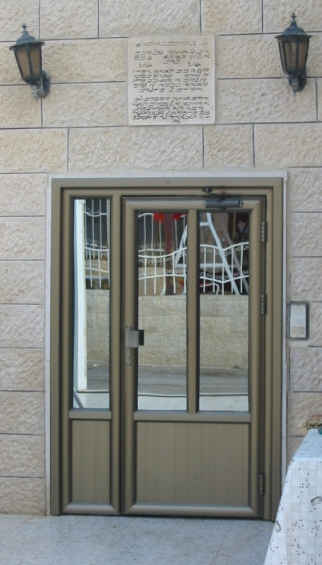
וכן אני מורה הלכה למעשה, לעשות נקב במקדח ולתתה [את המזוזה] ברוחב המזוזה, ואם נתנה לאורך המזוזה – פסולה, וכן פרשיות של תפלין לרוחב הבתים, ולא לגובה, כמו מזוזה. וכשאבנה ארון [בבית-כנסת], אם אזכה, ארחיבו לפי העמדת ספר-תורה מיושב, כספר-תורה שהיה מונח בארון"When I build a Synagogue, if I will merit, I will store the Torah Scroll horizontaly (...)", said Rabennu Tam. So the Belz Rebbe felt compelled to follow Rabeinu Tam's dream when he built his synagogue. However, his Mezuzot and Tefillin were all vertical - only the Sefer Torah, which was specially highlighted in abovementioned passage, was stored according to Rabbeinu Tam. (By the way, it took him 15 years to build his Synagogue and he was part of the construction crew, highlighting how important this was for him. It also took 15 years to build the new Belz Great Synagogue in Jerusalem, pictured above, and the current Belz Rebbe was also actively involved in the building process, along with his Hassidim).
Monday, April 13, 2009
Petuchot and Setumot
The Basics
The Torah is comprised of many parshiot, or "segments", which can be connected to each other in two ways, in a "Setuma" (סתומה) layout or in a "Petuha" (פתוחה) layout. The Rambam and the Rosh discuss what's the exact layout of Setuma and Petuha and in many instances what is a Parsha Stuma for the Rosh is a Petuha for the Rambam.
The two instances where they disagree are the following:
- According to the Rambam, whenever a Parsha starts in the middle of the line that will be considered a Parsha Setuma. The Rosh will say the opposite - according to him this is the layout of a Parsha Petuha.
- According to the Rambam, whenever a Parsha starts in the beggining of the line that is the Parsha Petuha. The Rosh says that this is a Parsha Setuma.

The Poskim say that the Sofer must try to write the פרשיות in the two layouts in which there's no debate ("universal layouts"), in order to follow both the Rambam and Rosh. There are two universal layouts - one Petuha and one Setuma - and you can identify them in the picture in the right. The "space" at the top is a universal Parsha Petuha while the "space" at the bottom of this picture is a universal Setuma.Today, all the sofrim don't have to worry about these layout issues since they have the luxury of copying it from spotless computerized Tikkunim, so all Sifrei Torah today have the universal Petuchot and Setumot, which is great. But until recently the sofrim didn't have such great Tikkunim and they occasionally had to use a non-universal layout.
If a Sofer is forced to use a non-universal layout the Rema notes that he should not stray away from the opinion of the Rambam, since he had a very reliable Tikkun in his possession. Most scholars say that this Tikkun is the Aleppo Codex, and I hope I can write a more about this codex in the future.
Impact in the Modern Day Mezuzot
As I introduced in the previous section, the Rambam vs. Rosh discussion has a direct impact in the layout of our מזוזות. The Mezuza has two Parshiot - Shema and Vehaia - and the Talmud says that they must be connected in a Setuma layout. You would think that we again use the "universal" Setuma layout in a Mezuza but that's not the case and that's when this whole subject becomes really interesting. The Sephardim, expectedly, follow the non-universal Setuma of the Rambam and they are "safe", since they have no business with the Rosh's shita. But for the Ashkenazim is really tricky and here is why.
Until some 300 years ago, if one would open an Ashkenazi Mezuza he would see a very odd layout, that would not conform with ANY of the main opinions. Basically, the Parshiot were written without any pause, almost like the two parshiot were in fact one. Although this was a very established Minhag, many Halachic authorities sought to fix the problem and choose an alternative layout. There were two main solutions proposed, one by the Taz (Turei Zahav) and another, more "radical", by the another leading Rabbi (can't remeber the name now..).
The Taz's proposal, which changed the established Minhag just a little and allegedly was good both for the Rosh and Rambam's opinions, was widely accepted by the Ashkenazi Jews and it has emerged to become the standard layout which we use until this very day. You can see the modern day Ashekenazi (left) and Sephardi (right) Mezuzot in the pics below.

There's a third solution, proposed by the Mahari Abuhab, which is very interesting and worth to mention. He proposed the most obvious solution: to use the universal Setuma layout, thus solving all the problems. No one really accepted this solution, and the Shach (יו"ד סימן רפח סק"י) speculates that there is Mesorah that disctates all the words which are line-headers. According to the Mahari Abuhav, the line of the second Parsha will not start with "Vehaia", like the Ashkenazi and Sephardi Mezuzot, but with the word "Mitzva" (see pic below). That might explain why people didn't follow this opinion. Rabbi Moshe Feinstein explores this topic in more depth in יו"ד סימן ק"פ.

Impact in Modern Day Tefillin
While the Petuhot/Setumot topic has great revelance to Mezuza, its relevance to Tefillin is even greater. If a Mezuza wasn't written in a proper Setuma way, the Mezuza is still Kosher "bedieved". In Tefilin, it's more problematic - if a Tefillin doesn't have this Setuma layout, the Tefilin are potentially Pasul!
Like in Mezuza, the Sephardim do the Setuma layout like the Rambam, so once again they're safe. Most of the Ashkenazim follow once again the solution of the Taz, but I've heard of many Hassidim who are Makpid in following the Rambam in the Tefilin layout because of the above-mentioned stringency. From my personal research, even tough these groups have Rambam Tefillins, their Mezuzot are written according to the Taz, a rather ironic fact. In my humble opinion both Mezuzot and Tefillin should be written in the same Setuma way - be it like the Rambam or like the Taz - but that is the least of my "problems":
I've heard that some "Briskers" wear two Rashi Tefillin - one according to the Taz and another one according to the Rambam, just to be safe. Now that's really odd. If you would (theoretically) be a Chassidish Brisker you would probably wear two Rashi Tefillins (Rambam +Taz) and two Rabbeinu Tam Tefillins (Rambam+Taz)!
Now I understand better what they say in the name of the Gaon - that we would have to own over 70 pairs of Tefillin if we wanted to be "yotze" all the opinions.
Another Important Discussion
I didn't even mentioned the "Breuer" factor - the recent debate about the Petuchot and Setumot found in the Aleppo Codex, extensively explored by the late Rabbi Breuer. That's a whole different story, and it's difficult to fully understand it before knowing the basics of Setuma and Petuha Parshiot, which you hopefully do know by now. I will get into this in another opportunity. Gitten Tzimmer!
Saturday, March 21, 2009
The Parchement - Klaf or Gevil?
As I wrote in my post about the Kulmus, around 700 bce the feather quills started to become immensely popular among scribes in general and, specially in Europe, many sofrim started to favor these quills instead of the "original" reed quills. The parchment was also improved and the European scribes started to write not on the outer, but on the inner part of the animal's skin, because it was more smooth and thus suitable for the delicate feather quills (reed quills are more sturdy and can write in either Gvil or Klaf. Feather quills don't write well in Gvil). This inner part of the animal's skin is called "Klaf" (קלף) and eventually all Ashkenazi scribes switched for this parchment and the feather quill altogether, for both Mezuzas and Torah Scrolls. The Gevil went "out of fashion", so to speak.
The Ashkenazi Rabbis accepted these changes and an all Ashkenazi Torah Scrolls are written in Klaf until this very day.
But the Sephardi world was less influenced by these changes and the Sefardi sofrim kept using reed quills and Gvil parchement, like the original Sifrei Torah. However, as the Sephardi Jews started to leave the Arab world it seems that they were influenced by the Ashkenazi way of writing and many Sefardi scribes today do use feather quills and Klaf, a surprising fact. Virtually all parchments produced in Israel are "Klaf", not "Gvil/גביל".
Last week I luckily found a great Yemenite website which is pushing for the "resurrection" of the Gvil parchment (read "The Gewil Torah Scrolls are Popular once Again" - take it with a grain of salt...). The Yemenite Jews follow the Rambam's customs blindly and as I noted, the Rambam wrote his own Sefer Torah in Gevil, so this campaign really makes sense. But they claim that a Rabbi Mordechai Eliahu, the former Sephardic Chief Rabbi, has a Gvil Sefer Torah, so I guess many Sephardim will like this campaign as well since their older Sifrei Torah are also written in Gvil.
It's easy to differentiate between a Gvil Torah Scroll and a Klaf one. The Gvil scroll is dark in the inside (where the text is written) and lighter in the reverse side; the Klaf scroll is the exact opposite.
| Yemenite Gewil Scroll (note the reed quill in the scribe's hand) |
![]() |
| Ashkenazi scroll. Note the white klaf color |
I was so fascinated by this story that I decided to make a field trip to a klafim factory in Jerusalem. I saw the whole process and the owner explained to me that besides all the Gewil vs. Klaf story there was another interesting development.
Until very recently, all klafim were made out of skin of fully-grown animals. But the Rabbinic authorities always praised the skin of a "Shlil" (שליל), or unborn animal, even tough it was unpractical to write a Sefer Torah from a Shlil - you need dozens of fetuses and that was hard if not impossible to find. But 30 years ago someone in the klafim business heard that the big slaughter houses in the US and Europe had dozens of "shlil" everyday in their factories and they didn't have any use from them. Since then all the klafim factories buy these shlils and make a super-smooth klaf out of it. So our klafim became even better!
The klafim process, as I saw it:
1- Put the skins in chemicals for 4 weeks.
2- Take it out and remove the hairs.
3- Hang it for a few days so it can dry.
4- Stretch it for a few days.
5- Remove the remaining impurities.
6- Cut the Klaf to the desired thickness and size.