Wednesday, September 30, 2009

Stam Stories #1

In this series of posts, you will read about the few stories of Chazal that speak about Sta"m - Sefer Torah, Tefillin and Mezuzot. This story is about a Mezuza and a diamond gift (full disclosure: YK works with diamonds).

Yerushalmi Peah - Page 4, Chapter 1, Halacha 1:
"Artevan (either a king or a wealthy Jew), sent to Rabbenu Hakadosh (Rabbi Judah the prince - 2nd century CE), the compiler of the Mishnah, a precious diamond as a gift, and requested that Rabbenu Hakadosh reciprocate by sending him a gift, equal to his. The Rabbi sent him a mezuzoh. Artevan asked him, "I sent you and invaluable diamond, and you send me a gift that is worth a half-shekel? Rabbenu Hakadosh replied, "My property (Rabbenu Hakadosh was very wealthy) and your property cannot pay the value of a mezuzoh, as King Solomon says in Proverbs: 'All your desirables cannot equal it.' Moreover, our riches we must guard, whereas the mezuzoh guards us."

The Sheiltot of Rabbi Achai, Parshat Ekev, adds another layer to the story:
"Right after (Rebi sent the Mezuza), Artevan's only daughter fell seriously sick. He summoned the most skillful physicians, but no one could save her. Artevon then decided to heed to Rebi's advice and fix the Mezuza in his doorpost and his daughter got immediately cured."
And finally, in Yoma 11A:
"There was a story with Artevin, who was once checking the market's Mezuzot and got fined by the local authorities (who banned all Mezuzas)."
Why was Artevin checking Mezuzas in the market? Some commentators say that after his daughter healed he took upon himself to make sure that every Jew would have a proper Mezuza at his doorpost, and he would go around checking them once a year.

Sunday, September 27, 2009

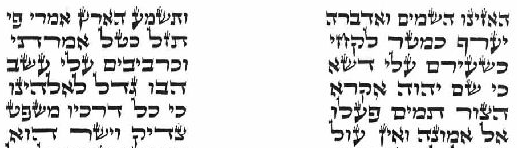
The Two Columns of Shirat Haazinu

The Mitzva of writing a Sefer Torah comes from this past week's Parsha, Haazinu. In the preceding Parsha, G-d says to Moshe that the Jews should "write this song", in a reference to Haazinu, one of the Torah's two songs (the other one is Az Yashir). Although the commandment refers only to Haazinu the commentators note that it's prohibited to divide the Torah and write it in a form of "megillot, megillot" i.e. in fragments, since all the Torah is one. So the commentators all conclude that the commandment must have been to write the whole Torah, which will contain the song of Haazinu.

This highlights how important this intricate song is in relation to the whole Torah.

Also aesthetically, Haazinu stands out with its special two-column layout. In the modern Torahs, the two columns are perfectly even, like two towers, and usually are two pages long. I wanted to post a picture of the whole thing but I only found this one:

We find the same layout in the Megillat Esther, in which the ten sons of Haman are listed in the same fashion. Like in Haazinu, most sofrim (not me!) stretch the letters so every column will start and end in the same place:


But if you look in the old Torahs and in the Torahs of the Yemenite Jews you will see that the columns there aren't uniform at all. Below is a picture from a Yemenite tikkun:


I guess the Ashkenazi sofrim took the liberty to strectch the lines in order to make the scrolls look nicer, on the grounds of "zeh keli veanveiu".

But there's another thing that really puzzled me. Aside from the layout, the Yemenite scrolls also differ in the actual poem structure and that's the real reason why their columns aren't simetrical - there are less lines and thus some of the lines are longer.

For instance, look in the 17th line in the above picture, "zechor yemot olam.." - this is a long line. In the Ashkenzai scrolls this long line is divided in two, enabling our sofrim to justify the lines. Now that's odd! There are two other places where there's a difference in the poem structure but I will leave it for you to figure it out.

Which is the right structure?

That's where the Aleppo Codex comes to the scene. This is a topic for another post, but it suffices to say that the Aleppo Codex, guarded by the Aleppo Jews until 1948, is the most accurate Tikkun ever. Unfortunately, this Tikkun only covers the Nach; the Torah pages were mysteriously lost in a Arab riot in Aleppo. That is, all the Torah pages were lost besides..... that's right, the pages of Shirat Haazinu! And if you guessed that the Yemenite scrolls are identical to it, you are right. I got this image from the Aleppo Codex website:


This would imply that the Ahskenazi structure of Shirat Hazinu is problematic. Halacha says that if there's a pause (parsha setuma or petucha) in a wrong place, this will invalidate a Sefer Torah. If the Ashkenazi scrolls have a different poem structure, some of the open spaces are in the wrong place!

The answer is simple: the open spaces in Shirat Haazinu (and Az Yashir) are not open and separate Parshas, but a special layout of a song. The halachot of Parsha Petucha and Setuma don't apply here and whatever layout you have - Yemenite or Ashkenazi - will be Kosher for all intents and purposes. So although it's clear that the Yemenite arrangement is more reliable, you should not start complaining about our modern-day structure.

This is the story of the layout of Shirat Haazinu. I hope you enjoyed and I wish you a Gmar Hatima Tova!

Sunday, August 16, 2009

The Psalms Menorah


UPDATE: see a more recent detailed post here.

One of the best-selling Safrut items is the Lamnatzeach Menora. You can see it in almost every Sephardic and Chassidic synagogue but I never knew what was the story behind it. This past Shabbos I saw an explanation in the Chatan Sofer's Bircon - see the bottom of the the picture for the Hebrew version. I will summarize it in English below.

"In the sefer Kaf Hachaim (...) is brought that G-d showed to King David and Moshe Rabbeinu the Mizmor Lamnatzeach Bineginot in the form of a Menorah, written in a golden sheet. King David inscribed this Psalm Menorah in his war shield and would meditate upon it in his wars, for protection."

That sparkled the Minhag of reciting this Psalm in this format every day and many people prefer to read it from parchment. I'm currently writing my Shir Hashirim scroll but I got so excited about this that I decided to write a large Lamnatzeach Menorah hopefully next month ii"H. Stay tuned!

Tuesday, July 21, 2009

Esnoga's Scrolls

The Esnoga is one of the most important historic synagogues of the world and it was built during the golden years of the Jewish community of Amsterdam. My family was there for a visit and they brought me some pictures of the scrolls featured in the adjacent Jewish Museum. The Museum's site doesn't have any pictures so I took the liberty of sharing it with my readers in this blog entry.

All of them are unique and showcase the elegance and taste of the Dutch Jews of that era.

The Megillat Esther below has some very beautiful illustrations in between each column and is written is a very odd layout - 30 lines (see my post on this subject here) and each line is way too long (each line should ideally have 30 letters, which is three times the word "lemishpechotam", but in this scroll there are more than 60 letters per line). The letter Peh has a very different shape, with a big Tag in the left top corner.


This other Megilla has 32 lines, also not standard, but the lines have the proper amount of letters. What catches my attention is the arrangements of the Parshiot - if you look carefully you will see that the Parsha of "איש יהודי" is written in the middle of the line and "אחר הדברים האלה" has a very odd layout - it starts almost where the preceding line ended. According to our Mesorah, all the Parshiot of Megillat Esther should have a Setuma layout (see my post on this subject here) and if so, this Sofer followed the Rambam's opinion of Setuma and Petucha.


Next is my personal favorite, a Sefirat Haomer scroll. This is the first time I see such scroll and it takes a little time before you actually understand what's going on. The top box is the days' count - 46 days; the middle and bottom boxes are the week's count.


Last but not least, this antique Torah scroll written in Veilish script (read more here). The top Lamed in this Sefer torah is almost bent backwords, opposite to the Lamed of our modern scrolls, which are slightly bent forward.


Tuesday, July 14, 2009

Otiot Meshunot - Odd Letters of the Torah

In the Torah scrolls of today, there are very few scribal oddities and it's not so hard to single them out:
  • Large and small letters - example: the large Bet of the word Bereshit.
  • The inverted Nuns in the Parsha of Vayehi Binsoa.
  • The splitted Vav in the word "Shalom", in last week's Parsha.
  • Dots on top of specific words like "Hanistarot Lashem".
However, many old Sifrei Torah have many more oddities that are no longer in use today (see images). One of the most famous examples is the Peh Melufaf, which is still in use in the Teimani scrolls, and the Torah Shlema has an extensive list of these less popular odd letters. Also, there are numerous additional tagim that are often times mentioned by popular commentators like the Baal Haturim that also fell is disuse. 

 The Meiri compiled a very detailed work (Kriat Sefer) on the odd letters, depicting the oddities of the Torahs of his time. A more contemporary Sefer was written by the Badei Aharon roughly 150 years ago. There of course the ancient Sefer HaTagin (see image) , which according to tradition was copied by Eli HaCohen from the 12 stones of Yehoshua Bin Nun over two thousand years ago.

What are these letters? 

Various Geonim, Rishonim and Achronim have mentioned these letters and among them, the Rambam simply says that this is a very old tradition that should be observed. Few elaborate on the reason behind these oddities but the fact is that there was such a tradition and at some point this tradition was lost. But before the Second World War there was this "in-between" period where some communities accepted this tradition while others were very critical of it, arguing that this tradition was rather unreliable. This controversy gathered more attention when an old Torah scroll written by Beit Yehuda, a famous rabbi, was found to have numerous otiot meshunot. 

Also the first Rebbe of Zanz reportedly wrote his Sefer Torah with unusual Otiot Meshunot, and in both cases even those who didn't approve this Minhag were afraid to say bad about these Torahs, given their exceptional importance. 

 Following the devastating events of the Holocaust, few antique Torah Scrolls remained intact and the Mesora of the odd letters was wiped out alongside with the European shtetls. This topic is of special interest to me since I'm planning to start writing my own Sefer Torah soon. All these scribal oddities are so interesting and did feature in the Sifrei Torah of previous generations so I have to admit that I felt tempted to add some of these oddities in my own Torah. 

That's why I decided to study Rabbi Ratzabi's authoritative sefer on this subject, featured in the Torah Shelema, and now that I finished learning it I have another approach to this subject. Rabbi Ratzabi doesn't say if scribes should or shouldn't write the Otiot Meshunot but he somehow expounds how confusing and complex this topic is and it becomes clear that whoever decides to write the Otiot Meshunot will be putting himself in a sea of possibilities where there isn't a clear path to follow. That is the danger of following a Mesora that isn't yours; it's almost like inventing a Gezeira Shava out of your own mind, which is forbidden. The very few oddities that have been preserved in our scrolls have resisted the test of time and are our only undisputed Mesora. Here and there I hear of people talking about bringing back the Mesora of Otiot Meshunot but this page was turned after the Holocaust, as I noted above. Whatever is left of it is a living testament of the richness of the field of Safrut and how it evolved over centuries of Exile and persecutions.

Tuesday, June 23, 2009

Jewish Week Article

Here's a great article from the Jewish Week, pointed out by Lion of Zion (don't miss the post discussion there).

"A Safer Torah

At the Plainview Jewish Center, the congregation’s 14 Torah scrolls were recently unrolled and examined by three Torah scribes while congregants milled around.

We were evaluating the Torahs, repairing some and registering those that had not been previously registered,” explained Zerach Greenfield, executive director of Machon Ot, a nonprofit Torah registry organization with offices in College Point, Queens, and Jerusalem.

The organization was created nearly 20 years ago at the behest of Interpol and the Israeli police department after the discovery of 65 stolen Torahs hidden behind a false wall in Rosh Ha’ayin, Israel, Greenfield said.

Since then, registration of sifrei Torah has gained increased acceptance. Greenfield pointed out that the eight Torahs in the main sanctuary of the Jewish Center of Kew Gardens Hills were stolen last year. The custodian was later arrested and charged with the theft, and the scrolls were recovered.


Greenfield said those Torahs were registered with Machon Ot (Institute of the Letter) and could have easily been identified if a question had arisen about their ownership.


The International Torah Registry uses pin marks to identify Torahs, but Greenfield said Machon Ot developed two other “far more sophisticated” methods of identification.


The first involves making a transparency of a randomly chosen column of the Torah; because each Torah is written by hand, no two columns are identical. Transparencies can be placed over the column to see if the letters line up. The second method involves scanning a column and drawing an invisible vertical line on a template to see which letters cross that line when measured from the end of the line, creating a unique pattern.


Lacking identification marks, there is no way to identify stolen Torahs and return them to their owners.

Greenfield said sofrim, or scribes, are often the very people who steal and try to resell the scrolls. Therefore, he said, an identification method that these men could not circumvent was needed. That ruled out invisible ink, embossed stamps and code markings.

Rabbi Ronald Androphy, spiritual leader of the East Meadow Jewish Center, said Machon Ot registered his congregation’s nine Torahs, evaluated them to check for discoloration, and repaired letters that had become difficult to read. The registration, evaluation and repair cost a total of $30,000, he said.


In the past, Rabbi Androphy said he would call a sofer when there was a problem with a Torah. And he said that more than 20 years ago he sought to register the Torahs with the Universal registration with its pin code but found the kit he was sent “very difficult to do.”


“We never followed through with it,” he said.


Now, his Torahs are not only registered with Machon Ot but repaired by it, Rabbi Androphy said, noting that Machon Ot once took two of his congregation’s Torahs to its Jerusalem office for repair.

“Torahs deteriorate naturally,” he said, adding that Machon Ot scribes have returned at no additional charge to fix letters in those Torahs when the ink later cracked.

Although Machon Ot helps synagogues interested in commissioning the writing of a new Torah as a fundraising project, Greenfield said the economic downturn has caused more synagogues to hold fundraisers to repair their Torahs.


Machon Ot began registering Torahs worldwide in 1990. It now has a database of 14,000 registered Torahs and registers about 400 to 500 each year.


“The goal is 30,000 because that would be a critical mass that would make someone believe he would get caught if he tried stealing a Torah and then selling it,” Greenfield said.


As part of its evaluation of each Torah, he said, Machon Ot scribes determine what it would cost to replace it. Such an appraisal is required by major insurance companies in Israel and is helpful for synagogues and others in the United States so that they don’t over insure their Torahs.
"

Monday, June 15, 2009

Rashi Vs. Rabbeinu Tam - Round II

There are two major discussions between Rashi and Rabeinu Tam that relate to Safrut and in this post I will talk about the second. My first post can be found here. You've probably noticed that in some houses the Mezuza is set in the doorpost in a complete vertical position, while in other households it is slightly bent. Why? Which is the correct way?


The two possibilities I just mentioned are not the opinions of Rashi and Rabbeinu Tam, so please bear with me. 

The Discussion 

 Rashi and Tosafos dispute what is the proper way of storing holy items. Rashi understands that Mezuzot and Torah Scrolls must be stored in the vertical position. Rabeinu Tam goes the opposite way and holds that the proper way to store a holy item is in the horizontal position, and according to him to store it in a vertical way it's improper. So what's good for Rashi - vertical - is bad (yes, Pasul) for Tosafos and vice-versa. As a side note, some of the Tefillin found in the Qumran excavations had the scrolls arranged horizontally, like Rabeinu Tam (see more here), indicating that this discussion preceded the times of Rashi and Rabbeinu Tam (who lived 1000 years ago, opposed to the 2000 year old Qumran scrolls). 

Practical Halacha 

The Shulchan Aruch decided like Rashi and thus all Sephardic Jews affix their Mezuzas in the vertical way. Also, the Sephardic Sefer Torah is stored in a "box" and always stays in the vertical position, even when being read in public - another ramification of Rashi's opinion that holy items must be stored vertically. The Rema however mentions Rabeinu Tam's position and introduces a compromise: not vertical nor horizontal but in a diagonal position. That is a classical Jewish solution - in face of two opposing opinions we do like a third one, but jokes aside, this proposition was universally accepted by all Ashkenazi Jews to this day. That explains why the Bima in the Ashkenazi Shuls is slightly bented and also why they store their Torah Scrolls in a slightly diagonal position in the Aron Kodesh - they follow the Rema's solution in every situation. (Incidentally, the Tur offers another solution, to bend the Mezuza's parchment like an L in order to follow both Rashi and Rabeinu Tam in one go but no one follows this view, most likely because it would damage the Mezuza's Klaf (parchement), a far larger problem.) 

The Belz Minhag

But there's an interesting exception to this rule in the Ashkenazi world - the exquisite Minhag (custom) of the Belz Rebbe's family of storing the Sefer Torah horizontally. When I heard about this I was open-mouthed and I did a little research about this. It turns out that the Belz Shuls and yeshivot around the world store their Torah's in the usual way - vertically. Only the Rebbe's Torah Scroll is stored according to Rabeinu Tam's opinion, horizontally, and this Torah is currently stored in the famous Belz Great Synagogue (picture in the right). 

Why? 

Reb Meir of Primishlan, a famous Hassidic Rabbi, once said that the first Rebbe of Belz, Reb Shalom Rokeach, had "sparkles of the soul of Rabbeinu Tam" and this had so much impact in the Rebbe that he decided that if he would one day build a Synagogue he would store the Torah according to his "soul-mate", Rabbeinu Tam. He did eventually build a synagogue and stored the Torah horizontally, and this custom was kept by the subsequent Belz Rebbes. If you find this hard to accept, take a look in Rabbeinu Tam's original piece:
וכן אני מורה הלכה למעשה, לעשות נקב במקדח ולתתה [את המזוזה] ברוחב המזוזה, ואם נתנה לאורך המזוזה – פסולה, וכן פרשיות של תפלין לרוחב הבתים, ולא לגובה, כמו מזוזה. וכשאבנה ארון [בבית-כנסת], אם אזכה, ארחיבו לפי העמדת ספר-תורה מיושב, כספר-תורה שהיה מונח בארון
"When I build a Synagogue, if I will merit, I will store the Torah Scroll horizontaly (...)", said Rabennu Tam. So the Belz Rebbe felt compelled to follow Rabeinu Tam's dream when he built his synagogue. However, his Mezuzot and Tefillin were all vertical - only the Sefer Torah, which was specially highlighted in abovementioned passage, was stored according to Rabbeinu Tam. (By the way, it took him 15 years to build his Synagogue and he was part of the construction crew, highlighting how important this was for him. It also took 15 years to build the new Belz Great Synagogue in Jerusalem, pictured above, and the current Belz Rebbe was also actively involved in the building process, along with his Hassidim). 

So as you see, this ancient discussion between Rashi and his grandson is still relevant, 1000 years later!

Thursday, June 4, 2009

About the Name of This Blog

You probably noticed that the web url of this blog is kind of weird - "Lavlor". What's that?

A scribe is usually called a "sofer" in Hebrew but it turns out that "sofer" is a word with multiple meanings and although I'm not a fan of ethimology I conducted a thourough research about this word. The root of sofer is S-F-R and the Aruch, an authoritative dictionary written over 1000 years ago, mentions five different possible meanings:
  1. A "sefer" (book).
  2. To count ("lispor" in Hebrew)
  3. A barber ("sapar", still used in Modern Hebrew)
  4. A small town ("sfar")
  5. Rabbis ("sofrim")
Mind you that a scribe is not among the possibilties, a striking fact. What's the Aruch's word for a scribe? You guessed right - lavlor.

Coming back to the word "sofer", Hebrew words that share the same root are almost always connected in some way but in this case, "sofer" has way too many meanings and it's quite impossible to find common ground between a barber and a Rabbi. So what's going on?

It turns out that we are talking about two different languages. The Torah's language is a mix of two distinct but similar languages, and while the Tanach is written in Lashon Hakodesh (old Hebrew), the Talmud is written in Aramaic. Occasianally a word can have different meanings in these two languages and the word "sofer" is a telling example.

Exclusively in Lashon Hakodesh, a "sofer" has only four meanings:
  1. To count ("lispor")
  2. To tell something ("lesaper")
  3. To write
  4. A book
These four things are connected - a book is a story, a writer is a storyteller and "counting" is closely connected to "telling" in many other languages, including Latin, French and English.

But in Aramaic a "sofer" has other meanings and Aruch, a work on the Talmud and Midrashim, approprietly identifies alternative possibilities which include barber, Rabbis or a small city.

So what's the correct word for scribe? In Hebrew it's "Sofer" and in Aramaic it's "Lavlor". I decided to use both - lavlor.blogspot.com, home to YK's Sofer Blog!

______
Some sources:

Avot Chapter 6 (written in Lashon Hakodesh):
אמר רבי יוסי בן קסמא, פעם אחת הייתי מהלך בדרך ופגע בי אדם אחד, ונתן לי שלום, והחזרתי לו שלום, אמר לי, רבי, מאיזה מקום אתה, אמרתי לו, מעיר גדולה של חכמים ושל סופרים אני, אמר לי, רבי רצונך שתדור עמנו במקומנו ואני אתן לך אלף אלפים דנרי זהב ואבנים טובות ומרגליות, אמרתי לו אם אתה נותן לי כל כסף וזהב ואבנים טובות ומרגליות שבעולם, איני דר אלא במקום תורה, וכן כתוב בספר תהלים על ידי דוד מלך ישראל, טוב לי תורת פיך מאלפי זהב וכסף.
Talmud (Eiruvin 13:A), in Aramaic:
אמר רב יהודה אמר שמואל משום ר' מאיר כשהייתי לומד אצל ר' עקיבא הייתי מטיל קנקנתום לתוך הדיו ולא אמר לי דבר וכשבאתי אצל ר' ישמעאל אמר לי בני מה מלאכתך אמרתי לו לבלר אני אמר לי בני הוי זהיר במלאכתך שמלאכתך מלאכת שמים היא
Jastrow's Talmudic Dictionary:

Thursday, May 28, 2009

Exquisite Megillat Esther Case


Made out of ivory, gold and silver, this is one of the nicest cases I've seen - I love the look of Esther and Achashverosh and the assimetrical canopy. Maybe one day I will buy it for my 11-lines Megillat Esther... I wish! Artwork by my friend Uri Revach; price upon request.

Thursday, May 21, 2009

The Minhag of Writing the Last Words of a Sefer Torah

One of my favorite blogs, Lion on Zion, wrote a post about women in Safrut and in the discussion thread we somehow got drawn to the interesting "Minhag Israel" of letting other people write the very last words of the Torah in public. But what is the nature of this custom? I got curious and in this post I will write what I read about this.

Firstly, there's a Miztva of writing your own Sefer Torah and a Sofer can write on behalf of others who can't write themselves. But even if you hire a Sofer you must participate in the process in some way - the Talmud mentions that you should buy the klafim, for instance, and usually the "Baal Hasefer" writes a word or more in the Torah. But which word?

Three possibilities are mentioned: "Bereishit", the very first word, or "Israel", the very last or the whole passage of Devarim 33;4 - "Torah Tziva Lanu Moshe (...)". In a best case scenario the owner would write all three but almost no one knows how to write properly and to even write one of the three possibilities is already unrealistic, so the Sofrim found ways to go around this problem.

The "Keter Shem Tov" says that the Sofrim in his time would draw small dots outlining the words Bereishit and Israel, and the Baal Sefer would literary connect the dots. That's one solution.

Today, the Sofrim outline the letters and the owner just fills in. Halachically speaking, an outlined letter is Kosher thus the owner is not actually doing anything - the Sefer Torah is actually finished before he fills in.

But we haven't answered the original question: why is there the Minhag of letting others write a letter in the end of the Torah?

The "Mei Yehuda" (here) offers a nice theory. Halacha says that if a person buys an unfit (Pasul) Sefer Torah and corrects it, he fulfills the Mitzva of writing a Torah. But there's an obscure opinion that says that even if the Torah belongs to someone else, the one who corrects it fulfills the Mitzva the same way. If so, it could be that people that write a letter in the end of the Sefer Torah do fulfill the Miztva according to this minority opinion and maybe that's how this Minhag started.

Be it as it may, this is an ancient Minhag Israel and in many cases is the only indication that the Sefer Torah was written by a proper Sofer - a Torah could look 100% kosher but be written by a gentile, for instance. This Minhag helps us with this issue and here is why:

Before the Sofrim came up with the outlining idea, the owners and guests would write the last letters themselves and, expectedly, the result was somewhat messy - you could tell that the letters were not uniform. But this mess was a good thing; if a Sefer Torah had perfect letters in the end, it would indicate that it wasn't unveiled in public, which is not a good sign. Only when it had the messy letters we would know that there was a public festivity and other people wrote the messy letters, which tells us that the Sefer Torah was most likely Kosher.

This is a great example of Chazal's saying: "Minhag Israel Torah".

Saturday, May 2, 2009

Jewish Fonts - A Guide for the Different Ktavim

Although all Holy scrolls are written in Ktav Ashurit, there are many subdivisions within this script. Additionally, there are other fonts that are not related to Ktav Ahurit, so I think it's worthwhile to talk a little about the Jewish Fonts.

Let's start from the beggining. There's a discussion in the Talmud if the Luchot given in Har Sinai were given in Ktav Ashurit (the font we use today) or perhaps Ktav Ivri, an obscure and completely different font. We follow the opinion that the Luchot were given in Ktav Ashurit.

So right from the start, we have two fonts: Ashurit and Ivri. The Ktav Ivri is also known as "Paleo-Hebrew Alphabet" and you can see a full verse from Tanach in the pic in the right. It's way easier to write Ktav Ivri than Ashurit - it's basically sketches rather than an artistic alphabet and I imagine it would be a lot easier to write a Sefer Torah in Ktav Ivri.

Another font that became very popular is Rashi's Script, which is commonly found in Chumashim, Talmud and commentators. This font was introduced in the 15th century and it is still printed today in a standard way, that is, with no variations. If you take to account the quantities of Talmuds, Mishnayot, Peirushim out there that use this script, it's no exaggeration to claim that this script has become more popular than the Ktav Ashurit, only found in the holy scrolls.

But I'll spend more time talking about the different versions of the Ktav Ashurit, since this is the script we use for all scrolls and most people have no clue about this. There are four versions:
  1. Beit Yosef
  2. Ariz"al
  3. Chabad
  4. Veilish (Sefardic)
All scripts have the same Halacha status and are Kosher for any Jew, since the differences are very slight. Rabbi Ovadia Yosef, the foremost authority of the Sefardic Jews today, proves this extensively in his sefer Yebia Omer and before him the Kaf Hachaim claims the same, so there's nothing to fear - whatever script you have is okay.

However, if you can choose between these four versions of Ktav Ashurit, why not make the right choice? Most people who buy Tefillin or Mezuzot don't really pay any attention about the version used by the scribe but just like anything else in life you should make an informed decision. And I will try to organize it for you here.

If you are Sefardi, it's easy - buy a Tefillin/Mezuza/Torah written in Veillish. The easiest way to identify this ktav is through the Shin, which has a distinctive round base like this (you can see a full sample in the end of this post)

For the Ashkenazim it's more tricky. If you are not Hassidic go Beit Yosef, which is the standard and most popular version. But for the Hassidic readers I need to first give the big picture.

The Arizal script was introduced by the Ari, in the 1500's. Before him, the Ashkenazim basically wrote in a uniform way, but the Ari, with his unmatched Kabalistic knowledge, pushed for a few changes in the Ktav Ashurit. He also introduced a new way of writing the Holy Shem, according to the Kaballa and many sofrim today write it this way (click here for my post about the Holy Shem). But what most people overlook is the fact that the Ari only pushed for changes in the Tefillin, not in the Torah scrolls. The Ari never intended to change the way our Torah scrolls are written and that's when the confusion starts.

Most Hassidic scribes today write not only Tefillins, but also Torah scrolls and Mezuzas in Ktav Arizal. Frankly, I don't know why, but that's a fact. One of the few Hassidic sects who oppose this practice is the Tzanz dynasty, since the Divrei Chaim was very clear about writing the Torah in Ktav Beit Yosef and Tefillins in Ktav Ari.

So if you are Hassidic, you should order a Ktav Arizal Tefillin. But if you one day hire a sofer to write you a Torah, make sure you ask your Rebbe if you should use Ktav Ari or Beit Yosef. Anyways, it's easy to identify an Arizal ktav - the Chet and Shins look like this:

On top of all this mess there's the Chabad Ktav, introduced by the Alter Rebbe. I heard from a fellow Chabad scribe that the Alter Rebbe once said that when Mashiach comes this will be the main Ktav, but the fact is that the Chabad Ktav is the least popular of all the four versions of the Ktav Ashurit. This Ktav is very similar to the Ktav Arizal, but you can identify it by the exquisite Lamed and Peh:

So, if you are still reading this, yes, there are many Jewish Fonts. And next time you order a
scroll, make sure you choose the one that is right for you!
_______________
Samples:

From left to right: Sephardi, Beit Yosef, Arizal and Chabad.

Friday, April 17, 2009

A Brief Dikduk Dvar Torah on Pessach and Shemini

I don't focus much in Dikduk but I had a cool insight on the Parsha of this week and I will share. After all, Dikduk and Safrut do go hand on hand.

The Vilna Gaon often times links the "trop" (cantilation sign) of words to their actual meaning. One famous example, in Shemot 1:13:
Many commentators explain that the Jews stayed in Egypt for less time because of the extreme hardship of their slavery. In the verse above, the Torah describes this hardship and the words have a cantillation sign called "Kadma Ve'azla". Says the Gaon that if you take the name of the cantillation literary it means "Anticipated and went" in Aramaic, indicating that because of the hardship of the slavery the Jews "anticipated and went" from Egypt before pre-set time. I heard this yesterday and I got excited about this kind of Dvar Torah and had the following insight:

In the coming week's Parsha, Shemini, I saw a very rare cantillation sign in the passage that speaks about Nadav and Avihu, the two sons of Aharon who died while doing work in the Mishkan. The Torah explains that they brought an....:
LinkThe rare "trop" below the word "Lo" is called Mercha Kefula or, alternatively, "Trei Ta'amei". Following the methodology of the Gaon, if we take the word "Trei Taamei" literary it means "Two Reasons" in Aramaic (I don't know the exact translation of the other name, Mercha Kefula, but Kefula also means two). The Talmud, mentioned by Rashi in this passage, says that there are two reasons why Nadav and Avihu died - either because they entered the Mishkan drunk or because they said an Halacha in front of Moshe, two actions that cause a death penalty. So here again, the trop gave us a hint about this passage.

Update: I refer you to Josh Waxman's piece on the Mercha Kefula, where he discusses this pshat and gives a broader perspective to this distinctive trop.

Monday, April 13, 2009

Petuchot and Setumot


This is one of the most hotly debated topics of Safrut and I just want to write a little bit about the basics and how this subject impacts us today. Although this is a longer-than-usual post, I can safely say it's my most important piece so far in this blog, since it has a direct impact in two daily Mitzvot - Mezuza and Tefillin.

The Basics
The Torah is comprised of many parshiot, or "segments", which can be connected to each other in two ways, in a "Setuma" (סתומה) layout or in a "Petuha" (פתוחה) layout. The Rambam and the Rosh discuss what's the exact layout of Setuma and Petuha and in many instances what is a Parsha Stuma for the Rosh is a Petuha for the Rambam.

The two instances where they disagree are the following:

  1. According to the Rambam, whenever a Parsha starts in the middle of the line that will be considered a Parsha Setuma. The Rosh will say the opposite - according to him this is the layout of a Parsha Petuha.
  2. According to the Rambam, whenever a Parsha starts in the beggining of the line that is the Parsha Petuha. The Rosh says that this is a Parsha Setuma.
The best way to visualize this discussion is by taking a look at the Mezuzot of the Ashkenazim and the Sephardim. As you will see in the next section of this post, the Talmud says that the Mezuzot must have a Setuma layout and the Sephardic Jews write it like the opinion of the Rambam (see pic below). According to the Rosh, this is actually a Parsha Petuha layout !


The Poskim say that the Sofer must try to write the פרשיות in the two layouts in which there's no debate ("universal layouts"), in order to follow both the Rambam and Rosh. There are two universal layouts - one Petuha and one Setuma - and you can identify them in the picture in the right. The "space" at the top is a universal Parsha Petuha while the "space" at the bottom of this picture is a universal Setuma.

Today, all the sofrim don't have to worry about these layout issues since they have the luxury of copying it from spotless computerized Tikkunim, so all Sifrei Torah today have the universal Petuchot and Setumot, which is great. But until recently the sofrim didn't have such great Tikkunim and they occasionally had to use a non-universal layout.

If a Sofer is forced to use a non-universal layout the Rema notes that he should not stray away from the opinion of the Rambam, since he had a very reliable Tikkun in his possession. Most scholars say that this Tikkun is the Aleppo Codex, and I hope I can write a more about this codex in the future.

Impact in the Modern Day Mezuzot

As I introduced in the previous section, the Rambam vs. Rosh discussion has a direct impact in the layout of our מזוזות. The Mezuza has two Parshiot - Shema and Vehaia - and the Talmud says that they must be connected in a Setuma layout. You would think that we again use the "universal" Setuma layout in a Mezuza but that's not the case and that's when this whole subject becomes really interesting. The Sephardim, expectedly, follow the non-universal Setuma of the Rambam and they are "safe", since they have no business with the Rosh's shita. But for the Ashkenazim is really tricky and here is why.

Until some 300 years ago, if one would open an Ashkenazi Mezuza he would see a very odd layout, that would not conform with ANY of the main opinions. Basically, the Parshiot were written without any pause, almost like the two parshiot were in fact one. Although this was a very established Minhag, many Halachic authorities sought to fix the problem and choose an alternative layout. There were two main solutions proposed, one by the Taz (Turei Zahav) and another, more "radical", by the another leading Rabbi (can't remeber the name now..).

The Taz's proposal, which changed the established Minhag just a little and allegedly was good both for the Rosh and Rambam's opinions, was widely accepted by the Ashkenazi Jews and it has emerged to become the standard layout which we use until this very day. You can see the modern day Ashekenazi (left) and Sephardi (right) Mezuzot in the pics below.


There's a third solution, proposed by the Mahari Abuhab, which is very interesting and worth to mention. He proposed the most obvious solution: to use the universal Setuma layout, thus solving all the problems. No one really accepted this solution, and the Shach (יו"ד סימן רפח סק"י) speculates that there is Mesorah that disctates all the words which are line-headers. According to the Mahari Abuhav, the line of the second Parsha will not start with "Vehaia", like the Ashkenazi and Sephardi Mezuzot, but with the word "Mitzva" (see pic below). That might explain why people didn't follow this opinion. Rabbi Moshe Feinstein explores this topic in more depth in יו"ד סימן ק"פ.


I find it strange that the Ashekenazi Jews don't write the Mezuza in the way the Sephardim do, in accordance to the Rambam's shita. After all, the Rema did say that when in doubt the opinion of the Rambam should be followed, and here in Mezuza I would think the same rule applies. I guess the Ashkenazim were hesitant to completely refuse their old Minhag and preferred the Taz's solution, which is a slight amendment to the Mezuza layout they already had.

Impact in Modern Day Tefillin

While the Petuhot/Setumot topic has great revelance to Mezuza, its relevance to Tefillin is even greater. If a Mezuza wasn't written in a proper Setuma way, the Mezuza is still Kosher "bedieved". In Tefilin, it's more problematic - if a Tefillin doesn't have this Setuma layout, the Tefilin are potentially Pasul!

Like in Mezuza, the Sephardim do the Setuma layout like the Rambam, so once again they're safe. Most of the Ashkenazim follow once again the solution of the Taz, but I've heard of many Hassidim who are Makpid in following the Rambam in the Tefilin layout because of the above-mentioned stringency. From my personal research, even tough these groups have Rambam Tefillins, their Mezuzot are written according to the Taz, a rather ironic fact. In my humble opinion both Mezuzot and Tefillin should be written in the same Setuma way - be it like the Rambam or like the Taz - but that is the least of my "problems":

I've heard that some "Briskers" wear two Rashi Tefillin - one according to the Taz and another one according to the Rambam, just to be safe. Now that's really odd. If you would (theoretically) be a Chassidish Brisker you would probably wear two Rashi Tefillins (Rambam +Taz) and two Rabbeinu Tam Tefillins (Rambam+Taz)!

Now I understand better what they say in the name of the Gaon - that we would have to own over 70 pairs of Tefillin if we wanted to be "yotze" all the opinions.

Another Important Discussion

I didn't even mentioned the "Breuer" factor - the recent debate about the Petuchot and Setumot found in the Aleppo Codex, extensively explored by the late Rabbi Breuer. That's a whole different story, and it's difficult to fully understand it before knowing the basics of Setuma and Petuha Parshiot, which you hopefully do know by now. I will get into this in another opportunity. Gitten Tzimmer!

Tuesday, March 31, 2009

My Progress #3: 11-lined Megillat Ester

After some 2 months I managed to finish my first Megilla, a small 11-lines Megillat Ester. I put a great deal of effort in this project since I'm not planning to write another Meggilat Esther anytime soon - it's way to much work and this is only a hobby for me. So I wrote it slowly, in the best way I could. No one writes an 11-lines Megilla right off the start since the parchment is more expensive, but I figured that I should do it right if I only do it once.

The original goal was to finish by Purim but I decided to take it easy and not run too much, even though I do feel quite stupid to finish it just 3 weeks after Purim... I was intending to bind whatever I had ready on the day before Purim and bring it to Shul - after all, according to Halacha if the Megilla is 51% complete one could technically recite a blessing over it and read it in public (as long as no full chapter is skipped) and I had a good 75% ready, but I was too busy to bind the klafim together on time.

Be as it may, I'm posting pictures of the whole Megila at the end of this post. I would greatly appreciate if anyone finds mistakes, I only went thru it once and it's easy to overlook your own mistakes.

Also, I added a few little decorations like the ones you see in the popular Hamelech Megilot. As I noted in my post about Megilla lines, the 11-lines Megilla is not "Hamelech" (i.e. it doesn't always start with the word Hamelech at the top of the column) but I did take the liberty to decorate the Hamelechs that appeared in the top of the columns. That's the cool thing about writing your own Megilla - you can do (almost) whatever you want!


From left to right: The Palace, The Tree, The Tear, The Justice


From left to right: The Dots, The Flames, The Crown, The Sharbit


From left to right: The Two Kerubim, Another Crown, The Galaxy

And here it's the full Megilla. I couldn't post it in order, so it's all scrambled together...: