I'm reposting this story I read in Mezuzah.net. I was actually looking for a similar story but this one is another good example of how meticulous the Alter Rebbe was in regards to Safrut:
It has been told that the Alter Rebbe (the first Lubavitcher Rebbe) was once visited by a melamed (teacher of Jewish topics) from Klimowitz.
“I have a small favor to ask of you,” the Alter Rebbe said. “Will you please go to the town of Yanowitz and purchase some Mezuzos from Reb Reuven, the sofer [scribe], for me?” he asked.
“It would be my pleasure,” the melamed answered without a second thought.
“Excellent,” answered the Rebbe. “In that case, please hand Reb Reuven this letter.”
Delighted with the opportunity to fulfill his Rebbe's request, the Chosid departed immediately. Along the way, the melamed thought "I think I'll ask Reb Reuven to write some Mezuzos for me as well. Yes, despite their high price, I'll get just as many as the Rebbe. After all, is there any greater proof of their quality than the Rebbe himself buying Reb Reuven's Mezuzos?"
When the melamed arrived at the house of the scribe, he handed Reb Reuven the letter from the Rebbe and ordered the same number of mezuzos for both the Alter Rebbe and himself. Reb Reuven told him he would have to wait several days. True to his word, a few days later the Mezuzos were ready.
“Be careful not to mix up your Mezuzos with the Rebbe's Mezuzos,” Reb Reuven cautioned, the melammed as he handed them over, carefully indicating which package was which.
“These are the ones written especially for the Rebbe,” he said, pointing to one of the small bundles.
On the way home, our melamed began to think: "What possible harm could come from substituting one batch of Mezuzos for the other?"
The melamed decided to intentionally give the Alter Rebbe the wrong ones, and take the Rebbe's Mezuzos for himself. He rationalized "If the Rebbe noticed the change, he would claim to have accidently mixed them up.
As soon as the melamed arrived in Lubavitch, he rushed to the Rebbe's office to give him the Mezuzos.
The Rebbe carefully examined the package and looked intently at each of the Mezuzos.
Then the Rebbe said, “Are these the ones Reb Reuven sent to me?”
The melamed became nervous and reluctantly answered, “Perhaps I made a mistake and confused yours with the ones I bought for myself.”
So he took out the second parcel and handed them to the Alter Rebbe.
The Alter Rebbe scrutinized them closely.
Then he happily said, “Ah, yes. These are the Mezuzos I ordered.”
Angry and confused, the melamed went back to Yanowitz to confront the sofer Reb Reuven.
“Why did you sell me Mezuzos that were posul [not kosher]?” he demanded in a loud voice.
He recounted to the scribe how he had mistakenly given the Rebbe the wrong package. Then he described in detail the Rebbe's reaction to the first Package (the one designated by Reb Reuven as the melammed's Mezuzos) and then to the second package (the one designated by Reb Reuven as the Rebbe's Mezuzos).
"It's obvious", he yelled, "that the first Mezuzos were no good."
Reb Reuven answered in a gentle voice, “Rest assured that your mezuzos were also written, as with the Alter Rebbe's, to the most stringent specifications, with the same concentration of thought, and with all the requirements set forth by the holy Arizal of Safed. The only difference between yours and the ones I wrote for the Rebbe is that I had instructions in the letter from the Rebbe to write his only when the moon is full. That is why you had to wait several days in Yanowitz. I could not begin to write the Rebbe's Mezuzos until the full moon. The Rebbe obviously saw that the Mezuzos you gave him were the wrong ones because they were written before the full moon.”
And so it was.
Sunday, March 21, 2010


Wednesday, March 17, 2010
Mezuza
 The Mezuza is one of Safrut's most interesting items. It must be written Kesidran, in order, and Chazal say that it provides a special heavenly protection to your house, something we don't see by any other Miztva. Last week I started to write my first Mezuza and this is the first time I write a piece of Safrut containing the Shem, so going to the Mikva became part of my daily schedule for the first time in my life.
But is the writing of the Mezuza part of the Mitzva? After all, if you read this pasuk literally it says "וכתבתם על מזוזות ביתך ובשעריך", that you should write it.
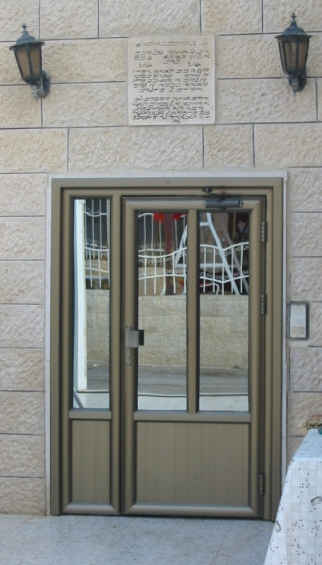
Incidently, the Samaritans interpret this last Pasuk literally and go even further - they write the Parshiot not in Klaf but in the actual wall just over the door (see picture). They understand that the commandment is that "You shall write on top of your doors".
But most commentators understand that although it's written וכתבתם , "you shall write", the Miztva of Mezuza is fulfilled when you affix the Mezuza scroll in the doorpost.
The Sefer Alei Desheh, authored by the brother-in-law of the Zanz Rebbe, has a lengthy discussion on this question and is of the opinion that the writing of the Mezuza IS part of the Mitzva, and goes so far to say that because of this you should hire a sofer to write the Mezuza specially for you, a principle that is applied to Hilchot Sefer Torah (if you don't hire a Sofer and buy a ready Sefer Torah you don't fulfill the Mitzva).
The Talmud Yerushalmi goes a step ahead and says that you should say a Brocho not only when affixing the Mezuza but also when writing it, and the Bracha is:
ברוך אתה ה' א‑לוהינו מלך העולם, אשר קדשנו במצותיו וצונו על כתיבת מזוזה
The Halacha is not like the Yerushalmi and, furthermore, Minhag Israel is not to hire a sofer for the writing of the Mezuza, but rather to just buy the Mezuza off the shelf. But I have nothing to lose and whenever I write my Mezuza I have the Kavana to fulfill the Mitzva of Mezuza according to the abovementioned opinions.
Wednesday, February 24, 2010
Amazing Megillot #8: Avraham Borshevski
Avaraham Borshevski has one of the nicest Ktavim I know and among his projects is this nice Megillat Esther, which was illustrated by Irina Golub. She did a fantastic job and this Megilla is really cheerful and modern. Click in the image to see the full-size picture.


Thursday, February 11, 2010
The New and Old Peh
If you look at old Ashkenazi Torah Scrolls, Tefillin and Mezuzot, you will always note a very distinctive Peh. This old Peh has a "hunchback" and almost looks like something is wrong with it.
This Peh is referred to as the "Peh Shavur", or "Broken Peh". You can see the Peh Shavur in this old Yeriah I own:

 What happened? Why and how the Peh suddenly "changed"?
Let's use reverse chronological order, that is, first understand the modern Peh. The source to the modern Peh is the Mishna Berura, who clearly rules that you should avoid using the broken Peh:
Then it came the First and Second World Wars, and many of the old scribal traditions were forgotten - including the old Peh. Following the wars, the rulings of the Mishna Berura became even more influential in communities around the world and the next generation of Sofrim relied heavily in the Mishna Berura's take on the Hebrew letters, effectively ignoring the controversies surrounding this ruling. That's how the modern Peh became the standard Peh in all subsequent holy scrolls.
But if you look at pre-war Torahs and Tefillins, you will often find the old Peh, specially in scrolls of eastern Europe and Russia.
For almost all readers, this is just a history lesson. But for the Chabad readers, this post is a eye-opener. The Alter Rebbe, author of the Tania, clearly writes that the broken Peh is a must and all Chabad sofrim have kept this tradition even after the wars. Thus, the Chabad communities have their own version of the Ktav Ashurit, which is different than the Ashkenazi, Chassidic and Sephardic scripts. This is known as the ktav Chabad, and the broken Peh is one of its signature characteristics. See the full Aleph Bet Chabad below:
 You can also see the special Kuf, Mem Sofit and Tet prsent in this Ktav.
The Ktav Chabad is exactly the same Ktav used by the communities of Eastern Europe and Russia before the war. So the Ktav Chabad has survived the war to become one of the last standing old-European scripts in use, remarkably. Now you understand the tradition among the Chabad Chassidim that their Ktav is the most accurate and that when Moshiach comes it will become the standard script for all Jews. Perhaps it will.
 UPDATE: In reponse to the questions raised in the comments thread, I did some further research and here's what I came up with. My source is Sofer Lipshitz, one of the most knowledgeble Sofrim I know, who happens to be Chabad. The real Old Peh, which is the modern-day Chabad Peh, ideally should have a smooth hunchback and not a real step - see this picture (note that the Chabad Aleph Bet picture above is not very precise):
However, there are many different versions of this hunchback Peh and some of them are a bit less precise then others. The Peh of my manuscript is one of these less precise Pehs - it's more than a slight hunchback and it really looks "Shavur", and perhaps this imprecise version of the Peh prompted the Ktiva Tama to protest against what he considered to be a "broken Peh/ Peh Shavur" and the Mishna Berura agreed with his claim. But as Zalman and Jskarf mentioned, it's very likely that the Mishna Berura didn't have any complaints against the precise version of the original Peh, which is roundish in the outside. Still, the "new and improved" Peh became extremely popular and it now our generation's standard Peh. In regards to the Chabad Sefer Torah of my Shul, it turns out to be that it is also an imprecise old Peh - not a slight hunchback but a very clear broken Peh. This is a small imprecision of the author of this Torah; the Chabad Peh should be roundsish in the outside. Yudi sent me the Peh of his shul's 120 years-old Sefer Torah and it seems to me that this is a perfect old Peh; not broken and round in the outside (click to enlarge):

This Peh is referred to as the "Peh Shavur", or "Broken Peh". You can see the Peh Shavur in this old Yeriah I own:


Let's use reverse chronological order, that is, first understand the modern Peh. The source to the modern Peh is the Mishna Berura, who clearly rules that you should avoid using the broken Peh:
הג"ה ולא כמה שנהגו איזה סופרים לעשות עקב מבחוץ בצדה ... כי הוא ממש אות שבור. ובאמת צריך להיות עגול מבחוץ כמו שכתבנו ... ומה שנהגו כך מפני שאינם יודעים ההרגל לעשות לתפוס הקולמוס באלכסון ולהמשיכה מעט לאחוריה הקולמוס בפנים ... עכ"ל ספר כתיבה תמה בקיצור לענינינוThe Mishna Berura quotes the Sefer Ketiva Tama as the source of this ruling, claiming that the broken Peh is a mistake that should be avoided. When the Mishna Berura was first printed in the late 19th century, this ruling created a big controversy and debates in communities that had a long-standing tradition of using the broken Peh, and many Sofrim continued to write it in their old way for many years.
Then it came the First and Second World Wars, and many of the old scribal traditions were forgotten - including the old Peh. Following the wars, the rulings of the Mishna Berura became even more influential in communities around the world and the next generation of Sofrim relied heavily in the Mishna Berura's take on the Hebrew letters, effectively ignoring the controversies surrounding this ruling. That's how the modern Peh became the standard Peh in all subsequent holy scrolls.
But if you look at pre-war Torahs and Tefillins, you will often find the old Peh, specially in scrolls of eastern Europe and Russia.
For almost all readers, this is just a history lesson. But for the Chabad readers, this post is a eye-opener. The Alter Rebbe, author of the Tania, clearly writes that the broken Peh is a must and all Chabad sofrim have kept this tradition even after the wars. Thus, the Chabad communities have their own version of the Ktav Ashurit, which is different than the Ashkenazi, Chassidic and Sephardic scripts. This is known as the ktav Chabad, and the broken Peh is one of its signature characteristics. See the full Aleph Bet Chabad below:
 You can also see the special Kuf, Mem Sofit and Tet prsent in this Ktav.
The Ktav Chabad is exactly the same Ktav used by the communities of Eastern Europe and Russia before the war. So the Ktav Chabad has survived the war to become one of the last standing old-European scripts in use, remarkably. Now you understand the tradition among the Chabad Chassidim that their Ktav is the most accurate and that when Moshiach comes it will become the standard script for all Jews. Perhaps it will.
UPDATE: In reponse to the questions raised in the comments thread, I did some further research and here's what I came up with. My source is Sofer Lipshitz, one of the most knowledgeble Sofrim I know, who happens to be Chabad. The real Old Peh, which is the modern-day Chabad Peh, ideally should have a smooth hunchback and not a real step - see this picture (note that the Chabad Aleph Bet picture above is not very precise):However, there are many different versions of this hunchback Peh and some of them are a bit less precise then others. The Peh of my manuscript is one of these less precise Pehs - it's more than a slight hunchback and it really looks "Shavur", and perhaps this imprecise version of the Peh prompted the Ktiva Tama to protest against what he considered to be a "broken Peh/ Peh Shavur" and the Mishna Berura agreed with his claim. But as Zalman and Jskarf mentioned, it's very likely that the Mishna Berura didn't have any complaints against the precise version of the original Peh, which is roundish in the outside. Still, the "new and improved" Peh became extremely popular and it now our generation's standard Peh. In regards to the Chabad Sefer Torah of my Shul, it turns out to be that it is also an imprecise old Peh - not a slight hunchback but a very clear broken Peh. This is a small imprecision of the author of this Torah; the Chabad Peh should be roundsish in the outside. Yudi sent me the Peh of his shul's 120 years-old Sefer Torah and it seems to me that this is a perfect old Peh; not broken and round in the outside (click to enlarge):

Wednesday, January 20, 2010
Amazing Megillot #7: Iraqi Esther Scroll
 I came across this beautiful Esther Scroll from Iraq. It's a very special piece, with symmetric motifs and splendid coloring. Written in Veilish, the Sephardi version of Ktav Ashurit.
Full disclosure:
Esther Scroll
- Ink and tempera on parchment; wooden roller
- Length: 8 3/4 in. (22.2 cm) Diameter: 1 3/4 in. (4.4 cm)
- The Jewish Museum, New York
- Gift of Dr. Harry G. Friedman, F 3374
Published References: The Jewish Museum. THE JEWISH MUSEUM AT 75. Commemorative album. New York: The Jewish Museum, New York, 1980, Color ill.


Sunday, January 3, 2010
Good Hand or a Good Heart?
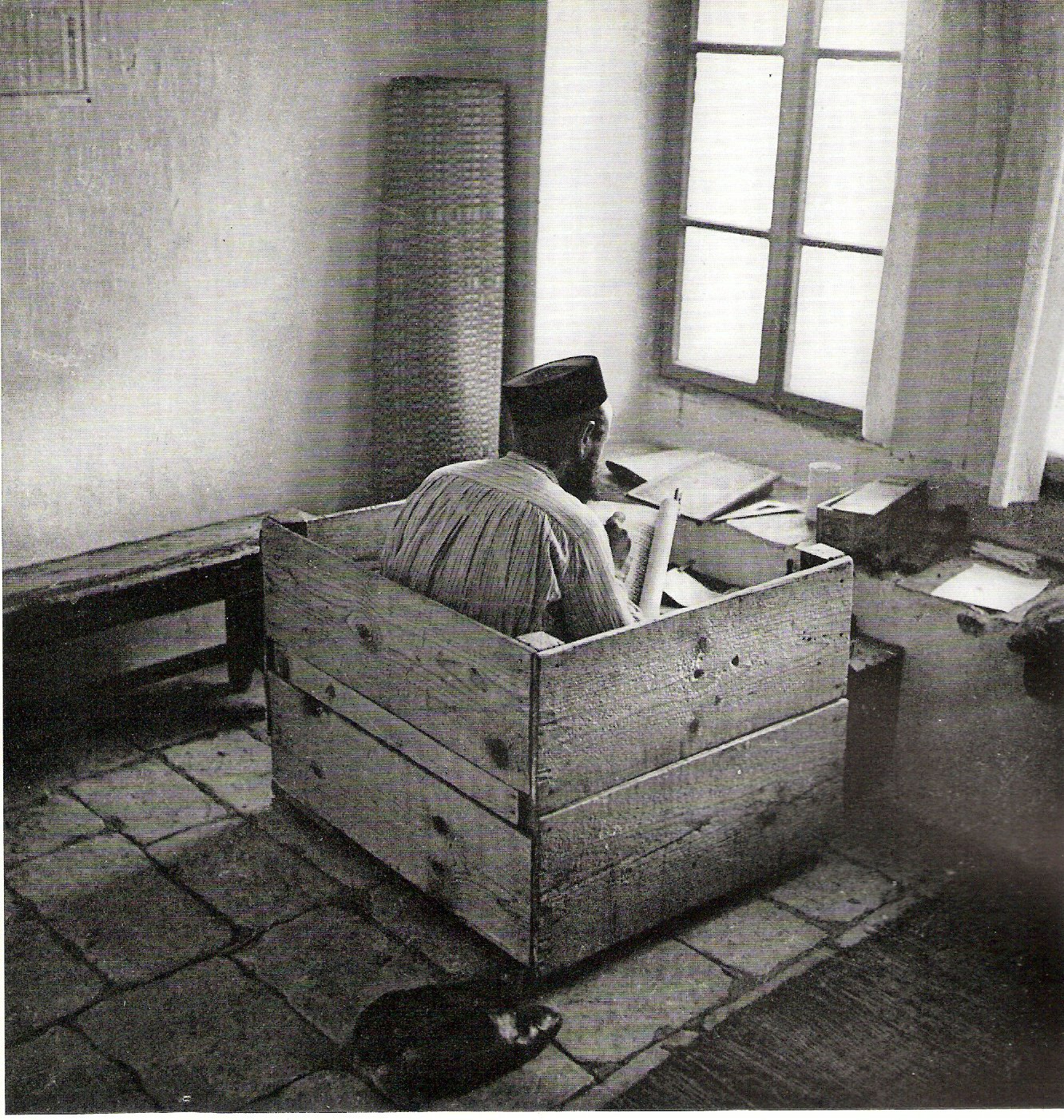 "Ze Keili Veanveihu", roughly translated as ”this is my G-d and I will glorify him", is the source of Chazal's concept of beautifying and adorning the Torah and Mitzvot.
This concept is specially relevant when writing a Sefer Torah, Tefillin and Mezuzot - it's good to have a nice hand writing and a nice klaf. But what should you do if you are confronted with the following dilemma:
- buying Tefillin-parshiot from a sofer who has an amazing hand-writing or;
- buying them from another sofer who has a writing that is less nice but he is known to be a very pious person.
The Kaf Hachaim, a very proeminent Sephardic codifier, writes in Hilchot Tefillin that you should choose option #1 because "people look at eyes, but G-d looks at the heart", meaning that G-d favors a good heart over aestetics. But why?
The Kaf Hachaim doesn't go this far but I've heard a very good explanation for choosing option #2: the concept of Zeh Keili Veanveihu only applies to something that is displayed in public, to everyone's eyes. The Tefillin's parshiot are sealed and never displayed in public, so there's no reason to favor aesthetics over a good pious sofer. The Kaf Hachaim doesn't necessarily subscribes to this explanation but the bottom line is the same - choose option #2.
In the other hand, the Machane Ephraim says that it's impossible to know who's really pious and who's not - we can only speculate, and appearances can be deceiving. If so, the only fact-based analysis that can be made is the quality of the ktav and that alone should be the deciding factor. This would lead you to favor option #1.
This leads us to the next question - what would be the answer in regards to Sefer Torah, which is always displayed in public? Should you choose a better hand or sofer that is known to be a special person?
The answer is option #1, that is, choose a sofer with the best handwriting. The Poskim also say that if you write a Sefer Torah to yourself and later find that a specific yeriah (section) is not written nicely, you may rewrite a new, more beautiful yeriah. That's because of the concept of Zeh Keili, which is critically important in Hilchot Sefer Torah.
Finally, the last branch of this topic. Joe knows how to write Sta"m but he isn't a pro; his handwriting is just ok. Now Joe wants to write a Sefer Torah, in accordance to the Torah's commandment of "Kitvu Lachem", but he is thinking if it's better to hire a professional sofer who has a better hand. What should he do?
The uber-popular Nitei Gavriel says that you should hire a sofer with a better hand-writing and he brings numerous sources for this, but I have strong objections to this claim. They are summarized in the small-case text below, but this is only for the readers who like in-depth discussions:
(Firstly, the Talmud in Sukka says that a person should only spend a 33% (or 20% according to others) premium for a Hiddur Miztva and not more. For instance, if a regular Etrog/Lulav set costs U$70, you don't have to pay more than U$93 if you want to do Hiddur Miztva. Zeh Keili Venveihu is a Hiddur Miztva and if Joe hires a Sofer who has a better hand this will surely incur a cost of more than 33% of the cost of this Miztva, so having a nicer hand writing in this case is not a compelling argument. I would rather say that Joe should write it himself even if his hand writing is not as nice as the Sofer's since there's no Chiyuv of Zeh Keili Veanveihu here.This discussion has special appeal to me since I plan to write my own Sefer Torah. I don't have the world's best Ktav but I think my hand-writing is quite nice, and although the Nitei Gavriel says I should hire a Sofer, if I do this I will do it myself!
Secondly, I have a practical problem with this approach. So let's say we do require Joe to hire a Sofer who has a nice ktav - who should he hire? Let's say he hires David, who has a nice ktav, but if you look around you will always find someone better. Will we also tell Joe to go necessarily to the best Sofer in the world in order to conform with Zeh Keili? I don't think so - there's no end to this. I rather think Zeh Keili only applies to a case where the hand writing is ugly, in which Ze Keili urges you to choose a better hand. But if Joe has a decent Ktav - not ugly, but ok - there's no concept of Zeh Keili forcing him to hire the world's best sofer.)
See my follow up post here
Saturday, December 12, 2009
World's Smallest Torah Scroll
Shuki Freiman is one of my favorite judaica artist and his latest project was the development of this alleged smallest Sefer Torah, along with the special Etz Haim and Aron Kodesh.
Shuki's style is traditional, yet he always manages to differentiate himself from everyone else. For those of you visiting Jerusalem, he has a new shop in the popular Mamila mall, featuring many of his most special works, including this revolutionary Seder plate.
According to what I can see in the video, the Sefer Torah's ktav is Ashkenazi, possibly Arizal but I can't see too well (too small..!), and it's quite nice for such small Torah. The gaps in the top and bottom of the Klaf are rather too small, but it was done like that to make the Torah as small as possible, more specifically, 4.3 centimeters in width.
Shuki is today a very expensive artist and I can only begin to imagine what he's asking for the Torah. My guess is U$450,000, but the sky is the limit for these kind of things.
Tuesday, December 8, 2009
My Progress #4: Megillat Shir Hashirim
I finally managed to finish my Megillat Shir Hashirim, which took some 4 months to write. I had a very tough time writing this one since the klaf was quite bad, specially in the very first column, and this dragged the process more since I couldn't write as fast as usual.
This highlights how important it is to look for top-quality klaf; if you can't get it, wait until you find a good one. I couldn't erase mistakes properly and I even did the capital sin of a Sofer - I made a small hole while trying to correct something. It doesn't matter so much since I managed to "place it" just in between two words - look in the last line of the forth column.
Additionally, I used a computerized Tikkun (from which I copy the Megilla layout) which was awful - I was forced to stretch and squash words in almost every line. Now I know: only buy copies of hand-written Tikkunim.
But Shir Hashirim is fun to write, since I can use it every week (there's a minhag of reciting it every Shabbat-eve) and it's shorter than Megillat Esther. Now my next project is to write a large Mezuza - stay tuned!


This highlights how important it is to look for top-quality klaf; if you can't get it, wait until you find a good one. I couldn't erase mistakes properly and I even did the capital sin of a Sofer - I made a small hole while trying to correct something. It doesn't matter so much since I managed to "place it" just in between two words - look in the last line of the forth column.
Additionally, I used a computerized Tikkun (from which I copy the Megilla layout) which was awful - I was forced to stretch and squash words in almost every line. Now I know: only buy copies of hand-written Tikkunim.
But Shir Hashirim is fun to write, since I can use it every week (there's a minhag of reciting it every Shabbat-eve) and it's shorter than Megillat Esther. Now my next project is to write a large Mezuza - stay tuned!


Sunday, November 29, 2009
Amazing Megillot #6: Sotheby's Important Judaica Auction
In my previous post I wrote about Sotheby's Sefer Torah auction, which pocketed 398,500 (the estimate was 300,000 to 500,000). But there were a few interesting Megillot being auctioned as well and I singled out three of them.
Firstly, the allegedly "earliest complete decorated Esther Scroll" (Venice, 1562). It was sold for a whooping U$ 600,000, making it the most expensive item sold in Sotheby's auction. I personally cannot understand why would someone favor this Megilla over the above-mentioned Sefer Torah from the 13th century, but bottom line is that this Megilla is surely unique. Every column starts with only one, large-type, word and subsequent 22 lines. From a Safrut perspective these top large words are not desirable but it doesn't causes the scroll to become Pasul. (click in the image to enlarge)
Firstly, the allegedly "earliest complete decorated Esther Scroll" (Venice, 1562). It was sold for a whooping U$ 600,000, making it the most expensive item sold in Sotheby's auction. I personally cannot understand why would someone favor this Megilla over the above-mentioned Sefer Torah from the 13th century, but bottom line is that this Megilla is surely unique. Every column starts with only one, large-type, word and subsequent 22 lines. From a Safrut perspective these top large words are not desirable but it doesn't causes the scroll to become Pasul. (click in the image to enlarge)

Next is a magnificent Megilla from Prague, 1700's, decorated by Jean-Paul Franck. From the catalogue: "Additionally, nude, half-length female figures emerge from scrolling foliate vines and peacocks, perched in naturalistic poses create a theatrical, albeit unrelated, backdrop to the Hebrew text." This is odd but not uncommon in old Megillot, unfortunately. Sold for U$ 134,500.


Saturday, November 21, 2009
Sotheby's Sefer Torah Auction
Menachem Butler pointed me to Sotheby's Important Judaica auction which will take place in just a few days. One of the Auction's highlights is a complete Spanish Sefer Torah from the 13th century and in Sotheby's catalogue there's a very interesting write-up detaling the origin and the style of this Torah. For Safrut fans, this is a delightful read that expounds the sources and Minhagim of writing the extra Taguim in Torah Scrolls, as per the ancient Sefer Hataguim.

One of the key traits of this Sefer is the fact that it didn't originally have the Taguim in all Shatnez Getz letters thorought the scroll but a later scribe added these taguim, in conformity with the present day Minhag. The original Sofer followed the opinion of the Rambam, which holds that only Mezuzot need Taguim in all Shaatnez Getz letters, and the later Sofer added them because over time all Bnei Israel started to use the Shaatnez Getz taguim in Torah Scrolls.

I encourage you to read the whole report, it's a real eye-opener. Here's the link for the article, and here's the link for the pdf-presentation with pictures.


I encourage you to read the whole report, it's a real eye-opener. Here's the link for the article, and here's the link for the pdf-presentation with pictures.
Saturday, November 7, 2009
The Czech Holocaust Scrolls
 I just came back from a short trip to Prague, one of the most beautiful cities of Europe. One of the main attractions of the city is it's ancient Jewish Quarter and while visiting it, I got familiar with a truly fantastic story - the story of the over 1800 Torah Scrolls that somehow survived the Holocaust.
"In 1942, a group of members of Prague’s Jewish Community devised a way to bring the religious treasures from the deserted provincial communities to the comparative safety of Prague. The Nazis were persuaded to accept this plan and more than 100,000 items were sent to the Museum.
Among them were about 1,800 Torah Scrolls. Each was meticulously recorded on a card index by the Museum’s staff with a description of the Scroll and the place from which it came. The legend that there was a Nazi plan to create a ‘museum to an extinct race’ in Prague has never been proved. Be it as it may, these scrolls were left untouched by the Nazis but were abandoned for many years.
Under the Communist regime, the Torah Scrolls were accumulated in the abandoned Michle Synagogue in a suburb of Prague, and here it was that Eric Estorick, a London art dealer, was shown the collection in 1963. At the behest of his friend and client, philanthropist Ralph Yablon, and Rabbi Dr Harold Reinhart, he negotiated with the Communist state authorities to bring this precious collection of 1564 Torah Scrolls to Westminster Synagogue in 1964."

The Westminster Synagogue distributed the scrolls to communities around the world and the oldest Sefer Torah, dating back to 1650, is reportedly housed in Temple Havurat Emet in Arizona.
As you can imagine, this collective group of Sifrei Torah is invaluable. Very few Sifrei Torahs survived the Holocaust and, as I noted previously, many old Mesorot were completely forgotten after the war. If a trained Sofer went through the Czech Torahs in detail, I have no doubt that he would come across many of the forgotten Mesorot, like the Otiot Meshunot for example.
It turns out that one person handled all the scrolls and did all the necessary fixes himself. That's David Brand, an orthodox Sofer who spent 27 years of his life looking at these precious scrolls. I don't think any other Sofer has seen as many pre-war Torah Scrolls as him and I started a man-hunt after him. But as I began looking, I found this note in the Czech Memorial Trust's website:
"The arrival at Kent House of David Brand, the Trust’s only resident sofer (scribe), has passed into legend. The story has often been told of the knock on the front door of the synagogue, Ruth Shaffer’s reception of an elderly Orthodox Jew who asked in Yiddish, ‘Do you have any Torahs to repair? And her reply, ‘We have 1,564; come in!’. The friendship and respect between David Brand and the modern forward-thinking Reform Rabbi Harold Reinhart laid the foundation of the whole Scroll story.
David Eliahu Brand was strictly Orthodox in his approach to Judaism. He would not partake of any food or drink at Westminster Synagogue, bringing his own refreshment and staying in London in a small flat found for him by Rabbi Reinhart. When introduced to the Lady Mayor of Westminster on the occasion of the opening of the Scrolls Centre in 1988, he would not take her hand in greeting, explaining with dignity that his religion did not allow it.
When he returned to Jerusalem – the work being nearly complete – he kept in touch for a while, returning from time to time on special visits. Sadly, the Trust has now lost touch with him but if anyone knows the whereabouts of this charming, friendly, knowledgeable man of much distinction, the Trust would be delighted to have the information."

So if anyone knows this David Brand, please let me (and the Trust) know!
This topic can also be found in this CJLS Halakhic discussion, from the Conservative community. It's an interesting discussion about displaying Sifrei Torah that are Pasul in Museums and the Czech Scrolls are a case-point. But I was saddened to read the footnote below:

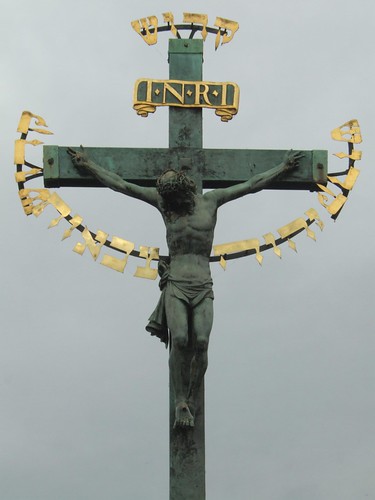
I do realize the importance of interfaith dialogue and all that, but after such miraculous story of disguise and survival, I'm uncomfortable to hear that these special scrolls found their way into Cathedrals and churches. For some odd reason, it brings me sad flashbacks of another major tourist attraction of Prague - the Crucifix with the Hebrew inscription of Kadosh, Kadosh. Oy!
_________________________________________________
You can also read this PDF for more info about the scrolls.
Wednesday, October 14, 2009
Bet of Bereishit and the Masechet Sofrim
The Mesechet Sofrim, one of the mini-Tractates of the Talmud, says:

The second statement is well known and all Sifrei Torahs have the large-type Bet at the start. However the commentary of the Masechet Sofrim, "Shehi Takim Leolam", is difficult to understand but I will leave it to you to come up with explanations.
I want to focus in the first statement - that the Bet should have four Tagim. The only time I saw this bet was in an old Tikkun, but the fact is that all modern day Torahs do not have these Taguim. This is how it should look, according to the Masechet Sofrim:

What's strange is that this Masechet Sofrim is a prime source and I had a tough time understanding how can we afford ignore it. For instance, the Gemara says that the "foot" of the Daled should be slightly bent and according to many opinions a Daled that has a straight "foot" will invalidate the Torah scroll. If we are so stringent about what's mentioned in the Gemara, why do we ignore what's mentioned in the Masechet Sofrim?
The answer to this question is interesting. Aside from the Masechet Sofrim, there's another even smaller Tractate called Masechet Sefer Torah. Most of the content of this little Masechta is anyways mentioned in its "big brother", the Masechet Sofrim, which includes Halachot of Sefer Torah, Mezuza, Tefillin and Mesora. Rabbi Chaim Kanievski, in his work on the small Tractates of the Talmud, asks why there's a need for both Masechtas if they are essentially dealing with the same topic.
His answer is quite radical. He says that the Masechet Sofrim is not part of the Talmud (written between 300 and 400 CE), but a later addition by the Geonim, who lived in the 6th century. Basically, the Geonim took one of the little Tractates of the Talmud - the Masechet Sefer Torah - and expanded it, creating the Masechet Sofrim, which deals with all Safrut related Halachot.

The second statement is well known and all Sifrei Torahs have the large-type Bet at the start. However the commentary of the Masechet Sofrim, "Shehi Takim Leolam", is difficult to understand but I will leave it to you to come up with explanations.
I want to focus in the first statement - that the Bet should have four Tagim. The only time I saw this bet was in an old Tikkun, but the fact is that all modern day Torahs do not have these Taguim. This is how it should look, according to the Masechet Sofrim:

What's strange is that this Masechet Sofrim is a prime source and I had a tough time understanding how can we afford ignore it. For instance, the Gemara says that the "foot" of the Daled should be slightly bent and according to many opinions a Daled that has a straight "foot" will invalidate the Torah scroll. If we are so stringent about what's mentioned in the Gemara, why do we ignore what's mentioned in the Masechet Sofrim?
The answer to this question is interesting. Aside from the Masechet Sofrim, there's another even smaller Tractate called Masechet Sefer Torah. Most of the content of this little Masechta is anyways mentioned in its "big brother", the Masechet Sofrim, which includes Halachot of Sefer Torah, Mezuza, Tefillin and Mesora. Rabbi Chaim Kanievski, in his work on the small Tractates of the Talmud, asks why there's a need for both Masechtas if they are essentially dealing with the same topic.
His answer is quite radical. He says that the Masechet Sofrim is not part of the Talmud (written between 300 and 400 CE), but a later addition by the Geonim, who lived in the 6th century. Basically, the Geonim took one of the little Tractates of the Talmud - the Masechet Sefer Torah - and expanded it, creating the Masechet Sofrim, which deals with all Safrut related Halachot.
If so, Halachot only brought in the Masechet Sofrim do have less weight than the Halachot mentioned in the Talmud. The four Tagim of the Bet of Bereishit is a telling example of this phenomena and that's why we don't have them in our scrolls today.
Friday, October 9, 2009
Pic: Zoomed Shin

Aside from Safrut, I love photography and I wanted to post this cool pic, which I took using my diamond lupe. This is my soon-to-be-completed Meggilat Shir Hashirim and I zoomed in the Shin because I just love this letter, and with the lupe you can take a deeper look in it. It's very easy to mess-up this letter since everything is "squashed" together - the three Yuds and the Taguim. Next to it you can see a Yud and it's lower Tag (lower left side), which is mandatory according to Rabbeinu Tam.
I hope to finish this Megilla in the next two weeks and I will post more pictures.
Chag Sameach
Wednesday, September 30, 2009
Stam Stories #1
In this series of posts, you will read about the few stories of Chazal that speak about Sta"m - Sefer Torah, Tefillin and Mezuzot. This story is about a Mezuza and a diamond gift (full disclosure: YK works with diamonds).
Yerushalmi Peah - Page 4, Chapter 1, Halacha 1:
Yerushalmi Peah - Page 4, Chapter 1, Halacha 1:
"Artevan (either a king or a wealthy Jew), sent to Rabbenu Hakadosh (Rabbi Judah the prince - 2nd century CE), the compiler of the Mishnah, a precious diamond as a gift, and requested that Rabbenu Hakadosh reciprocate by sending him a gift, equal to his. The Rabbi sent him a mezuzoh. Artevan asked him, "I sent you and invaluable diamond, and you send me a gift that is worth a half-shekel? Rabbenu Hakadosh replied, "My property (Rabbenu Hakadosh was very wealthy) and your property cannot pay the value of a mezuzoh, as King Solomon says in Proverbs: 'All your desirables cannot equal it.' Moreover, our riches we must guard, whereas the mezuzoh guards us."
The Sheiltot of Rabbi Achai, Parshat Ekev, adds another layer to the story:
And finally, in Yoma 11A:"Right after (Rebi sent the Mezuza), Artevan's only daughter fell seriously sick. He summoned the most skillful physicians, but no one could save her. Artevon then decided to heed to Rebi's advice and fix the Mezuza in his doorpost and his daughter got immediately cured."
"There was a story with Artevin, who was once checking the market's Mezuzot and got fined by the local authorities (who banned all Mezuzas)."Why was Artevin checking Mezuzas in the market? Some commentators say that after his daughter healed he took upon himself to make sure that every Jew would have a proper Mezuza at his doorpost, and he would go around checking them once a year.
Sunday, September 27, 2009
The Two Columns of Shirat Haazinu
The Mitzva of writing a Sefer Torah comes from this past week's Parsha, Haazinu. In the preceding Parsha, G-d says to Moshe that the Jews should "write this song", in a reference to Haazinu, one of the Torah's two songs (the other one is Az Yashir). Although the commandment refers only to Haazinu the commentators note that it's prohibited to divide the Torah and write it in a form of "megillot, megillot" i.e. in fragments, since all the Torah is one. So the commentators all conclude that the commandment must have been to write the whole Torah, which will contain the song of Haazinu.
This highlights how important this intricate song is in relation to the whole Torah.
Also aesthetically, Haazinu stands out with its special two-column layout. In the modern Torahs, the two columns are perfectly even, like two towers, and usually are two pages long. I wanted to post a picture of the whole thing but I only found this one:

We find the same layout in the Megillat Esther, in which the ten sons of Haman are listed in the same fashion. Like in Haazinu, most sofrim (not me!) stretch the letters so every column will start and end in the same place:

But if you look in the old Torahs and in the Torahs of the Yemenite Jews you will see that the columns there aren't uniform at all. Below is a picture from a Yemenite tikkun:


I guess the Ashkenazi sofrim took the liberty to strectch the lines in order to make the scrolls look nicer, on the grounds of "zeh keli veanveiu".
But there's another thing that really puzzled me. Aside from the layout, the Yemenite scrolls also differ in the actual poem structure and that's the real reason why their columns aren't simetrical - there are less lines and thus some of the lines are longer.
For instance, look in the 17th line in the above picture, "zechor yemot olam.." - this is a long line. In the Ashkenzai scrolls this long line is divided in two, enabling our sofrim to justify the lines. Now that's odd! There are two other places where there's a difference in the poem structure but I will leave it for you to figure it out.
Which is the right structure?
That's where the Aleppo Codex comes to the scene. This is a topic for another post, but it suffices to say that the Aleppo Codex, guarded by the Aleppo Jews until 1948, is the most accurate Tikkun ever. Unfortunately, this Tikkun only covers the Nach; the Torah pages were mysteriously lost in a Arab riot in Aleppo. That is, all the Torah pages were lost besides..... that's right, the pages of Shirat Haazinu! And if you guessed that the Yemenite scrolls are identical to it, you are right. I got this image from the Aleppo Codex website:

 This would imply that the Ahskenazi structure of Shirat Hazinu is problematic. Halacha says that if there's a pause (parsha setuma or petucha) in a wrong place, this will invalidate a Sefer Torah. If the Ashkenazi scrolls have a different poem structure, some of the open spaces are in the wrong place!
The answer is simple: the open spaces in Shirat Haazinu (and Az Yashir) are not open and separate Parshas, but a special layout of a song. The halachot of Parsha Petucha and Setuma don't apply here and whatever layout you have - Yemenite or Ashkenazi - will be Kosher for all intents and purposes. So although it's clear that the Yemenite arrangement is more reliable, you should not start complaining about our modern-day structure.
This is the story of the layout of Shirat Haazinu. I hope you enjoyed and I wish you a Gmar Hatima Tova!
This highlights how important this intricate song is in relation to the whole Torah.
Also aesthetically, Haazinu stands out with its special two-column layout. In the modern Torahs, the two columns are perfectly even, like two towers, and usually are two pages long. I wanted to post a picture of the whole thing but I only found this one:
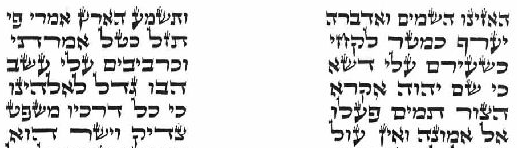
We find the same layout in the Megillat Esther, in which the ten sons of Haman are listed in the same fashion. Like in Haazinu, most sofrim (not me!) stretch the letters so every column will start and end in the same place:

But if you look in the old Torahs and in the Torahs of the Yemenite Jews you will see that the columns there aren't uniform at all. Below is a picture from a Yemenite tikkun:


I guess the Ashkenazi sofrim took the liberty to strectch the lines in order to make the scrolls look nicer, on the grounds of "zeh keli veanveiu".
But there's another thing that really puzzled me. Aside from the layout, the Yemenite scrolls also differ in the actual poem structure and that's the real reason why their columns aren't simetrical - there are less lines and thus some of the lines are longer.
For instance, look in the 17th line in the above picture, "zechor yemot olam.." - this is a long line. In the Ashkenzai scrolls this long line is divided in two, enabling our sofrim to justify the lines. Now that's odd! There are two other places where there's a difference in the poem structure but I will leave it for you to figure it out.
Which is the right structure?
That's where the Aleppo Codex comes to the scene. This is a topic for another post, but it suffices to say that the Aleppo Codex, guarded by the Aleppo Jews until 1948, is the most accurate Tikkun ever. Unfortunately, this Tikkun only covers the Nach; the Torah pages were mysteriously lost in a Arab riot in Aleppo. That is, all the Torah pages were lost besides..... that's right, the pages of Shirat Haazinu! And if you guessed that the Yemenite scrolls are identical to it, you are right. I got this image from the Aleppo Codex website:
 This would imply that the Ahskenazi structure of Shirat Hazinu is problematic. Halacha says that if there's a pause (parsha setuma or petucha) in a wrong place, this will invalidate a Sefer Torah. If the Ashkenazi scrolls have a different poem structure, some of the open spaces are in the wrong place!
The answer is simple: the open spaces in Shirat Haazinu (and Az Yashir) are not open and separate Parshas, but a special layout of a song. The halachot of Parsha Petucha and Setuma don't apply here and whatever layout you have - Yemenite or Ashkenazi - will be Kosher for all intents and purposes. So although it's clear that the Yemenite arrangement is more reliable, you should not start complaining about our modern-day structure.
This is the story of the layout of Shirat Haazinu. I hope you enjoyed and I wish you a Gmar Hatima Tova!
Sunday, August 16, 2009
The Psalms Menorah

UPDATE: see a more recent detailed post here.
One of the best-selling Safrut items is the Lamnatzeach Menora. You can see it in almost every Sephardic and Chassidic synagogue but I never knew what was the story behind it. This past Shabbos I saw an explanation in the Chatan Sofer's Bircon - see the bottom of the the picture for the Hebrew version. I will summarize it in English below.
"In the sefer Kaf Hachaim (...) is brought that G-d showed to King David and Moshe Rabbeinu the Mizmor Lamnatzeach Bineginot in the form of a Menorah, written in a golden sheet. King David inscribed this Psalm Menorah in his war shield and would meditate upon it in his wars, for protection."
That sparkled the Minhag of reciting this Psalm in this format every day and many people prefer to read it from parchment. I'm currently writing my Shir Hashirim scroll but I got so excited about this that I decided to write a large Lamnatzeach Menorah hopefully next month ii"H. Stay tuned!
Tuesday, July 21, 2009
Esnoga's Scrolls
The Esnoga is one of the most important historic synagogues of the world and it was built during the golden years of the Jewish community of Amsterdam. My family was there for a visit and they brought me some pictures of the scrolls featured in the adjacent Jewish Museum. The Museum's site doesn't have any pictures so I took the liberty of sharing it with my readers in this blog entry.
All of them are unique and showcase the elegance and taste of the Dutch Jews of that era.
The Megillat Esther below has some very beautiful illustrations in between each column and is written is a very odd layout - 30 lines (see my post on this subject here) and each line is way too long (each line should ideally have 30 letters, which is three times the word "lemishpechotam", but in this scroll there are more than 60 letters per line). The letter Peh has a very different shape, with a big Tag in the left top corner.

This other Megilla has 32 lines, also not standard, but the lines have the proper amount of letters. What catches my attention is the arrangements of the Parshiot - if you look carefully you will see that the Parsha of "איש יהודי" is written in the middle of the line and "אחר הדברים האלה" has a very odd layout - it starts almost where the preceding line ended. According to our Mesorah, all the Parshiot of Megillat Esther should have a Setuma layout (see my post on this subject here) and if so, this Sofer followed the Rambam's opinion of Setuma and Petucha.

Next is my personal favorite, a Sefirat Haomer scroll. This is the first time I see such scroll and it takes a little time before you actually understand what's going on. The top box is the days' count - 46 days; the middle and bottom boxes are the week's count.

Last but not least, this antique Torah scroll written in Veilish script (read more here). The top Lamed in this Sefer torah is almost bent backwords, opposite to the Lamed of our modern scrolls, which are slightly bent forward.


All of them are unique and showcase the elegance and taste of the Dutch Jews of that era.
The Megillat Esther below has some very beautiful illustrations in between each column and is written is a very odd layout - 30 lines (see my post on this subject here) and each line is way too long (each line should ideally have 30 letters, which is three times the word "lemishpechotam", but in this scroll there are more than 60 letters per line). The letter Peh has a very different shape, with a big Tag in the left top corner.

This other Megilla has 32 lines, also not standard, but the lines have the proper amount of letters. What catches my attention is the arrangements of the Parshiot - if you look carefully you will see that the Parsha of "איש יהודי" is written in the middle of the line and "אחר הדברים האלה" has a very odd layout - it starts almost where the preceding line ended. According to our Mesorah, all the Parshiot of Megillat Esther should have a Setuma layout (see my post on this subject here) and if so, this Sofer followed the Rambam's opinion of Setuma and Petucha.

Next is my personal favorite, a Sefirat Haomer scroll. This is the first time I see such scroll and it takes a little time before you actually understand what's going on. The top box is the days' count - 46 days; the middle and bottom boxes are the week's count.

Last but not least, this antique Torah scroll written in Veilish script (read more here). The top Lamed in this Sefer torah is almost bent backwords, opposite to the Lamed of our modern scrolls, which are slightly bent forward.


Tuesday, July 14, 2009
Otiot Meshunot - Odd Letters of the Torah
In the Torah scrolls of today, there are very few scribal oddities and it's not so hard to single them out:
 H
H owever, many old Sifrei Torah have many more oddities that are no longer in use today (see images). One of the most famous examples is the Peh Melufaf, which is still in use in the Teimani scrolls, and the Torah Shlema has an extensive list of these less popular odd letters. Also, there are numerous additional tagim that are often times mentioned by popular commentators like the Baal Haturim that also fell is disuse.
- Large and small letters - example: the large Bet of the word Bereshit.
- The inverted Nuns in the Parsha of Vayehi Binsoa.
- The splitted Vav in the word "Shalom", in last week's Parsha.
- Dots on top of specific words like "Hanistarot Lashem".
 H
H owever, many old Sifrei Torah have many more oddities that are no longer in use today (see images). One of the most famous examples is the Peh Melufaf, which is still in use in the Teimani scrolls, and the Torah Shlema has an extensive list of these less popular odd letters. Also, there are numerous additional tagim that are often times mentioned by popular commentators like the Baal Haturim that also fell is disuse.
 The Meiri compiled a very detailed work (Kriat Sefer) on the odd letters, depicting the oddities of the Torahs of his time. A more contemporary Sefer was written by the Badei Aharon roughly 150 years ago. There of course the ancient Sefer HaTagin (see image) , which according to tradition was copied by Eli HaCohen from the 12 stones of Yehoshua Bin Nun over two thousand years ago.


What are these letters?
Various Geonim, Rishonim and Achronim have mentioned these letters and among them, the Rambam simply says that this is a very old tradition that should be observed. Few elaborate on the reason behind these oddities but the fact is that there was such a tradition and at some point this tradition was lost.
But before the Second World War there was this "in-between" period where some communities accepted this tradition while others were very critical of it, arguing that this tradition was rather unreliable.
This controversy gathered more attention when an old Torah scroll written by Beit Yehuda, a famous rabbi, was found to have numerous otiot meshunot.
Also the first Rebbe of Zanz reportedly wrote his Sefer Torah with unusual Otiot Meshunot, and in both cases even those who didn't approve this Minhag were afraid to say bad about these Torahs, given their exceptional importance.
Following the devastating events of the Holocaust, few antique Torah Scrolls remained intact and the Mesora of the odd letters was wiped out alongside with the European shtetls.
This topic is of special interest to me since I'm planning to start writing my own Sefer Torah soon. All these scribal oddities are so interesting and did feature in the Sifrei Torah of previous generations so I have to admit that I felt tempted to add some of these oddities in my own Torah.
That's why I decided to study Rabbi Ratzabi's authoritative sefer on this subject, featured in the Torah Shelema, and now that I finished learning it I have another approach to this subject. Rabbi Ratzabi doesn't say if scribes should or shouldn't write the Otiot Meshunot but he somehow expounds how confusing and complex this topic is and it becomes clear that whoever decides to write the Otiot Meshunot will be putting himself in a sea of possibilities where there isn't a clear path to follow. That is the danger of following a Mesora that isn't yours; it's almost like inventing a Gezeira Shava out of your own mind, which is forbidden.
The very few oddities that have been preserved in our scrolls have resisted the test of time and are our only undisputed Mesora. Here and there I hear of people talking about bringing back the Mesora of Otiot Meshunot but this page was turned after the Holocaust, as I noted above. Whatever is left of it is a living testament of the richness of the field of Safrut and how it evolved over centuries of Exile and persecutions.
Tuesday, June 23, 2009
Jewish Week Article
Here's a great article from the Jewish Week, pointed out by Lion of Zion (don't miss the post discussion there).
"A Safer Torah
At the Plainview Jewish Center, the congregation’s 14 Torah scrolls were recently unrolled and examined by three Torah scribes while congregants milled around.
We were evaluating the Torahs, repairing some and registering those that had not been previously registered,” explained Zerach Greenfield, executive director of Machon Ot, a nonprofit Torah registry organization with offices in College Point, Queens, and Jerusalem.
The organization was created nearly 20 years ago at the behest of Interpol and the Israeli police department after the discovery of 65 stolen Torahs hidden behind a false wall in Rosh Ha’ayin, Israel, Greenfield said.
Since then, registration of sifrei Torah has gained increased acceptance. Greenfield pointed out that the eight Torahs in the main sanctuary of the Jewish Center of Kew Gardens Hills were stolen last year. The custodian was later arrested and charged with the theft, and the scrolls were recovered.
Greenfield said those Torahs were registered with Machon Ot (Institute of the Letter) and could have easily been identified if a question had arisen about their ownership.
The International Torah Registry uses pin marks to identify Torahs, but Greenfield said Machon Ot developed two other “far more sophisticated” methods of identification.
The first involves making a transparency of a randomly chosen column of the Torah; because each Torah is written by hand, no two columns are identical. Transparencies can be placed over the column to see if the letters line up. The second method involves scanning a column and drawing an invisible vertical line on a template to see which letters cross that line when measured from the end of the line, creating a unique pattern.
Lacking identification marks, there is no way to identify stolen Torahs and return them to their owners.
Greenfield said sofrim, or scribes, are often the very people who steal and try to resell the scrolls. Therefore, he said, an identification method that these men could not circumvent was needed. That ruled out invisible ink, embossed stamps and code markings.
Rabbi Ronald Androphy, spiritual leader of the East Meadow Jewish Center, said Machon Ot registered his congregation’s nine Torahs, evaluated them to check for discoloration, and repaired letters that had become difficult to read. The registration, evaluation and repair cost a total of $30,000, he said.
In the past, Rabbi Androphy said he would call a sofer when there was a problem with a Torah. And he said that more than 20 years ago he sought to register the Torahs with the Universal registration with its pin code but found the kit he was sent “very difficult to do.”
“We never followed through with it,” he said.
Now, his Torahs are not only registered with Machon Ot but repaired by it, Rabbi Androphy said, noting that Machon Ot once took two of his congregation’s Torahs to its Jerusalem office for repair.
“Torahs deteriorate naturally,” he said, adding that Machon Ot scribes have returned at no additional charge to fix letters in those Torahs when the ink later cracked.
Although Machon Ot helps synagogues interested in commissioning the writing of a new Torah as a fundraising project, Greenfield said the economic downturn has caused more synagogues to hold fundraisers to repair their Torahs.
Machon Ot began registering Torahs worldwide in 1990. It now has a database of 14,000 registered Torahs and registers about 400 to 500 each year.
“The goal is 30,000 because that would be a critical mass that would make someone believe he would get caught if he tried stealing a Torah and then selling it,” Greenfield said.
As part of its evaluation of each Torah, he said, Machon Ot scribes determine what it would cost to replace it. Such an appraisal is required by major insurance companies in Israel and is helpful for synagogues and others in the United States so that they don’t over insure their Torahs. "
Monday, June 15, 2009
Rashi Vs. Rabbeinu Tam - Round II
There are two major discussions between Rashi and Rabeinu Tam that relate to Safrut and in this post I will talk about the second. My first post can be found here.
You've probably noticed that in some houses the Mezuza is set in the doorpost in a complete vertical position, while in other households it is slightly bent. Why? Which is the correct way?


The two possibilities I just mentioned are not the opinions of Rashi and Rabbeinu Tam, so please bear with me.
The Discussion
Rashi and Tosafos dispute what is the proper way of storing holy items. Rashi understands that Mezuzot and Torah Scrolls must be stored in the vertical position. Rabeinu Tam goes the opposite way and holds that the proper way to store a holy item is in the horizontal position, and according to him to store it in a vertical way it's improper. So what's good for Rashi - vertical - is bad (yes, Pasul) for Tosafos and vice-versa.
As a side note, some of the Tefillin found in the Qumran excavations had the scrolls arranged horizontally, like Rabeinu Tam (see more here), indicating that this discussion preceded the times of Rashi and Rabbeinu Tam (who lived 1000 years ago, opposed to the 2000 year old Qumran scrolls).
Practical Halacha
The Shulchan Aruch decided like Rashi and thus all Sephardic Jews affix their Mezuzas in the vertical way. Also, the Sephardic Sefer Torah is stored in a "box" and always stays in the vertical position, even when being read in public - another ramification of Rashi's opinion that holy items must be stored vertically.
The Rema however mentions Rabeinu Tam's position and introduces a compromise: not vertical nor horizontal but in a diagonal position. That is a classical Jewish solution - in face of two opposing opinions we do like a third one, but jokes aside, this proposition was universally accepted by all Ashkenazi Jews to this day. That explains why the Bima in the Ashkenazi Shuls is slightly bented and also why they store their Torah Scrolls in a slightly diagonal position in the Aron Kodesh - they follow the Rema's solution in every situation.
(Incidentally, the Tur offers another solution, to bend the Mezuza's parchment like an L in order to follow both Rashi and Rabeinu Tam in one go but no one follows this view, most likely because it would damage the Mezuza's Klaf (parchement), a far larger problem.)
The Belz Minhag


But there's an interesting exception to this rule in the Ashkenazi world - the exquisite Minhag (custom) of the Belz Rebbe's family of storing the Sefer Torah horizontally. When I heard about this I was open-mouthed and I did a little research about this.
It turns out that the Belz Shuls and yeshivot around the world store their Torah's in the usual way - vertically. Only the Rebbe's Torah Scroll is stored according to Rabeinu Tam's opinion, horizontally, and this Torah is currently stored in the famous Belz Great Synagogue (picture in the right).
Why?
Reb Meir of Primishlan, a famous Hassidic Rabbi, once said that the first Rebbe of Belz, Reb Shalom Rokeach, had "sparkles of the soul of Rabbeinu Tam" and this had so much impact in the Rebbe that he decided that if he would one day build a Synagogue he would store the Torah according to his "soul-mate", Rabbeinu Tam. He did eventually build a synagogue and stored the Torah horizontally, and this custom was kept by the subsequent Belz Rebbes. If you find this hard to accept, take a look in Rabbeinu Tam's original piece:
וכן אני מורה הלכה למעשה, לעשות נקב במקדח ולתתה [את המזוזה] ברוחב המזוזה, ואם נתנה לאורך המזוזה – פסולה, וכן פרשיות של תפלין לרוחב הבתים, ולא לגובה, כמו מזוזה. וכשאבנה ארון [בבית-כנסת], אם אזכה, ארחיבו לפי העמדת ספר-תורה מיושב, כספר-תורה שהיה מונח בארון"When I build a Synagogue, if I will merit, I will store the Torah Scroll horizontaly (...)", said Rabennu Tam. So the Belz Rebbe felt compelled to follow Rabeinu Tam's dream when he built his synagogue. However, his Mezuzot and Tefillin were all vertical - only the Sefer Torah, which was specially highlighted in abovementioned passage, was stored according to Rabbeinu Tam. (By the way, it took him 15 years to build his Synagogue and he was part of the construction crew, highlighting how important this was for him. It also took 15 years to build the new Belz Great Synagogue in Jerusalem, pictured above, and the current Belz Rebbe was also actively involved in the building process, along with his Hassidim).
So as you see, this ancient discussion between Rashi and his grandson is still relevant, 1000 years later!
Subscribe to:
Comments (Atom)

 Posts
Posts